
L. K. Holt / CC BY 4.0, via Wikimedia Commons
Crepis zacintha: complete guide
Crepis zacintha
Want to see Crepis zacintha: complete guide in your garden?
1 minute, no credit card
Overview
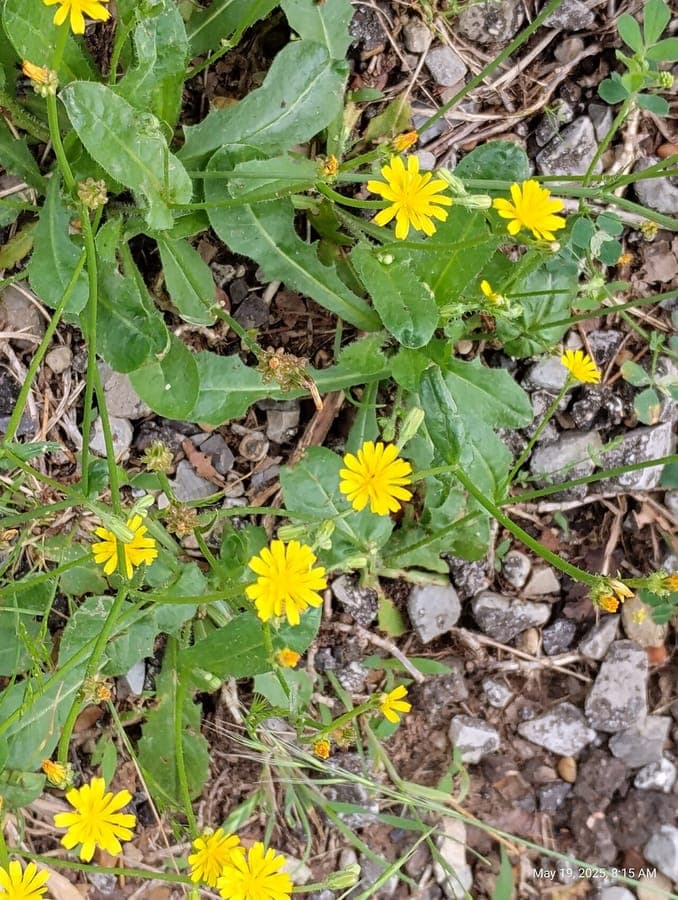
Crepis zacintha, commonly known as the striped hawksbeard or Zakynthos hawk's beard, is an annual herb belonging to the daisy family Asteraceae. It was formally described by the French botanist Loisel in 1807 and named after the Greek island of Zakynthos, one of its native haunts. The genus Crepis encompasses over a hundred species worldwide, all characterised by their dandelion-like yellow composite flowers and their ability to thrive in disturbed, open habitats.
The plant is native to a broad Mediterranean range: Albania, Bulgaria, Corsica, Cyprus, the Aegean Islands, France, Greece, Italy, Crete, the Crimea, Lebanon, Syria, Palestine, Sardinia, Spain, Switzerland, Turkey, Ukraine and the former Yugoslavia. It has also been introduced to Texas in the United States. In Algeria it is now considered extinct. For those planning a dry or Mediterranean-inspired garden, gardenworld.app offers a full library of compatible plant guides to help you build a coherent planting scheme.
Appearance and bloom cycle
Crepis zacintha forms a low rosette of deeply lobed, lance-shaped leaves that closely resemble those of the dandelion. The foliage is pale to mid green, with irregular teeth along the margins. From the rosette rise one or several branched stems that can reach 15 to 40 cm depending on soil richness and moisture availability.
The flowers are bright yellow, composed entirely of ray florets arranged in a tight capitulum - the characteristic head of the daisy family. Bloom time falls in May and June, the warmest weeks of spring in its native Mediterranean climate. After pollination, the plant produces achenes tipped with a white pappus of feathery hairs, similar to dandelion clocks, that enable wind dispersal over considerable distances. The ribbed, hollow stems become slightly grooved and papery as the plant matures toward seed set.
In poor, dry soils the plant stays compact - rarely more than 15 to 20 cm. On richer, moister ground it can stretch to 40 cm and branch more freely. The growth cycle is rapid: germination after autumn or winter rain, fast vegetative growth in spring, flowering in May and June, seed dispersal in July, and then the plant dies back completely.
Ideal location
In its natural habitat Crepis zacintha colonises rocky slopes, road verges, waste ground and thin-soiled grassland in full sun. It thrives with at least six hours of direct sun per day and will not perform well in shade or semi-shade. Sheltering it from afternoon sun is unnecessary - this is a plant of open Mediterranean hillsides where the sun beats down without relief.
In the garden it suits a gravel garden, a rock garden, a dry Mediterranean border or any well-drained sunny bed. Its compact size when grown lean also makes it suitable for larger patio containers and window boxes. Because it self-seeds freely, it will naturalise in gravel paths and between paving stones where other plants cannot establish. Avoid planting it in heavy, waterlogged, north-facing positions.
Soil
The ideal soil is light, lean and sharply drained. Crepis zacintha evolved on the calcareous and siliceous soils of the Mediterranean basin and performs poorly on heavy clay that holds water. In typical UK or Dutch garden soil, improve drainage by working in generous amounts of coarse horticultural sand or fine gravel before planting.
A soil pH between 6.5 and 8.0 is suitable, and the plant copes well with alkaline conditions - calcareous soils are no problem. The key requirement is drainage: waterlogging even briefly during winter or after heavy summer rain will cause root rot. Laying a 3 to 5 cm mulch of coarse grit around the plant base helps shed excess moisture away from the crown. Avoid compost-rich, fertile mixes that encourage lush, floppy growth rather than the tight, naturally beautiful form.
Watering
Once established, Crepis zacintha is drought tolerant and needs little supplemental watering. During germination and the first few weeks after transplanting, keep the soil lightly moist to encourage root development. After that, rainfall in most temperate climates is sufficient. In extended dry spells or heatwaves, water sparingly and always allow the soil to dry out completely between sessions.
In containers, ensure adequate drainage holes and use a gritty, free-draining compost mix that includes at least 25 percent perlite or coarse sand by volume. Never leave containers standing in saucers of water. Overwatering is far more likely to kill this plant than drought. Once the plant has set seed and the annual cycle is complete, watering is irrelevant as the parent plant dies.
Free design
Want to see Crepis zacintha: complete guide in your garden? Make a free design now.
Pruning
Crepis zacintha is an annual and does not require pruning in the traditional sense. Deadheading spent blooms during the flowering season can slightly extend the display and prevents excess self-seeding if you want to control where the plant appears next year. If you want the plant to naturalise freely, leave the seedheads to ripen and disperse on their own.
The dried stems have a certain winter interest and provide small seeds for finches and sparrows. You can leave them through autumn and into early winter before removing. Once the plant is fully dead in late summer or autumn, pull up the remains and compost them. The cleared spot will often host new seedlings the following spring without any additional effort on your part.
Maintenance calendar
January and February: The plant exists only as seed in the ground. Keep the area lightly weeded so seedlings have room to establish.
March and April: First seedlings emerge as temperatures climb above 10 degrees Celsius. Thin to at least 15 cm spacing if germination is dense.
May and June: Main flowering period. Enjoy the yellow blooms. Remove spent flowers if you want a tidier appearance. Water only in prolonged drought.
July: Seed ripening. Collect seed if you want to sow in another location, or let the plant disperse naturally.
August and September: Plant dies back. Remove dry stems or leave for wildlife. Lightly fork the soil to prepare for the next season.
October through December: Dormancy. Seeds overwinter in the soil. No care needed. A light scattering of grit over the planting area is beneficial on heavy soils.
Winter hardiness
Being an annual, Crepis zacintha overwinters as seed rather than as a living plant. The seeds are frost hardy and will survive even harsh winters without protection. In fact, a cold period helps break dormancy and stimulate spring germination - a process known as cold stratification. Seeds need no vernalisation treatment when sown outdoors in autumn.
In USDA zones 6 and warmer the plant will self-seed reliably year after year. In zones 8 and 9 with mild winters, seedlings can emerge in autumn and overwinter as small rosettes before resuming growth in spring. No special winter protection is required for seeds or seedlings. The seedheads resist most weather and only disperse when fully dry. In the UK and the Netherlands, the plant is fully self-sufficient.
Companion plants
Crepis zacintha pairs naturally with other sun-loving, drought-tolerant plants that share its preference for lean, well-drained ground. Excellent companions include:
- Sedum species (stonecrops): carpeting succulents that fill the space between taller stems and thrive in identical conditions.
- Thymus serpyllum (wild thyme): aromatic and drought-resistant, blooming just as Crepis fades in July.
- Stipa tenuissima (Mexican feather grass): airy and elegant, capturing the spirit of Mediterranean hillsides.
- Erigeron karvinskianus (Mexican fleabane): a long-flowering mat of tiny daisy flowers that covers the soil between self-seeded Crepis plants.
- Centranthus ruber (red valerian): bold, drought-tolerant and flowering in a red or white that contrasts with the yellow of Crepis zacintha.
Visit gardenworld.app to explore more planting combinations for dry, sunny gardens and receive personalised recommendations based on your garden conditions.
Closing thoughts
Crepis zacintha is a rewarding and low-maintenance annual for anyone who loves the Mediterranean look. It asks for little more than full sun, sharp drainage and patience - once sown, it tends to take care of itself year after year through self-seeding. The bright yellow flowers in May and June bring a cheerful, wild quality to gravel gardens and rock gardens. Seeds can be sourced from specialist wildflower and Mediterranean plant suppliers at garden centres. Plant it once and it may well return without any further effort on your part, drifting naturally into the cracks and corners of your outdoor space where it truly belongs.
Want to see Crepis zacintha: complete guide in your garden? Make a free design now.
Upload a photo, pick a style, and get a photorealistic design with plant list in under a minute.
10,000+ gardens designed already
No credit card required


Similar plants
Crepis zacintha: complete guide
Crepis zacintha
Full guide to Crepis zacintha, the striped hawksbeard. Learn where to grow it, how to care for it, and how to use it in a dry garden.
Cyperus acuminatus: complete guide
Cyperus acuminatus
Full guide to Cyperus acuminatus, the tapertip flatsedge. Learn how to grow this North American sedge in wet gardens and pond margins.
Dwarf galingale: complete guide
Cyperus michelianus
Full guide to Cyperus michelianus, the dwarf galingale. A compact wetland sedge for pond margins, rain gardens and bog planting.