
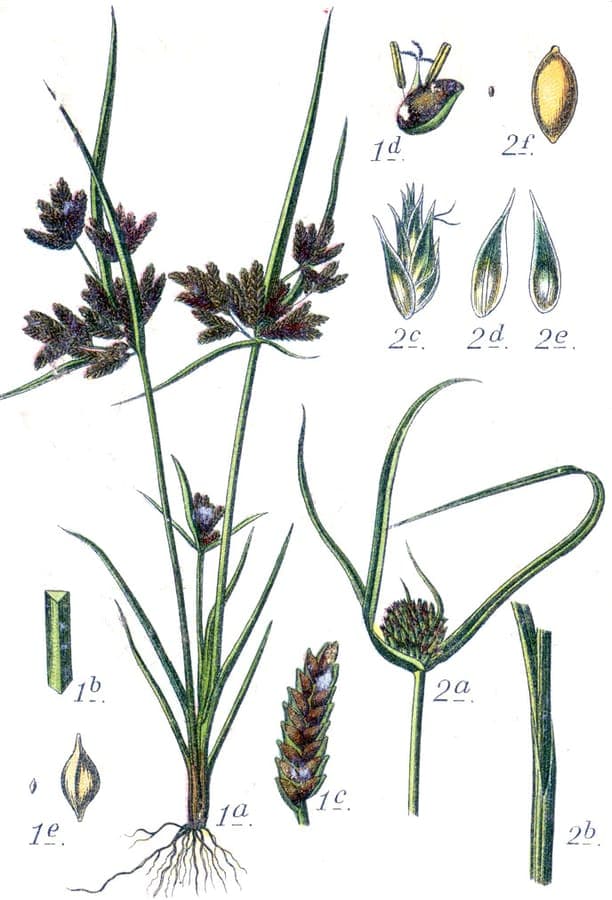
Johann Georg Sturm (Painter: Jacob Sturm) / Public domain, via Wikimedia Commons
Dwarf galingale: complete guide
Cyperus michelianus
Want to see Dwarf galingale: complete guide in your garden?
1 minute, no credit card
Overview
Cyperus michelianus, commonly known as dwarf galingale, is a small annual to short-lived perennial sedge in the family Cyperaceae. It was described by the French botanist Delile in 1813, based on Egyptian material, and named in honour of the Italian botanist Pier Antonio Micheli, a pioneering figure in early botanical science. In German the plant is called Zwerg-Zypergras; in French, Souchet de Michel.
The species has one of the most impressive global distributions in the Cyperus genus, occurring naturally across most of the Old World: from Portugal and France through central Europe, the Mediterranean basin, the Middle East, East Africa, India, China, Japan, Southeast Asia, and south to Australia. It is native to Germany, France, Greece, Italy, Bulgaria, Hungary, Austria and many other European countries. It is considered extinct in Switzerland and has been introduced to the Canary Islands and Sardinia. This vast range reflects the plant's adaptability to a wide variety of wet, open habitats. You can explore more compatible water garden plants on gardenworld.app.
In its natural habitat, dwarf galingale colonises the wet, often muddy margins of rivers, lakes and ponds where water levels fluctuate seasonally. Its small stature keeps it below the competitive canopy of taller reeds and rushes, allowing it to occupy the narrow zone between open water and dry ground. The plant blooms in July, August and September and prefers full sun (light level 9 of 10 in botanical databases) and high atmospheric humidity.
Appearance and bloom cycle
Cyperus michelianus is a compact, bunching sedge, typically reaching only 15 to 30 cm in height - significantly smaller than most Cyperus species cultivated in gardens. The stems are three-angled and pale green, as expected in the sedge family. The leaves are narrow, linear and roughly the same length as the stems or slightly longer.
The inflorescence is distinctive: a dense, compact head of closely packed spikelets at the very tip of each stem, surrounded by several long, leaf-like bracts that radiate outward like the spokes of a wheel. Unlike many Cyperus species, the flowers of Cyperus michelianus are notably white in colour, which makes the flowering heads stand out against the green foliage and gives the plant a lighter, fresher appearance than its relatives. Bloom time runs from July through September. After flowering, small fruits form among the glumes.
The overall texture of the plant is fine and delicate - a good foil for bolder-leaved pond plants. It forms slowly expanding clumps and does not spread aggressively.
Ideal location
Dwarf galingale demands full sun. With a light rating of 9 out of 10 in botanical references, it is one of the most light-demanding wetland plants you can grow. It will tolerate partial shade for part of the day but performs noticeably better in full, unobstructed sun. In nature it always occupies the most open, sunniest stretches of riverbank and lakeshore.
The plant thrives in wet to consistently moist, open or sparsely vegetated sites with little competition from taller plants. In the garden, suitable positions include the shallow-water margins of a garden pond (depth 0 to 10 cm), a bog garden kept permanently moist, a rain garden or swale that retains water after rainfall, and wet ditches or low-lying corners. Its compact size also suits large water containers on a terrace or balcony, provided they hold enough water. Gardenworld.app offers personalised planting advice for wet garden zones and pond margins.
Soil
The ideal soil is lean to moderately fertile (soil nutriment rating of 5 out of 10 in botanical data), consistently wet and with a pH between 6.5 and 7.0. The plant shows zero salt tolerance, so avoid any saline or brackish conditions. It grows naturally on silt, wet sandy substrates and clay-rich riverbank soil. Lean soils encourage compact, neat growth; richer substrates may produce coarser plants.
For planting at the pond margin, use an aquatic planting basket filled with pond plant compost or a mix of garden loam and coarse sand, and place in the shallow-water zone. In a bog garden, a clay-rich garden soil mixed with sand works well. Avoid standard potting mixes that dry out too quickly and lack the structural stability this water-dependent plant needs.
Free design
Want to see Dwarf galingale: complete guide in your garden? Make a free design now.
Watering
Cyperus michelianus has a high atmospheric humidity requirement (rating 8 of 10) as well as a need for constantly wet or moist substrate. At the pond margin or in a bog garden, the surrounding water meets the plant's needs without supplemental watering. In containers, always stand the pot in a tray or shallow basin of water so the roots remain constantly moist.
In summer heat, water consumption is high - check water levels in containers daily. If the leaf tips turn brown, the growing conditions are too dry: move the plant to a wetter position or increase the ambient humidity by misting. Unlike most garden plants, this sedge is very difficult to overwater - provided the water does not become completely stagnant and anaerobic, permanent waterlogging is fine. Consistent moisture is the primary requirement.
Pruning
Dwarf galingale requires very little pruning. At the end of the growing season in autumn, cut back the stems to just above the water surface or soil level. Remove yellowing or dead leaves during the season as they appear. Division is the main maintenance technique: when the clump becomes dense, divide it in early spring before new growth begins, replanting the sections in new locations. Division rejuvenates the plant and keeps it productive.
Given the small size of the plant, pruning is quick and straightforward. Use sharp scissors or small pruning shears for a clean cut. Pruned material can be composted.
Maintenance calendar
January and February: Dormancy. The plant may exist as seed or as dormant roots. Leave undisturbed. Protect the root zone from hard frost with a layer of straw at the pond margin.
March and April: New shoots emerge as temperatures rise. Remove old dead material. Check whether division is needed. Replant divisions as desired.
May and June: Active growth. Maintain consistently wet substrate and high humidity. No special maintenance needed.
July, August and September: Flowering period. White flower heads appear. Keep water supply constant. Remove spent heads after blooming if you want to limit self-seeding.
October: Blooming ends, seeds disperse. Cut back if desired or leave the stems for seasonal interest.
November and December: Aerial parts die back. Leave or cut back. In containers, move to a frost-free position if hard winters are expected.
Winter hardiness
Cyperus michelianus is hardy in USDA zones 7 and above as a perennial. In cooler zones (5 and 6) it behaves as an annual, overwintering as seed in the soil. In the UK, the Netherlands and other parts of northwest Europe, overwintering success is not guaranteed. Containerised plants should be brought indoors to a frost-free space before the first frost. Plants at the pond margin can be protected with a thick layer of straw or reed over the crown. Annual re-sowing from seed is a reliable strategy, as the plant germinates readily at temperatures above 15 degrees Celsius. The extraordinary global range of this species - from Siberia to the Sahara - suggests a degree of climatic flexibility, but reliable garden culture in cold climates requires some winter protection.
Companion plants
Cyperus michelianus pairs beautifully with other small, sun-loving wetland plants that share its preference for wet, open conditions. Recommended companions include:
- Eleocharis palustris (common spike-rush): a small, fine-stemmed rush that occupies the same shallow-water zone and provides complementary texture.
- Alisma plantago-aquatica (common water plantain): broader leaves and white flower sprays that contrast well with the fine structure of dwarf galingale.
- Ranunculus flammula (lesser spearwort): small yellow flowers along wet shores that suit this compact sedge perfectly.
- Persicaria amphibia (amphibious bistort): aquatic form with soft pink flower spikes above the water surface, adding warm colour.
- Glyceria fluitans (floating sweet-grass): a light, airy water grass that drifts alongside the compact clumps of Cyperus michelianus.
At garden centres, look in the aquatic plant section for suitable companions. Gardenworld.app has detailed guides on building ecologically rich, naturalistic pond margins with small wetland plants.
Closing thoughts
Cyperus michelianus - the dwarf galingale - is one of the lesser-known wetland sedges but one that deserves a much wider audience. Its compact, tidy habit, white-tinged flower heads and extraordinary adaptability across climates and continents make it a fascinating plant for the detail-conscious pond gardener. Give it full sun, permanent moisture and lean, slightly acidic soil, and it will reward you with delicate, naturalistic beauty from July through September. Plant it at the edge of a pond, in a rain garden or in a shallow water container, and let it quietly naturalise into its surroundings over the seasons. For more ideas on combining dwarf galingale with other wetland and pond margin plants, visit gardenworld.app for personalised planting guides suited to your garden conditions.
Want to see Dwarf galingale: complete guide in your garden? Make a free design now.
Upload a photo, pick a style, and get a photorealistic design with plant list in under a minute.
10,000+ gardens designed already
No credit card required


Similar plants
Cyperus acuminatus: complete guide
Cyperus acuminatus
Full guide to Cyperus acuminatus, the tapertip flatsedge. Learn how to grow this North American sedge in wet gardens and pond margins.
Crepis zacintha: complete guide
Crepis zacintha
Full guide to Crepis zacintha, the striped hawksbeard. Learn where to grow it, how to care for it, and how to use it in a dry garden.