
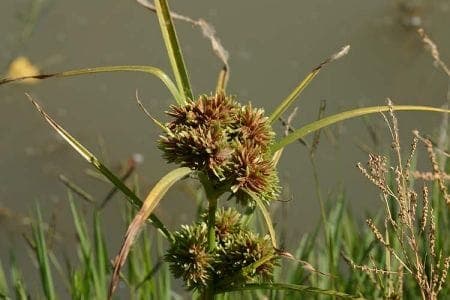
Stephen Laymon, Bureau of Land Management / Public domain, via Wikimedia Commons
Cyperus acuminatus: complete guide
Cyperus acuminatus
Want to see Cyperus acuminatus: complete guide in your garden?
1 minute, no credit card
Overview
Cyperus acuminatus, commonly known as the tapertip flatsedge, taper-tip umbrella sedge or short-pointed cyperus, is an annual to short-lived perennial sedge in the family Cyperaceae. It was described scientifically by Torr. and Hook. in 1836, with the species name 'acuminatus' being Latin for 'tapering to a sharp point' - a reference to the distinctly pointed tips of the glumes and bracts that identify this species. The genus Cyperus is one of the largest in the sedge family, encompassing nearly 700 species worldwide including the well-known Egyptian papyrus (Cyperus papyrus) and the umbrella plant (Cyperus alternifolius).
Cyperus acuminatus is native to a very broad range across the central and southern United States, from Alabama and Arizona to Montana, Washington and Wyoming. It also extends into northeastern Mexico. It has additionally become naturalised in New Hampshire, New York and Pennsylvania. The plant grows rapidly and forms bunching clumps that thrive in the dynamic, moisture-rich environments of stream banks, wet meadows and pond edges. Gardenworld.app provides detailed plant guides for creating beautiful and functional water garden planting schemes.
This is a plant for those who enjoy a naturalistic, ecologically rich garden. Its fine-textured, grass-like form adds elegance to wet corners that might otherwise be difficult to plant. It works especially well in rain gardens, bioswales and any area where water collects after heavy rainfall.
Appearance and bloom cycle
Cyperus acuminatus forms neat, bunching clumps of slender, three-sided stems with fine foliage that is typical of the sedge family. The stems reach between 20 and 50 cm in height, depending on growing conditions. The leaves are narrow, linear and fresh green, with a firm midrib and smooth margins.
The flower heads are umbrella-like clusters of small spikelets carried at the tips of the stems, surrounded by leaf-like bracts of varying length. The individual florets are green and inconspicuous, as befits a wind-pollinated plant, but the overall effect of the clustered heads is quite ornamental in a naturalistic way. The defining botanical character is the tapering, pointed tips of the glumes - the feature that gives the plant its common name.
Blooming typically occurs from summer through early autumn: in the northern part of its range from July to September, in the south potentially starting earlier. After flowering, small, compact fruits form at the base of the glumes. The foliage and stems remain green and attractive throughout the growing season. Growth rate is described as rapid, which means the plant establishes and fills in quickly.
Ideal location
Cyperus acuminatus naturally grows along stream banks, wet ditches, pond margins, wet meadows and other seasonally or permanently moist habitats. It prefers full sun to partial shade and performs best in positions that remain consistently moist or wet throughout the growing season. Temporary flooding of the roots is not a problem - this is a plant accustomed to the fluctuating water levels of natural waterways.
In the garden, the ideal positions are the shallow margins of a garden pond, a rain garden that holds water after rain, a bog garden, a wet corner or a low-lying area that drains poorly and stays moist. It can also be grown successfully in large containers or planting baskets submerged to the brim in a garden pond. Avoid dry, drought-exposed sunny borders - this plant will struggle and decline without reliable moisture.
For naturalistic planting designs that feature water, gardenworld.app has a full section on pond and wetland planting to inspire your garden layout.
Soil
The preferred soil is moist to wet, moderately fertile and slightly acidic. Cyperus acuminatus grows best at a soil pH of between 4.9 and 6.8, which encompasses slightly acidic to nearly neutral conditions. Heavy, moisture-retentive clay soils and loamy soils are ideal. In lighter sandy soils it will grow but requires more frequent supplemental watering to maintain the moisture levels it needs.
Organic-rich soil is a bonus. At the pond margin, simply plant directly into the moist or wet substrate and allow the roots to access the surrounding water table. In a container, use a mix of loam-based compost, clay granules and a small amount of coarse sand. Avoid strongly acidic soils below pH 4.5 or strongly alkaline conditions above pH 7.5.
Free design
Want to see Cyperus acuminatus: complete guide in your garden? Make a free design now.
Watering
Cyperus acuminatus has a high and constant water requirement. When planted at a natural pond margin or in a permanently moist area, no supplemental watering is needed because the plant accesses groundwater directly. In a border or raised bed, water deeply and regularly - never allow the soil to dry out completely. In a container, stand the pot in a shallow tray of water or partially submerge the container in the pond.
In hot summers water consumption is high - check containers daily and refresh the water regularly to prevent stagnation and algae build-up. Unlike most garden plants, waterlogging is not a concern for Cyperus acuminatus; it is far more likely to suffer from insufficient water than from too much. Consistent moisture is the single most important factor for keeping this plant thriving.
Pruning
Cyperus acuminatus requires very little pruning. At the end of the growing season in autumn, cut back the dried stems to about 5 cm above soil or water level. This keeps the plant tidy and prevents dead material from falling into the pond and decomposing. During the growing season no pruning is needed.
If the clump becomes too large or spreads beyond its allotted space, divide it in early spring before growth resumes. Lift the clump, split it into sections using a spade or sharp knife, and replant the divisions at the desired locations. Cyperus acuminatus tolerates division well and recovers quickly. Remove yellowing or dead leaves during the season to keep the plant looking fresh.
Maintenance calendar
January and February: Dormancy. Leave the plant undisturbed. In frost-prone areas, protect the root zone with a layer of straw or reed thatching. Stems left standing provide shelter for overwintering insects.
March and April: New shoots emerge. Remove dead stems from the previous season. Divide and replant if needed. Check water levels at the pond margin after winter.
May and June: Active growth. No special maintenance needed. Ensure consistent moisture during any dry spells.
July and August: Flowering period. Enjoy the elegant flower heads. Maintain constant soil moisture or water level in the pond.
September and October: Seed ripening and dispersal. Remove seedheads if you want to limit spread, or allow natural self-seeding.
November and December: Stems die back. Cut back or leave standing as overwintering habitat. Protect if severe frost is expected.
Winter hardiness
Cyperus acuminatus is an annual to short-lived perennial. In its native US range it behaves as a perennial in USDA zones 7 and above, where winters are relatively mild. In zones 5 and 6 it acts more like an annual, overwintering as seed in the soil. Hard frost below -15 degrees Celsius will kill the roots in most cases.
In the UK, the Netherlands and other parts of northwest Europe, winter survival is not guaranteed. Pot-grown specimens should be brought into a frost-free greenhouse or conservatory before the first frost. Plants in the ground at the pond margin may survive mild winters if the root zone is well protected with a thick mulch of straw. Annual re-sowing from seed is a straightforward alternative, as the plant germinates and establishes quickly when temperatures rise in spring.
Companion plants
Cyperus acuminatus combines naturally with other wetland and pond-margin plants that share its preference for consistently moist conditions. Good companions include:
- Carex species (true sedges): neighbouring graminoids that occupy the same moist habitat and provide complementary texture and colour variation.
- Juncus effusus (soft rush): a robust, round-stemmed rush with a distinctive, upright form that contrasts well with the finer clumps of Cyperus.
- Iris pseudacorus (yellow flag iris): bold yellow flowers in May and June above the more delicate Cyperus foliage.
- Mentha aquatica (water mint): aromatic, moisture-loving, and flowering in soft lilac-pink that contrasts attractively with the green of Cyperus.
- Alisma plantago-aquatica (common water plantain): elegant white flowers and broad, plantain-like leaves that complement the fine texture of the sedge.
Visit specialist aquatic plant departments at garden centres to find compatible plants. Gardenworld.app also provides personalised planting suggestions for water gardens and pond margins.
Closing thoughts
Cyperus acuminatus is a graceful, fine-textured sedge that brings the naturalistic feel of North American wetlands to garden ponds and wet borders. Its rapid growth, tolerance of wet feet and elegant bunching habit make it a practical and attractive choice for any area of the garden that holds water. Keep in mind that it may need winter protection in colder climates. With the right conditions - consistently moist soil, adequate sun and a little end-of-season tidying - this tapertip flatsedge will reward you with handsome foliage and subtle floral interest from summer through autumn. For more ideas on building a complete, ecologically rich water garden, visit gardenworld.app and explore the full range of compatible pond and wetland plant guides.
Want to see Cyperus acuminatus: complete guide in your garden? Make a free design now.
Upload a photo, pick a style, and get a photorealistic design with plant list in under a minute.
10,000+ gardens designed already
No credit card required


Similar plants
Dwarf galingale: complete guide
Cyperus michelianus
Full guide to Cyperus michelianus, the dwarf galingale. A compact wetland sedge for pond margins, rain gardens and bog planting.
Crepis zacintha: complete guide
Crepis zacintha
Full guide to Crepis zacintha, the striped hawksbeard. Learn where to grow it, how to care for it, and how to use it in a dry garden.