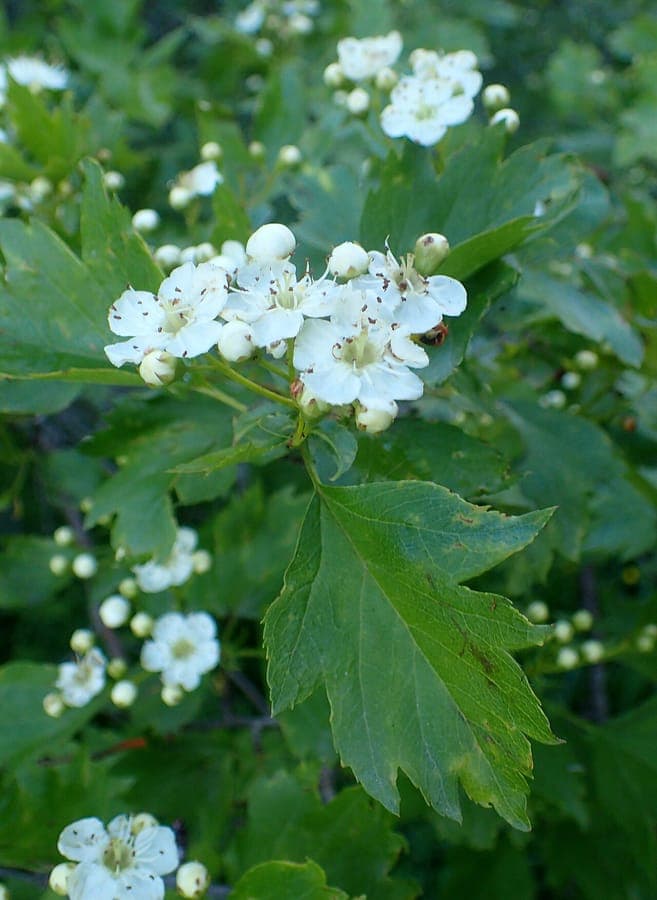
Krzysztof Ziarnek, Kenraiz / CC BY-SA 4.0, via Wikimedia Commons
Crataegus nigra: complete guide
Crataegus nigra
Want to see Crataegus nigra: complete guide in your garden?
Full design in HD: €7.99
Look after your Crataegus nigra with the GardenWorld app
Identify plants with your camera and get a care calendar with reminders for this plant.


Overview
Crataegus nigra, also called Hungarian-thorn or Pannonian Black Hawthorn, is a robust East European hawthorn species. Distinguished by its strong branching structure, delicate white flowers, and especially its dark, nearly black fruits.
Significantly hardier and more weather-resistant than many other hawthorn varieties. In northern European gardens grows excellently and forms dense hedges.
Appearance & bloom
Grows into a shrub or small tree reaching 4-6 meters in natural conditions. Branches are finely divided with small thorns. During May-June, white flowers sometimes with pink tinges appear in dense clusters. Frost-hardy and attract many pollinators.
Leaves are small, deep green, finely incised with three to five lobes. In autumn, foliage turns golden-yellow to red before falling. Fruits are distinctive feature - dark brown to black.
Ideal location
Extremely versatile. Thrives in both sunny and semi-shaded locations. Highly wind-tolerant, making it suitable for windy coastal and open countryside areas.
Plant in open gardens, as boundary plants, along property lines, or in wildlife-friendly hedges.
Soil
Not particular about soil type. Thrives on both dry and moist soils. Nearly all soil types work - from sandy to clay-based.
Extremely salt-tolerant. Well-drained soil prevents waterlogging during very wet winters.
Free preview
Want to see Crataegus nigra: complete guide in your garden? Make a free preview of your design.
Watering
After planting, water regularly during first growing season, especially during dry periods. Established plants are drought-tolerant and need hardly any supplemental water.
Young newly planted shrubs should be kept more moist.
Pruning
Can be shaped as hedge plant through regular pruning in June-July and August. Use pruning shears carefully due to thorns - use appropriate gloves.
For more natural growth, minimize pruning. Dead or damaged branches can be removed any season.
Maintenance calendar
January-February: Prune dormant plants. April-May: Full bloom. June-July: First summer pruning. September-October: Fruits ripen to black. November-December: Leaf fall.
Winter hardiness
Extremely winter-hardy. Tolerates temperatures down to -25 degrees Celsius. Fully adapted to European winters.
Even in harshest winters performs well without special protection. Bird-friendly fruits often remain on branches well into winter.
Companion plants
Grows beautifully with other wildlife-friendly hedge plants. Combine with hawthorn, dog rose and rowan for extra variety.
Closing
Fantastic choice for anyone wanting to establish a strong wildlife-friendly hedge. With beautiful flowers, dark fruits and exceptional winter hardiness creates real value in any garden.
Frequently asked questions about Crataegus nigra
Is Crataegus nigra winter hardy?
Extremely winter-hardy. Tolerates temperatures down to -25 degrees Celsius.
When and how do you prune Crataegus nigra?
Can be shaped as hedge plant through regular pruning in June-July and August. Use pruning shears carefully due to thorns - use appropriate gloves.
How much water does Crataegus nigra need?
After planting, water regularly during first growing season, especially during dry periods. Established plants are drought-tolerant and need hardly any supplemental water.
Where does Crataegus nigra grow best?
Extremely versatile. Thrives in both sunny and semi-shaded locations.
What soil does Crataegus nigra need?
Not particular about soil type. Thrives on both dry and moist soils.

See it in your garden
See Crataegus nigra in your garden
One photo of your garden and a few questions. You see the result in about a minute.
Try it with a photoIdentify this plant in your own garden. Identify a plant
Similar plants
Hawthorn: complete guide
Crataegus monogyna
Learn how to grow and care for Hawthorn (Crataegus monogyna): ideal location, pruning, soil needs, and companion plants for UK and European gardens.
Eglantine: complete guide
Rosa rubiginosa
Discover Rosa rubiginosa, the fragrant wild rose ideal for low-maintenance, wildlife-friendly gardens across temperate climates.
