
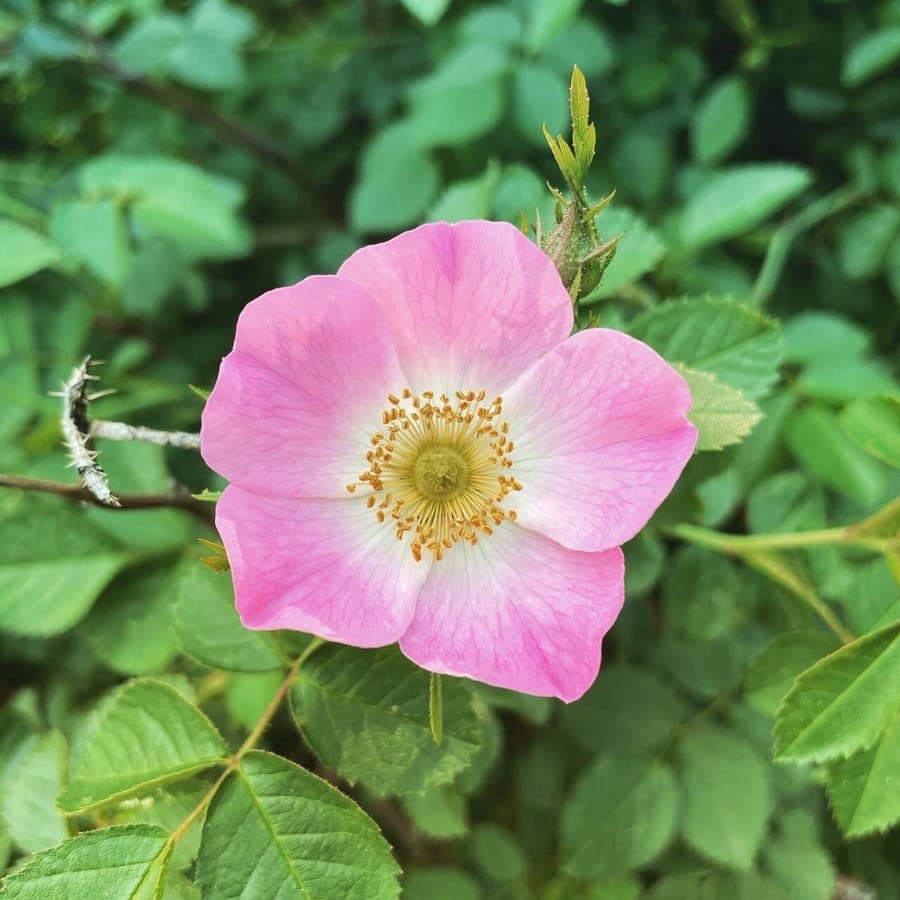
Dontreya / CC BY-SA 4.0, via Wikimedia Commons
Eglantine: complete guide
Rosa rubiginosa
Want to see Eglantine: complete guide in your garden?
1 minute, no credit card
Overview
Rosa rubiginosa, commonly known as Eglantine, isn't the flashy rose you'll find in glossy garden magazines. It's the quiet, tough relative that thrives on neglect and still manages to bloom beautifully. Native to central and eastern Europe, including parts of the Baltic and Central European Russia, this subshrub rose is a survivor. It pops up along roadsides, in hedgerows, and on dry banks, often spreading gently but never aggressively. In the garden, it brings a sense of wild charm, especially in cottage-style or wildlife-focused landscapes.
Appearance & bloom cycle
Eglantine has finely divided, fern-like foliage that's medium green and slightly serrated. What really sets it apart is the sweet apple-like scent released when you brush or crush the leaves - a trait that's especially noticeable on warm summer days. The flowers appear from June through August, peaking in midsummer. They're soft purple to pale pink, about 3–5 cm wide, with a cluster of golden stamens in the center. After blooming, small, oval hips form, turning deep red by autumn and persisting well into winter. These hips are rich in vitamin C and can be used in teas or syrups.
Ideal location
Eglantine thrives in full sun to light shade, scoring an 8 out of 10 on the light scale - meaning it needs at least 6 hours of direct sunlight daily. Too much shade leads to leggy growth and sparse flowering. It's wind-tolerant and makes a good informal hedge or boundary plant. Avoid planting in deep shade or under dense tree canopies. It works well in mixed borders, on slopes, or as part of a naturalized planting scheme. In urban gardens, it adds structure without dominating the space.
Soil requirements
This rose is adaptable but prefers well-drained, calcareous soils with a pH between 7.5 and 8.0. It does best in loamy or sandy loam soils that don't stay waterlogged. Heavy clay soils should be amended with grit or coarse sand to improve drainage. While it tolerates mild acidity, adding a bit of garden lime can help if your soil pH is below 7. Avoid overly rich soils, as this can encourage leafy growth at the expense of flowers.
Watering
Once established, Eglantine is drought-tolerant and rarely needs supplemental watering. Young plants, however, should be watered weekly during their first growing season, especially in dry spells. Give each plant about 10 liters of water, soaking the root zone deeply. After the first year, only water during prolonged droughts. Overwatering is a bigger risk than underwatering - soggy soil leads to root rot and fungal issues.
Free design
Want to see Eglantine: complete guide in your garden? Make a free design now.
Pruning
Pruning is minimal. The best time is late winter to early spring (February–March). Remove dead, damaged, or crossing stems to improve airflow. Cut back older canes by about a third to encourage new growth, but avoid heavy pruning - this rose blooms on previous year's wood. Use sharp bypass pruners and wear thick gloves; the thorns are sharp and can cause infections. Avoid pruning after May, as you'll remove developing flower buds.
Maintenance calendar
- Jan: Inspect for winter damage, prepare tools.
- Feb: Begin light pruning, remove dead wood.
- Mar: Complete pruning, clear debris around base.
- Apr: Apply a light layer of compost; check for aphids.
- May: Monitor bud development, water if dry.
- Jun: First blooms appear, no pruning.
- Jul: Peak bloom, watch for mildew in humid areas.
- Aug: Final flowering, stop fertilizing.
- Sep: Hips begin to color, reduce watering.
- Oct: Leave fallen leaves as natural mulch.
- Nov: No action needed, plant enters dormancy.
- Dec: Protect young plants in exposed sites with straw.
Winter hardiness
Eglantine is extremely hardy, surviving temperatures down to -20°C (USDA zones 4–7). It handles cold winters with ease and doesn't require any winter protection once mature. Young plants in their first winter may benefit from a light mulch of straw or leaf litter in windy or exposed locations. The persistent hips provide winter interest and food for birds like finches and thrushes.
Companion plants
Pair Eglantine with drought-tolerant perennials like Nepeta, Salvia officinalis, or Eryngium. In a wildlife garden, it complements Crataegus, Cornus, and native grasses. Avoid overly competitive groundcovers like ivy or vinca, which can smother its base. It works well in shrub borders alongside dwarf buddleja or Ceanothus. The scent and open flowers attract bees, hoverflies, and butterflies, making it a true pollinator asset.
Closing
Eglantine isn't for those who want a perfect, manicured look. But if you value resilience, fragrance, and ecological benefit, it's a standout choice. It's available at most garden centres in the UK, often labeled as 'sweet briar' or 'fragrant rose'. Use gardenworld.app to design a border where Eglantine fits perfectly, and explore plant combinations on gardenworld.app to create a balanced, low-effort garden that supports local wildlife.
Want to see Eglantine: complete guide in your garden? Make a free design now.
Upload a photo, pick a style, and get a photorealistic design with plant list in under a minute.
No credit card required


Similar plants
Siberian crab apple: complete guide
Malus x robusta
Complete guide to the Siberian crab apple (Malus x robusta): location, soil, pruning, winter hardiness and the best companion plants for your garden.
Chinese flowering crabapple (Malus x spectabilis): complete guide
Malus x spectabilis
Meet the Chinese flowering crabapple (Malus x spectabilis): a classic spring bloomer with carmine buds and pink blossom.
Potentilla crassinervia: complete guide
Potentilla crassinervia
Potentilla crassinervia, the Corsican cinquefoil, grows wild on Corsica and Sardinia's peaks. Discover how to grow this hardy alpine rock garden gem.