
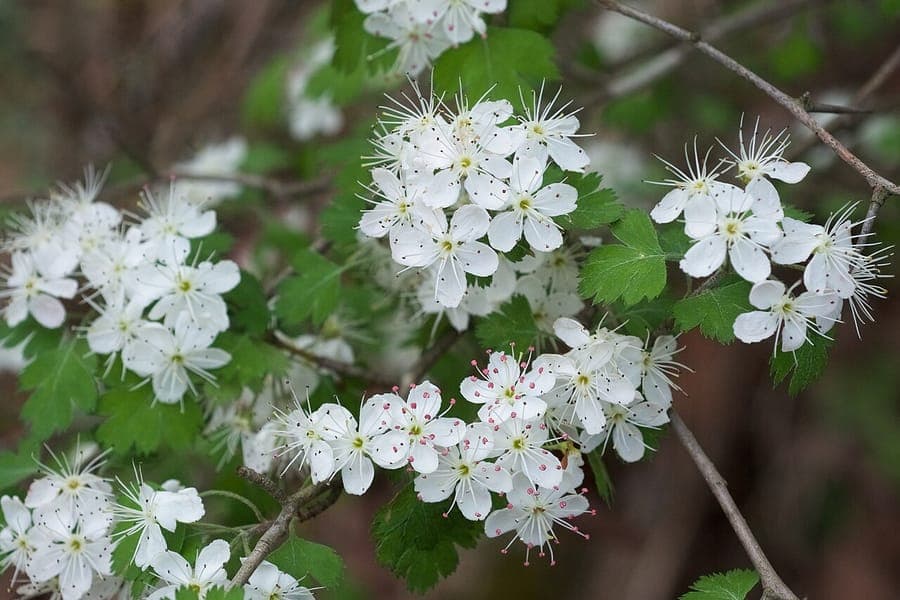
Eric Hunt / CC BY-SA 4.0, via Wikimedia Commons
Parsley hawthorn: complete guide
Crataegus marshallii
Want to see Parsley hawthorn: complete guide in your garden?
1 minute, no credit card
Overview
Parsley hawthorn (Crataegus marshallii) is among the most graceful and ornamentally distinct members of the hawthorn genus. Its common name is entirely apt: the deeply divided, multi-lobed leaves bear a striking resemblance to flat-leaf parsley or chervil, setting this species apart visually from virtually every other hawthorn in cultivation. Native to the central and southeastern United States - from Arkansas and Missouri south through Virginia, the Carolinas, Tennessee, Louisiana, Texas, and Florida - it grows as an understorey tree in open forests, along stream banks, and on calcareous slopes.
Described by Eggleston in 1908, the species honours Humphry Marshall, an early American botanist and nurseryman who documented the native flora of Pennsylvania in the eighteenth century. In European gardens, parsley hawthorn is seldom seen in mainstream garden centres, but specialist tree nurseries and botanical garden plant sales are good sources for those willing to seek it out.
At gardenworld.app you can explore garden design concepts that feature thorny, wildlife-rich small trees like parsley hawthorn as structural anchors in layered, naturalistic planting schemes.
Appearance and bloom cycle
Crataegus marshallii is a single-stemmed small tree or large shrub reaching 4 to 8 metres in cultivation, with an open, graceful branching habit. The bark of mature trunks is grey and slightly scaly, providing quiet winter interest of its own. The branches carry sharp thorns, though typically less densely armed than some other hawthorn species.
The leaves are the most distinctive feature: deeply lobed, almost like a miniature oak leaf but with the delicate, finely cut outline of flat-leaf parsley. They emerge in early spring as a fresh, bright green, darkening to deep forest green through summer. Autumn colour is variable but can produce attractive shades of orange and yellow before the leaves fall.
Flowering occurs in March and April, with clusters of five-petalled white flowers produced abundantly across the canopy before the foliage is fully open. The flowers are fragrant and provide an important early-season pollen and nectar resource for bees, hoverflies, and other pollinators emerging in late winter and early spring.
The fruits are the plant's greatest ornamental asset. Small - only 0.5 to 1 cm across - but strikingly bright red and produced in dense clusters, they ripen from July onwards and persist on the branches through autumn and well into winter, long after the leaves have fallen. This persistence makes them exceptionally valuable for birds, particularly thrushes, fieldfares, redwings, and waxwings that visit gardens in winter looking for berry crops.
Ideal location
Parsley hawthorn thrives in full sun to light partial shade. A position in full sun produces the most abundant flowering and the heaviest crop of fruits; light dappled shade is tolerated well but reduces flower and berry production somewhat. The plant is adaptable to a wide range of garden situations: as a specimen small tree, as part of a mixed wildlife hedge, as a woodland edge planting, or as an architectural accent in a prairie or meadow-style planting.
In its native range it grows in open woodland with well-lit conditions, often on limestone-derived soils with good drainage. In the garden, a position that avoids both prolonged waterlogging and severe summer drought is ideal. Shelter from the most damaging winter winds is helpful for young plants in the first two growing seasons.
The thorny branches make this an excellent nesting habitat for garden birds. Blackbirds, wrens, and dunnocks frequently choose the interior of a well-branched hawthorn as a secure nest site, protected from cats and other predators by the spiny outer branches.
Soil
In its native habitat, parsley hawthorn grows on a range of soil types from calcareous clay-loams to moist alluvial soils along streams, with a pH range of 5.8 to 7.2. In the garden it is broadly adaptable. Well-drained, moderately fertile soil produces the best growth, though the plant tolerates both somewhat drier and somewhat wetter conditions than this once established.
On sandy, free-draining soils, incorporate generous amounts of well-rotted compost or leaf mould at planting time to improve moisture retention. On heavy clay soils, improve drainage with coarse grit worked in to at least 30 cm depth, or slightly raise the planting level to prevent the roots sitting in cold, waterlogged soil in wet winters.
An annual mulch of 5 to 7 cm of leaf mould or composted bark chips applied around the base of the tree - but kept clear of the trunk itself - helps maintain even soil moisture through summer and feeds the soil biology as it decomposes. On calcareous soils, this species is particularly at home.
Watering
Established parsley hawthorns are notably drought-tolerant and require very little supplemental irrigation once the root system is well developed, typically after the second or third growing season. However, consistent moisture in the first year after planting is important to establish a strong, deep root system.
Water weekly in dry spells during the first growing season. In the second year, the need for supplemental watering diminishes greatly unless the summer is exceptionally hot and dry. For the best fruit production, a thorough watering in June and July during dry summers is beneficial.
Check soil moisture at 10 cm depth before watering rather than following a fixed schedule. Deep, infrequent watering encourages deeper root development and produces a more resilient, drought-tolerant tree than frequent shallow applications.
Avoid heavy irrigation in winter: waterlogged, frozen soil is more damaging to roots than dry cold. Good drainage takes priority over moisture retention in the dormant season.
Free design
Want to see Parsley hawthorn: complete guide in your garden? Make a free design now.
Pruning
Parsley hawthorn naturally develops a well-structured, pleasing form with minimal intervention. Pruning immediately after flowering in April or May avoids disrupting fruit set. Remove dead, diseased, or crossing branches annually using clean, sharp secateurs, making cuts just above a bud or lateral branch.
For hedging, clip once in late summer after the earliest fruits have formed but before they colour fully. The thorns make hedge trimming somewhat hazardous: always wear thick gloves and eye protection, and use long-handled loppers for thicker branches. The plant responds vigorously to cutting and produces dense, thorny regrowth.
For training as a single-stemmed tree, select the strongest upright stem in the first year and remove competing basal growth. Develop an open, well-spaced scaffold of main branches over the following years by removing inward-growing and crossing shoots. A balanced, open crown gives the best display of both flowers and fruits.
Maintenance calendar
January to February: Check for frost damage or disease on the bark. Prune out dead wood on dry days. Apply a slow-release balanced fertiliser around the drip line if growth was poor.
March to April: Flowering season - enjoy the display of white blossom. No pruning during flowering. Watch for aphids on emerging shoots.
May to June: Young fruits forming. Remove basal suckers if maintaining a tree form. Apply compost mulch if not done in autumn. Begin supplemental watering in dry spells.
July to August: Fruits ripening and turning red. Continue watering in dry weather. Monitor for any signs of fire blight or leaf scorch.
September to October: Peak fruiting season. Birds arrive to feed on berries. Apply fresh mulch around the base (5 to 7 cm). Autumn leaf colour develops.
November to December: Leaf fall. Red berries persist. Full dormancy - no maintenance required.
Winter hardiness
Parsley hawthorn has a native range that extends from the warm Gulf states north to Missouri and Virginia, giving it broader cold tolerance than the closely related mayhaw (Crataegus aestivalis). It is rated for USDA hardiness zones 5 to 9, meaning it is reliably hardy across most of temperate Europe, including the Netherlands, Belgium, the United Kingdom, France, and most of Germany.
In an average British or northern European winter, established parsley hawthorns require no winter protection. Young plants in their first one to two winters benefit from a generous mulch over the root zone and, in very exposed positions, a loose hessian wrap around the main stem in severe frost periods.
The persistence of the red berries through winter is not only ecologically valuable - it is also visually striking. A well-fruited parsley hawthorn in December and January, its bare branches studded with bright red clusters, is one of the most effective winter garden features a small tree can provide.
Companion plants
Parsley hawthorn works particularly well as the structural backbone of a mixed native or naturalistic hedge, combined with Rosa canina (dog rose) for scrambling summer flowers and hip fruits, Prunus spinosa (blackthorn) for early spring blossom and sloe fruits, and Cornus sanguinea (dogwood) for striking winter stem colour.
As a specimen tree with underplanting, consider Geranium sanguineum (bloody cranesbill) and Origanum vulgare (wild marjoram) at the base for a sun-drenched, pollinator-friendly edge. In light shade beneath the canopy, Anemone sylvestris, Lamium maculatum, and Ajuga reptans create a low-maintenance, attractive ground layer.
For a productive and wildlife-rich combination, pair parsley hawthorn with Amelanchier (serviceberry) for spring blossom and early summer berries, and Viburnum opulus (guelder rose) for spectacular autumn fruit clusters. Together these three create a four-season composition of remarkable ecological and ornamental richness.
At gardenworld.app you can put together a complete planting design that brings together structural small trees, fruiting shrubs, and herbaceous companions in a coherent, site-specific plan.
Closing thoughts
Parsley hawthorn is a small tree of real distinction. Its finely cut, parsley-like foliage is unlike anything else in the hawthorn genus; its spring flowers are abundant and fragrant; and its winter crop of bright red berries is among the most persistent and ornamentally useful of any berry-producing tree in the temperate palette. The plant is hardy, adaptable, relatively low-maintenance, and of substantial value to wildlife.
For any garden that has room for a small tree with year-round interest and ecological purpose, Crataegus marshallii deserves serious consideration. It is a plant that earns its place from the moment the first flowers open in April to the last berries disappear into a song thrush in January.
Want to see Parsley hawthorn: complete guide in your garden? Make a free design now.
Upload a photo, pick a style, and get a photorealistic design with plant list in under a minute.
10,000+ gardens designed already
No credit card required


Similar plants
Mayhaw hawthorn: complete guide
Crataegus aestivalis
Everything about Crataegus aestivalis, the fruiting mayhaw hawthorn from the American South. Site, soil, pruning, harvesting, and garden planting tips.
Midland hawthorn: complete guide
Crataegus laevigata
A detailed guide to growing Crataegus laevigata: ideal conditions, pruning tips, companion plants, and how to support wildlife in your garden.
Hawthorn: complete guide
Crataegus monogyna
Learn how to grow and care for Hawthorn (Crataegus monogyna): ideal location, pruning, soil needs, and companion plants for UK and European gardens.