
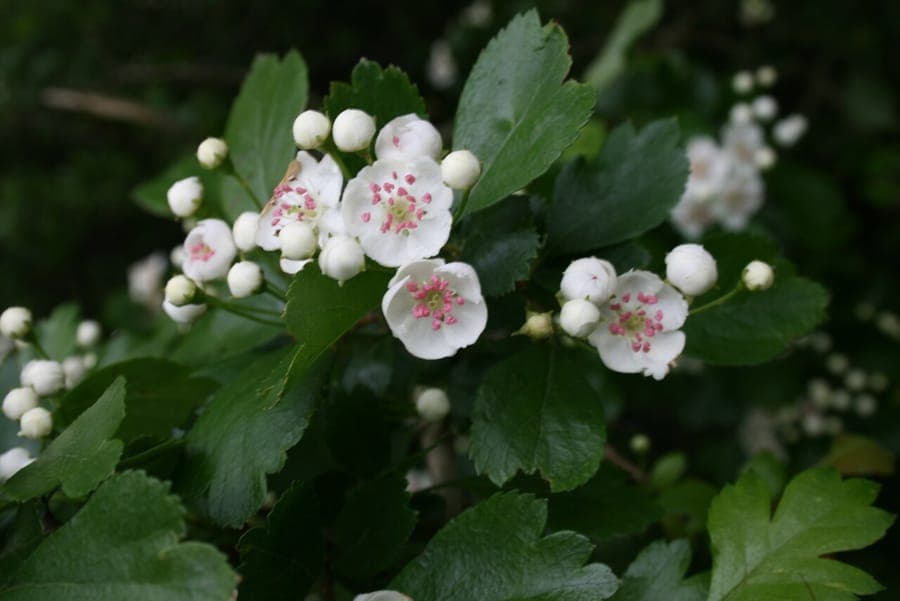
Sten Porse / CC BY-SA 3.0, via Wikimedia Commons
Midland hawthorn: complete guide
Crataegus laevigata
Want to see Midland hawthorn: complete guide in your garden?
1 minute, no credit card
Overview
Crataegus laevigata, commonly known as Midland hawthorn, is a rugged yet graceful deciduous shrub or small tree native to much of central and western Europe, including Germany, France, Belgium and the UK. It's a go-to choice for gardeners wanting a durable, flowering hedge or a standalone specimen that supports wildlife. Reaching a mature height of 6 to 8 meters with a spread of 4 to 5 meters, it grows at a moderate pace and develops a dense, thorny structure that deters intruders while welcoming pollinators and birds. On gardenworld.app you can design a mixed hedge layout that includes Midland hawthorn for year-round structure and seasonal interest.
This species is often confused with the common hawthorn (Crataegus monogyna), but can be distinguished by its flowers, which typically have two styles instead of one - hence the name "biflora" in some references. It's not just botanists who appreciate it; gardeners value it for its reliable flowering, hardiness, and low maintenance needs. Whether planted as a boundary hedge, windbreak, or ornamental tree, it integrates well into both rural and suburban gardens.
Appearance & bloom cycle
Midland hawthorn puts on a show in mid to late May, producing clusters of fragrant, pink-tinged white blossoms. The flowers open from deep pink buds and appear in corymbs of 10 to 20 blooms each. Each flowering period lasts about two to three weeks and is a magnet for bees, hoverflies, and butterflies. After pollination, small apple-like fruits - known as haws - begin to form. These ripen from green to deep red by September and often persist well into winter, providing vital food for birds like redwings, fieldfares, and thrushes.
The leaves are deeply lobed, glossy green on top and slightly paler underneath. In autumn, they turn yellow to bronze before falling. The stems are armed with short, sharp thorns up to 2 cm long, adding security and character. In winter, the branching pattern creates a striking silhouette, especially when backlit by low sunlight.
Ideal location
This hawthorn thrives in full sun but tolerates partial shade. For best flowering and fruiting, aim for at least 6 hours of direct sunlight daily. It's ideal for open borders, native hedgerows, or as a specimen tree in a lawn. It's also excellent for wildlife gardens, cottage-style plantings, or naturalised areas. Avoid exposed, windy sites - young trees may suffer stem breakage. If planting in such a spot, stake the tree for the first two years. You can use gardenworld.app to visualise how a Midland hawthorn will fit into your garden's sun map and spacing plan.
Soil requirements
Crataegus laevigata is adaptable to a wide range of soils, including clay, loam, and sandy types, as long as drainage is adequate. It does not tolerate waterlogged conditions, especially in winter. The ideal pH is between 5.5 and 7.5 - slightly acidic to neutral. In heavy clay, improve drainage by mixing in grit or well-rotted compost. On sandy soils, add organic matter to boost moisture retention. It won't thrive in highly alkaline or permanently dry soils, but with minimal amendment, it adapts well.
Free design
Want to see Midland hawthorn: complete guide in your garden? Make a free design now.
Watering
Once established, Midland hawthorn is drought-tolerant and rarely needs supplemental watering. However, during the first 12 to 18 months after planting, regular watering is crucial. Provide 10–15 litres per week during dry spells, especially in the first summer. Use rainwater when possible, as tap water with high lime content can affect young roots. Mulching around the base with bark or compost helps retain moisture and suppress weeds.
Pruning
Pruning isn't required for health, but it helps maintain shape and density, especially in hedges. The best time to prune is during winter dormancy, from November to February. Avoid pruning in spring or early summer to prevent removing flower buds. For hedges, cut back once a year for a tidy look, or twice for a denser screen. Always wear thick gloves and protective sleeves - the thorns are sharp. Remove dead, damaged, or crossing branches to improve airflow and reduce disease risk.
Maintenance calendar
- January: Inspect for winter damage, remove dead wood
- February: Final pruning window before bud break
- March: Apply a layer of compost around the base, check for pests
- April: No intervention needed - buds are swelling
- May: Peak bloom - keep clear of pruning
- June: Monitor for aphids or leaf spot; ensure young plants are watered
- July: Check soil moisture in prolonged dry spells
- August: Reduce watering as growth slows
- September: Haws turn red; birds begin feeding
- October: Leaf fall begins; leave fallen leaves as natural mulch
- November: Begin light pruning if needed
- December: Dormant period - no action required
Winter hardiness
Midland hawthorn is fully hardy in USDA zones 4 to 7, enduring temperatures down to -25°C. It's well-suited to most temperate climates, including the UK and northern Europe. Young plants may suffer tip dieback in harsh winters, especially in exposed locations. Consider using a horticultural fleece wrap for the first two winters if you're in a cold, windy area.
Companion plants
Pair with plants that share similar soil and light needs. Good companions include blackthorn (Prunus spinosa), guelder rose (Viburnum opulus), dogwood (Cornus sanguinea), and field maple (Acer campestre). For underplanting, try native bluebells (Hyacinthoides non-scripta), wood anemone (Anemone nemorosa), or primroses (Primula vulgaris). Avoid invasive groundcovers that could compete for light and nutrients.
Closing
Midland hawthorn is a resilient, beautiful, and ecologically valuable plant that earns its place in any garden. With minimal care, it delivers spring blossoms, autumn fruit, and year-round structure. You can find it at garden centres across the UK, often sold as bare-root whips in winter or container-grown specimens year-round. Use gardenworld.app to plan spacing, calculate how many plants you'll need for a 15-meter hedge, or explore design ideas that feature hawthorn as a key element.
Want to see Midland hawthorn: complete guide in your garden? Make a free design now.
Upload a photo, pick a style, and get a photorealistic design with plant list in under a minute.
No credit card required


Similar plants
Siberian crab apple: complete guide
Malus x robusta
Complete guide to the Siberian crab apple (Malus x robusta): location, soil, pruning, winter hardiness and the best companion plants for your garden.
Chinese flowering crabapple (Malus x spectabilis): complete guide
Malus x spectabilis
Meet the Chinese flowering crabapple (Malus x spectabilis): a classic spring bloomer with carmine buds and pink blossom.
Potentilla crassinervia: complete guide
Potentilla crassinervia
Potentilla crassinervia, the Corsican cinquefoil, grows wild on Corsica and Sardinia's peaks. Discover how to grow this hardy alpine rock garden gem.