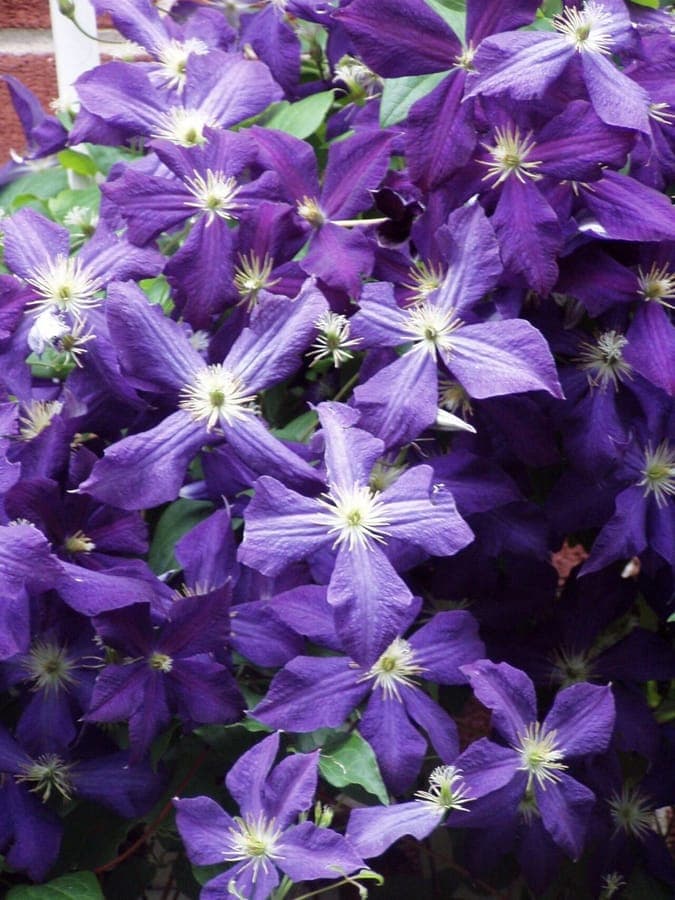
Mike Gifford from Ottawa, Canada / CC BY-SA 2.0, via Wikimedia Commons
Jackman's clematis: complete guide
Clematis × jackmanii
Want to see Jackman's clematis: complete guide in your garden?
Full design in HD: €7.99
Look after your Jackman's clematis with the GardenWorld app
Identify plants with your camera and get a care calendar with reminders for this plant.


Overview
Clematis × jackmanii is very likely the best-known clematis in the world. If you have ever seen a wall or pergola turn entirely violet-blue in July, you have probably met it already. The plant was raised in 1858 at George Jackman's nursery in Woking, Surrey, from a cross between the Chinese Clematis lanuginosa and viticella hybrids. Today it is often labelled as the cultivar Clematis 'Jackmanii', but everyone means the same plant.
Jackman's clematis is a deciduous climber in the buttercup family (Ranunculaceae). It reaches 3 to 4 metres in height and 1 to 1.5 metres across. Unlike ivy it has no aerial roots: it climbs by twisting its leaf stalks around thin supports. That is the first thing to remember, because without suitable support it simply will not climb. The second is that it belongs to pruning group 3, so it is cut back hard every spring. Support and pruning, between them, decide most of whether your plant thrives.
If you would like to know where a climber like this would work best in your own garden, on a house wall, over a pergola or through an old fruit tree, you can have a garden design made at gardenworld.app that takes your aspect and soil into account.
Appearance and bloom cycle
The flowers are 10 to 15 cm across and usually have four, occasionally five or six, broad sepals. What we call petals on a clematis are in fact coloured sepals. On Jackmanii they are velvety deep violet-purple, slightly redder as they open and bluer later, with a faint ridge along the centre. In the middle sits a tuft of creamy green stamens that stands out beautifully against the dark purple.
Flowering starts in late June or early July and carries on into September. Because the plant flowers on wood produced in the same year, the buds appear on new shoots that emerge in spring from the base and the lowest nodes. The leaves are divided into three to five oval leaflets, fresh green and fairly small compared with the flowers.
Ideal location
Clematis × jackmanii likes its head in the sun and its feet in the shade. That is not a cliché but sound botany: the stems and flowers need four to six hours of sun a day to bloom freely, while the roots prefer to stay cool and moist. An east- or west-facing wall is ideal; against a south wall it can get too hot, especially if the base also bakes.
Shade the base with a few low perennials, a flat stone or a 5 to 7 cm mulch. Plant 30 to 40 cm away from a wall, where the soil dries out less, and angle the plant towards its support.
Support. Leaf-stalk climbers can only grip thin things, up to roughly 1 cm in diameter. A smooth wall, a thick post or a wide plank is impossible for Jackmanii. Fix horizontal wires 20 to 30 cm apart, or use a timber or metal trellis with slim battens, mesh or climbing netting. Leave a 3 to 5 cm gap between support and wall so air can circulate and the leaf stalks can wrap around the wire. On a pergola or obelisk, wind the first shoots around the uprights yourself and tie them in loosely. Jackmanii also looks superb grown through a climbing rose or a medium-sized shrub, whose branches act as a natural framework.
Soil requirements
Clematis likes a deep, humus-rich, free-draining soil that never dries out completely. Light clay and loam are ideal; on sandy soil, mix plenty of garden compost or well-rotted manure into the planting hole. On heavy clay that becomes waterlogged in winter, improve drainage with coarse grit at the bottom of the hole. A neutral to slightly alkaline pH of roughly 6.5 to 7.5 suits it well.
Dig a hole at least 45 cm deep and wide. One key point: plant large-flowered clematis 5 to 10 cm deeper than they sat in the pot. That buries one or two pairs of buds, so if the top growth dies back after clematis wilt or an accident, the plant can reshoot from below ground. Spring or early autumn are the best times to plant.
Free preview
Want to see Jackman's clematis: complete guide in your garden? Make a free preview of your design.
Watering
In its first two years Jackmanii needs regular watering: in dry spells, give a full 10-litre can at the base once a week, thoroughly rather than little and often. An established plant in open ground usually copes on its own.
Water the soil, not the foliage, to keep mildew and other fungal problems down. Feed in March with an organic fertiliser or rose feed and again in May or June. A potassium-rich feed encourages flowering, while too much nitrogen mainly produces long green growth. Jackmanii also grows in containers of at least 50 litres, but then needs watering almost daily in summer and a liquid feed every fortnight.
Pruning
Clematis × jackmanii belongs to pruning group 3, the group that flowers on the current year's growth. That makes pruning simple and decisive.
When: late February or March, as soon as the new buds begin to swell.
How: cut every stem back to just above a healthy pair of buds 20 to 30 cm above ground. Pull last year's tangled growth off the support entirely. It looks brutal, but within a few months the plant puts on 3 metres of fresh growth and flowers generously on it.
Why: if you leave Jackmanii unpruned, each year's growth piles on top of the last. The flowers move ever higher while the lower part turns into a bare brown tangle.
With young plants, cut back to 30 cm in the first spring after planting, even if it feels wasteful: it forces the plant to produce several stems. During the growing season, spread the young shoots over the support every week or two and tie them in loosely with soft twine.
Maintenance calendar
February to March: main prune to 20 to 30 cm above ground, remove old growth, check supports and wires.
March: first feed and a fresh layer of mulch around the base.
April to May: spread out and tie in young shoots; watch for slugs, which love the tender new growth.
June: second feed; water during dry weather.
July to September: peak flowering. Deadhead if you want a tidy look, and keep watering in dry weeks.
October to November: the plant drops its leaves. Plant new specimens now or in spring.
December to January: dormant period. Do not prune, however untidy it looks.
You can find a personalised planting calendar for your garden, with pruning dates for each plant, at gardenworld.app.
Winter hardiness
Jackmanii is very hardy. Across Britain, Ireland and the Low Countries it survives without protection, even at -20 °C and below. The top growth may be frosted, but since you cut it back in spring anyway, that makes no difference. Only container plants deserve some insulation around the pot or a spot against the house in a severe winter.
One thing to watch for is clematis wilt, a fungal disease that makes a stem collapse and wither within days. Jackmanii is less susceptible than the early large-flowered clematis, but it can happen. Cut affected stems back into healthy wood; thanks to deep planting the plant will usually regrow.
Toxicity: all parts of clematis contain protoanemonin. The sap can irritate the skin, and eating the plant causes irritation of the mouth and digestive tract. Wear gloves when pruning and keep children, dogs, cats and rabbits away from the leaves and prunings.
Companion plants
The classic partner for Clematis × jackmanii is a climbing rose. A pink or soft yellow rose and the dark purple clematis enhance each other, and the rose provides support at the same time. The apothecary's rose (Rosa gallica) at the foot of an obelisk works well too.
Combine it with other clematis for a longer season, for instance wine-red Clematis viticella. At the base, low perennials shade the roots: catmint (Nepeta), bloody cranesbill (Geranium sanguineum) and lady's mantle (Alchemilla mollis) are ideal. Lavender echoes the colour nicely, but place it a little further from the base, as it prefers drier conditions.
Final thoughts
Clematis × jackmanii has been a classic for more than a century and a half, and rightly so. It is hardy, flowers for months and needs little work, provided you get two things right: give it thin wires or a trellis to pull itself up, and, as a pruning group 3 clematis, cut it back to 20 to 30 cm every spring. Plant it deep, keep the base cool and moist and give the stems sun. From July onwards you will have a wall of purple that your neighbours will remember for years.
Frequently asked questions about Jackman's clematis
Is Jackman's clematis winter hardy?
Jackmanii is very hardy. Across Britain, Ireland and the Low Countries it survives without protection, even at -20 °C and below.
When and how do you prune Jackman's clematis?
Clematis × jackmanii belongs to pruning group 3, the group that flowers on the current year's growth. That makes pruning simple and decisive.
How much water does Jackman's clematis need?
In its first two years Jackmanii needs regular watering: in dry spells, give a full 10-litre can at the base once a week, thoroughly rather than little and often. An established plant in open ground usually copes on its own.
Where does Jackman's clematis grow best?
Clematis × jackmanii likes its head in the sun and its feet in the shade. That is not a cliché but sound botany: the stems and flowers need four to six hours of sun a day to bloom freely, while the roots prefer to stay cool and moist.
What soil does Jackman's clematis need?
Clematis likes a deep, humus-rich, free-draining soil that never dries out completely. Light clay and loam are ideal; on sandy soil, mix plenty of garden compost or well-rotted manure into the planting hole.

See it in your garden
See Jackman's clematis in your garden
One photo of your garden and a few questions. You see the result in about a minute.
Try it with a photoIdentify this plant in your own garden. Identify a plant
Similar plants
Purple clematis: complete guide
Clematis viticella
How to grow Clematis viticella successfully: ideal conditions, pruning, watering, companion plants and design tips for your garden.
Hungarian rose: complete guide
Rosa gallica
Discover Rosa gallica: growth habits, care tips, bloom season and ideal planting conditions. A hardy, fragrant rose for classic and cottage gardens.
Raceme catnip: complete guide
Nepeta racemosa
Nepeta racemosa, or raceme catnip, is a hardy perennial with soft lavender-blue flower spikes. Great for borders, low-maintenance beds, and pollinator gardens. Drought-tolerant and easy to grow.
