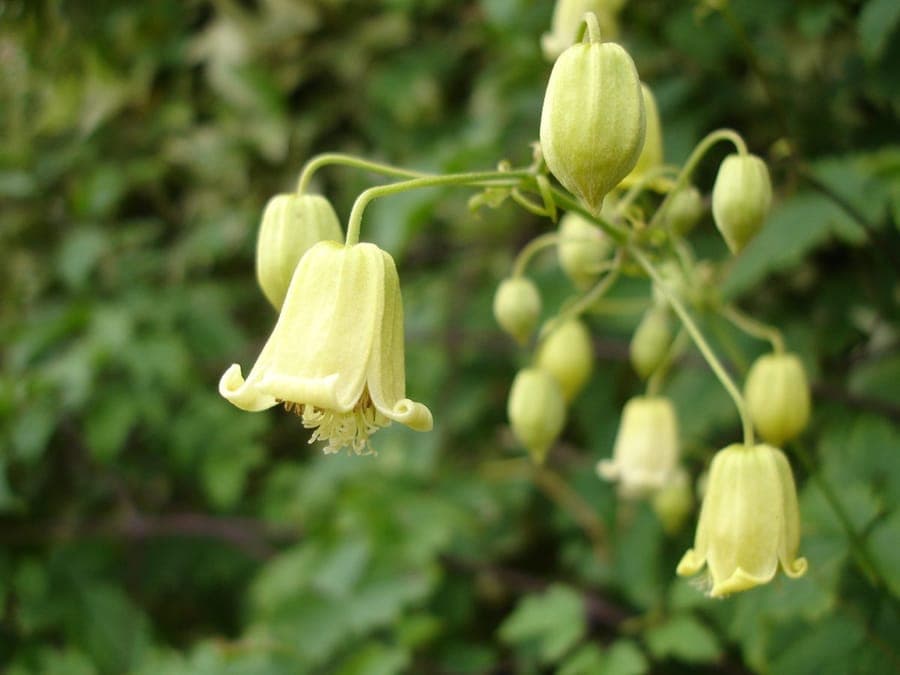
Epibase / CC BY 2.5, via Wikimedia Commons
Clematis rehderiana: complete guide
Clematis rehderiana
Want to see Clematis rehderiana: complete guide in your garden?
Full design in HD: €7.99
Look after your Clematis rehderiana with the GardenWorld app
Identify plants with your camera and get a care calendar with reminders for this plant.


Overview
Clematis rehderiana is a clematis for those who love subtlety and scent. Rather than the big, showy saucers of the familiar hybrids, it produces hundreds of small, nodding bells in pale primrose yellow that give off a sweet, honey-like fragrance from late summer into October. The species comes from the mountains of western China and is named after Alfred Rehder, the German-American dendrologist at the Arnold Arboretum. It holds the Royal Horticultural Society's Award of Garden Merit, a mark of a reliable garden plant.
It is sometimes called nodding virgin's bower, though most nurseries simply sell it as Clematis rehderiana. It is a vigorous deciduous climber in the buttercup family (Ranunculaceae) that can reach 6 to 7 metres in height and 2 to 3 metres across. It climbs with its leaf stalks, so it needs thin supports, and it belongs to pruning group 3. Its size makes it ideal for covering a shed, a large pergola, an old tree or a long fence. If you are unsure where such a vigorous grower would fit in your garden, you can have a garden design made at gardenworld.app in which climbers, aspect and space are worked out together.
Appearance and bloom cycle
The flowers are bell-shaped, 1.5 to 2 cm long, and hang in loose, branched clusters from the leaf axils. The four sepals are finely hairy on the outside, giving them a velvety feel, and their tips curl elegantly outwards. The colour ranges from pale yellow to greenish yellow, a little greener in shade. The scent recalls cowslips and honey and is most noticeable on warm evenings. Bees and bumblebees love it, which makes it a valuable late-summer food source.
Flowering begins in August, or late July in a favourable spot, and continues into October. Small silvery seed heads follow. The leaves are pinnate, with seven to nine coarsely toothed, hairy leaflets. The overall effect is fresh and airy: more a curtain of green with pale yellow highlights than a burst of colour.
Ideal location
Give Clematis rehderiana a spot in sun or light partial shade. The more sun the stems receive, the richer the flowering and the stronger the scent. As with all clematis, the base prefers to stay cool: plant on the shady side of a wall or tree and let the stems grow towards the light, or cover the soil around the base with mulch or low plants.
Above all, allow plenty of room. A plant that wants to grow 6 metres soon gets tangled up in itself on a 2-metre trellis. Good places are a large pergola or arbour, a shed or garage wall, an old fruit tree, or a dense hedge it can scramble over.
Support. Clematis rehderiana climbs with its leaf stalks, which can only wind around thin things up to about 1 cm in diameter. Against a wall, fix horizontal wires 25 to 30 cm apart, or use large-gauge mesh or sturdy climbing netting, leaving a 3 to 5 cm gap from the wall. On a pergola, stretch wires or mesh between the uprights, as it cannot grip thick posts. In a tree, plant at least 1 metre from the trunk, outside the driest root zone, and guide the first stems to the lowest branches with a cane or string.
Soil requirements
A deep, fertile, well-drained soil is ideal. The species tolerates lime and grows well on neutral to slightly alkaline ground. On heavy clay that stays wet in winter, improve drainage with coarse grit; on poor sand, work plenty of compost into the planting hole.
Dig a generous hole about 50 cm deep and wide. Set the plant 5 to 10 cm deeper than it was in the pot, so that a few buds lie below the soil. Plant in spring or early autumn and water in well straight away.
Watering
A young plant needs regular watering for its first two summers: in dry weeks, 10 litres at the base once a week. Because Clematis rehderiana produces so much foliage, it loses a lot of water in summer. Even established plants appreciate a soak during long dry spells, especially against a wall or under a tree, where the soil dries out quickly.
Feed in March with compost or an organic fertiliser, and again in June if you like. Do not overdo it: too much nitrogen gives mainly metres of green growth and fewer flowers. A potassium-rich feed in spring supports the late-summer display.
Free preview
Want to see Clematis rehderiana: complete guide in your garden? Make a free preview of your design.
Pruning
Clematis rehderiana belongs to pruning group 3: it flowers on shoots made in the current year. You can therefore cut it back hard every spring without losing any flowers.
When: late February or March, as the buds begin to swell.
How: cut all stems back to just above a healthy pair of buds 30 to 50 cm above ground, and pull the old growth out of the support. For a plant growing through a tree or over a shed, you can choose a lighter option: prune back to a permanent framework of 1 to 1.5 metres. Flowering then starts a little higher and slightly earlier.
Why: without pruning, a thick layer of dead growth builds up, the plant becomes heavy and bare at the base, and the flowers move to the top, out of sight and out of reach of your nose.
During spring and early summer, spread the young stems over the support and tie them in loosely. Do not let the plant grow into gutters or under roof tiles.
Maintenance calendar
February to March: main prune to 30 to 50 cm, remove old growth, check wires and mesh.
March: compost or organic fertiliser and a layer of mulch around the base.
April to June: guide and tie in young stems; watch for slugs on the first shoots.
June: optional second feed; water during dry spells.
August to October: flowers and fragrance. Enjoy them on warm evenings.
October to November: seed heads and leaf fall. Planting season for new specimens.
December to January: dormancy. No pruning.
If you would rather not forget these dates, use the planting calendar at gardenworld.app, which shows when to prune and feed each plant.
Winter hardiness
Clematis rehderiana is reliably hardy in Britain, Ireland and the Low Countries, tolerating frost down to about -20 °C. In a hard winter the top growth can be frosted, but because you cut it back in spring anyway, that is rarely a problem, and the roots reshoot. Its size makes it less suited to containers; if you want to try, choose a tub of at least 60 litres and insulate it in winter.
The species is healthy. Clematis wilt rarely affects this small-flowered botanical clematis. In dry, hot spots mildew can occasionally appear; adequate water and an airy position help.
Toxicity: like all clematis, Clematis rehderiana contains protoanemonin. The sap can cause skin irritation, and eating the leaves or stems leads to irritation of the mouth and digestive tract. Wear gloves when pruning and keep children, dogs, cats and rabbits away from the plant and its prunings.
Companion plants
The soft yellow of Clematis rehderiana looks best against a dark background. Let it climb through or over a yew hedge (Taxus baccata); the dark green makes the pale bells glow. Another classic is pairing it with a purple or deep red pruning group 3 clematis such as Clematis viticella. Because both are cut back in the same spring session, you can grow them together on one pergola.
Clematis tangutica, with larger golden bells, also works well if you want a yellow theme. In the border at the base, late-summer perennials tie everything together: purple coneflower (Echinacea purpurea), asters and tall ornamental grasses. Purple and lilac next to the pale yellow create a fresh, calm picture that lets the scent take centre stage.
Final thoughts
Clematis rehderiana is not a plant that shouts from across the garden, but once you get to know it up close, you will not want to be without it. Give it room and a support of thin wires or mesh it can grip, and as a pruning group 3 clematis, cut it back to 30 to 50 cm each spring. From August to October you will have a cloud of fragrant yellow bells, just as the rest of the garden is starting to wind down.
Frequently asked questions about Clematis rehderiana
Is Clematis rehderiana winter hardy?
Clematis rehderiana is reliably hardy in Britain, Ireland and the Low Countries, tolerating frost down to about -20 °C. In a hard winter the top growth can be frosted, but because you cut it back in spring anyway, that is rarely a problem, and the roots reshoot.
When and how do you prune Clematis rehderiana?
Clematis rehderiana belongs to pruning group 3: it flowers on shoots made in the current year. You can therefore cut it back hard every spring without losing any flowers.
How much water does Clematis rehderiana need?
A young plant needs regular watering for its first two summers: in dry weeks, 10 litres at the base once a week. Because Clematis rehderiana produces so much foliage, it loses a lot of water in summer.
Where does Clematis rehderiana grow best?
Give Clematis rehderiana a spot in sun or light partial shade. The more sun the stems receive, the richer the flowering and the stronger the scent.
What soil does Clematis rehderiana need?
A deep, fertile, well-drained soil is ideal. The species tolerates lime and grows well on neutral to slightly alkaline ground.

See it in your garden
See Clematis rehderiana in your garden
One photo of your garden and a few questions. You see the result in about a minute.
Try it with a photoIdentify this plant in your own garden. Identify a plant
Similar plants
Orange-peel clematis: complete guide
Clematis tangutica
How to grow Clematis tangutica: a striking vine with unique orange flowers. Learn about sun, soil, pruning and companion plants for your garden.
Purple clematis: complete guide
Clematis viticella
How to grow Clematis viticella successfully: ideal conditions, pruning, watering, companion plants and design tips for your garden.
English Yew: complete guide
Taxus baccata
Everything about English Yew (Taxus baccata): planting, clipping, topiary and care. Expert tips for a dense hedge or elegant sculptural form.
