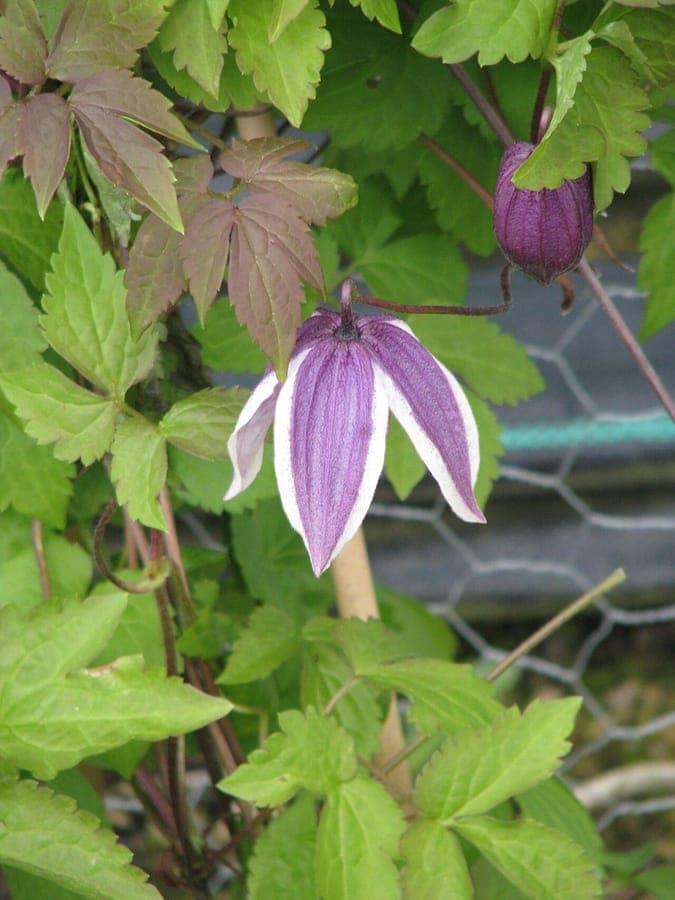
peganum from Small Dole, England / CC BY-SA 2.0, via Wikimedia Commons
Korean clematis: complete guide
Clematis koreana
Want to see Korean clematis: complete guide in your garden?
Full design in HD: €7.99
Look after your Korean clematis with the GardenWorld app
Identify plants with your camera and get a care calendar with reminders for this plant.


Overview
Korean clematis (Clematis koreana) is a small, graceful climber from the mountain woodlands of Korea and north-eastern China. It belongs to the same group as the familiar alpine clematis (Clematis alpina) and Clematis macropetala, known as the Atragene group: clematis with nodding, bell-shaped flowers that bloom early in the season and are exceptionally hardy. It is turning up more often in nurseries, mainly through cultivars such as 'Amber', with soft yellow flowers, and selections in violet and purple like the plant in the photo.
Clematis koreana reaches 2.5 to 4 metres in height and 1.5 to 2.5 metres across. It climbs with its leaf stalks, which twist around thin supports, and it can also scramble over a bank or a low wall as ground cover. For busy gardeners it is a rewarding choice: it belongs to pruning group 1 and needs very little pruning. If you would like to see how a compact climber like this would fit into your garden, on a fence, a small arch or through a shrub, you can have a garden design made at gardenworld.app that takes your soil and aspect into account.
Appearance and bloom cycle
The flowers hang like small lanterns from long, slender stalks. Each one has four pointed sepals, 3 to 5 cm long, that form a half-open bell. The colour varies with the plant and cultivar: violet, purple-red, reddish brown or creamy yellow. In some selections the sepals have a white or pale margin, which gives the flower extra definition. Inside the bell sits a ring of narrow, pale staminodes: sterile stamens that look like small inner petals, typical of the Atragene group.
The main display comes in May and June, a little later than the alpine clematis. A few odd flowers often follow in late summer. After flowering come silvery, silky seed heads that stay attractive into autumn. The leaves are ternate to biternate, with coarsely toothed, fresh green leaflets. Young foliage can emerge bronze, as you can see at the top left of the photo.
Ideal location
Clematis koreana tolerates shade far better than the large-flowered clematis. Sun or partial shade is ideal, and even a north wall or light shade under trees is fine, as long as the plant gets a few hours of light. As with other clematis, it prefers a cool root run. A low perennial or a layer of mulch around the base helps.
Support. Like other clematis, Korean clematis can only grip thin things, up to about 1 cm in diameter. Smooth walls and thick posts are of no use. Good options are:
- horizontal wires 20 to 30 cm apart, with a 3 to 5 cm gap to the wall;
- a trellis with slim battens, mesh or climbing netting;
- a small obelisk or arch in the border;
- a shrub or small tree for the stems to climb through.
After planting, guide the first shoots to the support yourself and tie them in loosely. After that the plant largely looks after itself. Because it stays fairly small, it also suits a large container on a balcony or patio, with a small trellis in the pot.
Soil requirements
Korean clematis is not fussy. It grows in any ordinary garden soil that drains well and does not stay wet for long. In the wild it grows on woodland edges and rocky slopes, so it dislikes standing water in winter. On heavy clay, mix coarse grit into the planting hole; on poor sandy soil, add some compost. A neutral to slightly alkaline pH is ideal, but mildly acid soil is tolerated well.
Dig a hole about 40 cm deep and wide. You can set this small-flowered species a little deeper than it was in the pot, around 5 cm, but it matters less than with large-flowered clematis, because Clematis koreana rarely suffers from clematis wilt. Spring or early autumn are the best planting times.
Free preview
Want to see Korean clematis: complete guide in your garden? Make a free preview of your design.
Watering
In the first year after planting, give a generous can of water at the base once a week during dry spells, so the roots can establish well. An established plant in open ground needs little extra water, except during long droughts or against a wall in a rain shadow. Always water the soil, not the leaves.
Feeding needs are modest: a handful of organic fertiliser or some compost in March is enough. Too much feed produces long stems with fewer flowers. In a container, water more regularly during the growing season and give a liquid feed every three to four weeks.
Pruning
Clematis koreana belongs to pruning group 1: clematis that flower early on the previous year's wood. The main rule is therefore: do not prune in winter or early spring, or you will cut off the flower buds.
Regular pruning is not needed. If the plant stays neatly within its support, simply let it grow. In spring, just remove any dead or damaged pieces.
Getting too big or untidy? Then prune straight after the main flowering, in late June or early July. Cut over-long stems back to within the desired shape and thin out a few older stems. The plant then has the whole summer to make new shoots that will flower next spring.
Renovation. If an old plant has become bare at the bottom, you can cut it back hard to 30 to 50 cm after flowering. Atragene clematis usually tolerate this well, but expect a year with few flowers.
Maintenance calendar
March: remove dead growth, add compost or organic fertiliser around the base, check the support.
April: guide new shoots onto the support. Watch for slugs on young plants.
May to June: main flowering. Water during dry weather.
Late June to July: any pruning, straight after flowering.
August to September: silky seed heads; sometimes a second, smaller flush.
October to November: leaf fall. A good time to plant new specimens.
December to February: dormancy. Do not prune.
At gardenworld.app you will find a planting calendar that tells you, plant by plant, when to prune, plant or feed.
Winter hardiness
Clematis koreana is exceptionally hardy. In its native range it faces harsh continental winters, and in Britain, Ireland and the Low Countries it survives without any protection, even at -25 °C. Late spring frosts can occasionally damage the earliest buds, but plenty more usually follow. Only container plants deserve some insulation around the pot in a severe winter.
The species is remarkably healthy. Clematis wilt is rare in the Atragene group, and mildew is seldom a problem in an airy spot.
Toxicity: like all clematis, Korean clematis contains protoanemonin. The sap can irritate the skin, and eating the plant causes irritation of the mouth and digestive tract. Wear gloves when pruning and keep children and pets such as dogs, cats and rabbits away from the leaves and prunings.
Companion plants
A lovely way to use Clematis koreana is to let it grow through a spring-flowering shrub. A snowy mespilus (Amelanchier lamarckii) or lilac (Syringa vulgaris) provides support, and the clematis comes into flower just as the shrub finishes. That gives you two flowering seasons in the same spot.
Combine it with other early clematis for a longer spring display: alpine clematis (Clematis alpina) flowers a little earlier, while Clematis montana climbs higher into a tree. At the base, shade-loving ground cover keeps the roots cool, for example lesser periwinkle (Vinca minor), Balkan cranesbill (Geranium macrorrhizum) or ferns. White spring bulbs and forget-me-nots make a pretty contrast with the violet bells.
Final thoughts
Korean clematis is an underrated climber: compact, very healthy, extremely hardy and happy in partial shade. Remember two things. Give it thin wires, a trellis or a shrub to climb into, because it cannot get up a smooth wall. And treat it as pruning group 1: no cutting in winter, at most a light trim after flowering. Every spring, dozens of little lanterns will hang in your garden again.
Frequently asked questions about Korean clematis
Is Korean clematis winter hardy?
Clematis koreana is exceptionally hardy. In its native range it faces harsh continental winters, and in Britain, Ireland and the Low Countries it survives without any protection, even at -25 °C.
When and how do you prune Korean clematis?
Clematis koreana belongs to pruning group 1: clematis that flower early on the previous year's wood. The main rule is therefore: do not prune in winter or early spring, or you will cut off the flower buds.
How much water does Korean clematis need?
In the first year after planting, give a generous can of water at the base once a week during dry spells, so the roots can establish well. An established plant in open ground needs little extra water, except during long droughts or against a wall in a rain shadow.
Where does Korean clematis grow best?
Clematis koreana tolerates shade far better than the large-flowered clematis. Sun or partial shade is ideal, and even a north wall or light shade under trees is fine, as long as the plant gets a few hours of light.
What soil does Korean clematis need?
Korean clematis is not fussy. It grows in any ordinary garden soil that drains well and does not stay wet for long.

See it in your garden
See Korean clematis in your garden
One photo of your garden and a few questions. You see the result in about a minute.
Try it with a photoIdentify this plant in your own garden. Identify a plant
Similar plants
Alpine clematis: complete guide
Clematis alpina
A practical guide to growing Clematis alpina (Alpine clematis) in your garden. Learn about ideal conditions, soil, pruning, and companion planting for this early-blooming climber.
Himalayan clematis: complete guide
Clematis montana
Everything you need to know about Clematis montana: fast-growing climber with spring flowers, perfect for walls, fences, and arbors. Care, pruning, and planting tips.
Juneberry: complete guide
Amelanchier lamarckii
Everything about the Juneberry (Amelanchier lamarckii): spring blossom, autumn colour, edible berries and care. Expert tips for this versatile four-season tree.
