Chhe (talk) / Public domain, via Wikimedia Commons
Metallic palm (Chamaedorea metallica): complete guide
Chamaedorea metallica
Want to see Metallic palm (Chamaedorea metallica): complete guide in your garden?
Full design in HD: €7.99
Look after your Metallic palm with the GardenWorld app
Identify plants with your camera and get a care calendar with reminders for this plant.


Overview
The metallic palm (Chamaedorea metallica) is a small indoor palm you are unlikely to mistake for anything else. Instead of finely divided feathery fronds, it carries broad, sturdy leaves with a blue-green sheen that looks almost metallic as the light shifts. That sheen gives the species its name. It is also known as the miniature fishtail palm, after the split leaf tip that resembles a fish's tail.
The palm belongs to the Arecaceae family and comes from Mexico, specifically the states of Veracruz and Oaxaca. There it grows in the shade of humid forests, often on limestone slopes beneath a dense canopy. It has become scarce in the wild, partly because plants were collected. Fortunately, those sold in garden centres are raised from seed in nurseries.
Its origins in the forest understorey make Chamaedorea metallica an excellent houseplant. It tolerates lower light than most palms, stays compact and grows slowly. A 50 cm plant takes years to reach a metre.
Appearance
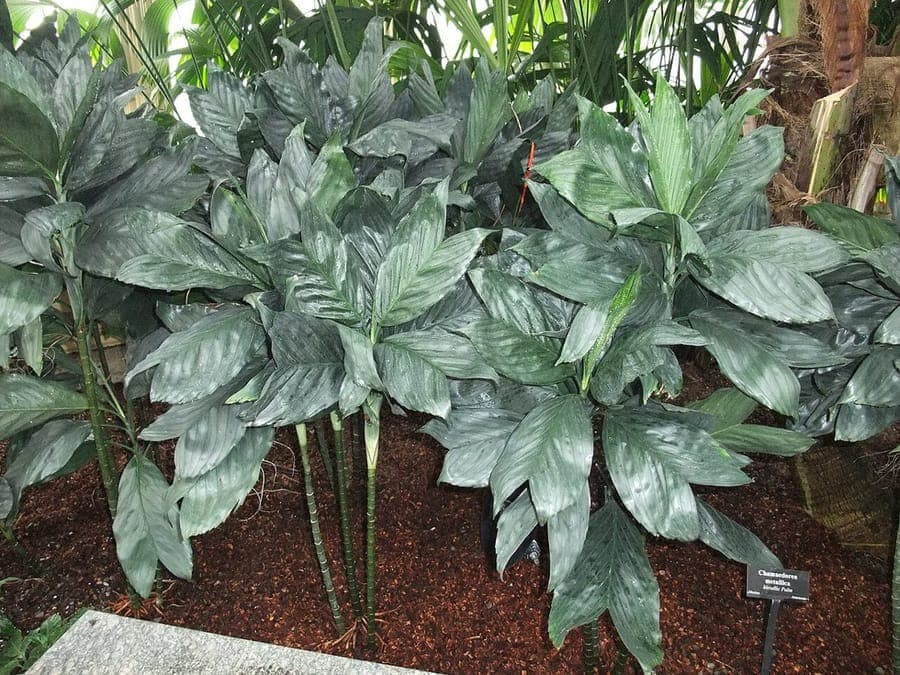
Chamaedorea metallica usually forms a single slender stem, green and ringed like bamboo. Indoors it rarely exceeds 1 to 1.5 m. Growers often put several seedlings in one pot so the plant looks fuller.
The leaves are the main attraction. Each is 25 to 40 cm long, thick and leathery, with prominent angled veins and a deep notch at the tip. Older plants sometimes produce leaves divided into a few broad segments. The photo, taken in a botanic garden glasshouse, shows several plants with their ringed green stems and the typical dark, glossy foliage.
Mature plants can flower indoors. The species is dioecious, so there are separate male and female plants. The flower stalks have bright orange-red branches, and on female plants pollination is followed by black berries about 1 cm across.
Position in the home
Place the palm somewhere bright but out of direct sun, for example a few metres from a south-facing window or closer to a north- or east-facing one. A hallway or office with good daylight also works. Avoid cold draughts and the direct heat of a radiator, which cause brown leaf tips and invite spider mite.
Because it grows slowly and stays small, the plant suits a side table, a north-facing windowsill or a group with other foliage plants.
Light
Medium to bright indirect light is ideal. It will survive in shade, but growth almost stops. Direct sun is a real problem: the dark leaves scorch quickly and develop pale, yellow patches. Turn the pot occasionally so the plant does not lean towards the window.
Humidity and temperature
The ideal temperature is 18 to 27 °C. In winter it can drop to about 12 °C, but preferably no lower. The palm is not hardy and in Britain and northern Europe it belongs indoors all year. In summer it can go outside in a sheltered, shady spot once nights stay above 15 °C.
Chamaedorea metallica copes with ordinary room humidity better than many tropical plants. In very dry air, especially during the heating season, the leaf tips do turn brown. Mist now and then or stand the pot on a tray of damp clay pebbles. Dry air also encourages spider mite, so check the undersides of the leaves for fine webbing.
Compost and repotting
Use a palm compost or an open mix of peat-free houseplant compost with a quarter perlite. Good drainage is essential, because wet roots are this palm's worst enemy.
Palms dislike root disturbance. Repot only when roots grow out of the drainage hole, roughly every two to three years, in spring. Choose a pot just a few centimetres larger and ease the root ball out without teasing the roots apart. Plant it at the same depth as before.
Free preview
Want to see Metallic palm (Chamaedorea metallica): complete guide in your garden? Make a free preview of your design.
Watering and feeding
Keep the compost lightly moist and let the top 2 to 3 cm dry before watering again. In summer that usually means once a week, in winter every two weeks or less. Never leave water standing in the outer pot.
The plant is somewhat sensitive to salts. Brown leaf tips may point to hard tap water or too much fertiliser. Use rainwater or water that has stood overnight where possible, and flush the pot through with plenty of water twice a year.
From April to September, feed once a month with a palm or foliage plant fertiliser at half strength. Do not feed in winter.
Pruning and leaf care
Pruning is hardly needed. Remove only leaves that are completely brown or yellow, cutting close to the stem. Brown tips can be trimmed with clean scissors, following the leaf's shape and leaving a thin margin of brown. Never cut off the top of the stem: each stem has a single growing point and will not produce new shoots there.
Wipe the leaves now and then with a damp cloth. It keeps the metallic sheen at its best and helps you spot pests early.
Propagation
This palm cannot be grown from cuttings. Nurseries raise it from fresh seed, which often takes months to germinate at 25 to 30 °C and high humidity, so it is a patient project for the home grower.
If there are several stems in one pot, you can carefully separate them when repotting in spring. Each stem needs its own sturdy root system. Expect divided plants to sulk for a while before they grow again.
Toxicity to pets
The ASPCA, the American animal welfare organisation whose list of toxic and non-toxic plants is widely used, has no separate entry for Chamaedorea metallica. Close relatives in the same genus, such as the parlour palm (Chamaedorea elegans) and the bamboo palm (Chamaedorea seifrizii), are listed as non-toxic to dogs and cats. Be aware that the ASPCA uses the name 'miniature fish tail dwarf palm' for Chamaedorea elegans, not for this species. No toxic compounds are known in Chamaedorea metallica, but there is no firm confirmation for this particular palm. A cat that chews the leaves may still get a mildly upset stomach.
Care calendar
March-April: Repot if needed. Resume feeding once new growth appears.
May-August: Growing season. Water when the surface is dry and feed monthly. The plant can go outdoors in a shady spot.
September-October: Bring it back inside before nights fall below 12 °C. Stop feeding at the end of September.
November-February: Water less, no feeding. Watch for dry air and spider mite during the heating season.
The plant calendar on gardenworld.app gives a monthly overview of jobs like these, so repotting and feeding never slip your mind.
Companion plants
Chamaedorea metallica pairs well with other plants that are content with indirect light. Its relatives the parlour palm (Chamaedorea elegans) and the bamboo palm (Chamaedorea seifrizii) form an attractive group with contrasting leaf shapes. The lady palm (Rhapis excelsa) adds a fan shape. Lower down, the ZZ plant (Zamioculcas zamiifolia) and the cast-iron plant (Aspidistra elatior) work well: both tough, slow and undemanding.
Want to carry that green corner through to a patio or veranda? On gardenworld.app you can have a garden design made in which indoor and outdoor spaces are planned as one.
Final thoughts
Chamaedorea metallica is a compact, characterful palm with leaves that gleam like metal. It asks for little: indirect light, free-draining compost that dries a little between waterings and a warm, draught-free spot. Keep it on the dry side rather than wet, let it grow at its own pace, and it will remain an elegant presence for years, even in a room with less light.
Frequently asked questions about Metallic palm
When and how do you prune Metallic palm?
Pruning is hardly needed. Remove only leaves that are completely brown or yellow, cutting close to the stem.
How much water does Metallic palm need?
Keep the compost lightly moist and let the top 2 to 3 cm dry before watering again. In summer that usually means once a week, in winter every two weeks or less.

See it in your garden
See Metallic palm in your garden
One photo of your garden and a few questions. You see the result in about a minute.
Try it with a photoIdentify this plant in your own garden. Identify a plant
Similar plants
Parlor Palm: complete guide
Chamaedorea elegans
Discover the Parlor Palm (Chamaedorea elegans), an elegant, compact palm perfect for indoors and outdoors. This beginner-friendly plant grows slowly to 1.5 meters and thrives in partial shade.
Chamaedorea seifrizii: complete guide
Chamaedorea seifrizii
Bamboo palm: elegant, compact tropical plant for indoors and patios. Graceful foliage and minimal maintenance requirements. Perfect for creating tropical ambiance.
Rhapis excelsa: complete guide
Rhapis excelsa (Thunb.) A.Henry
Discover the elegant lady palm, ideal for indoor and patio gardens. Fine, feathery fronds and graceful growth make this palm exceptionally popular.
