Krzysztof Ziarnek, Kenraiz / CC BY-SA 4.0, via Wikimedia Commons
Chinese plumbago: complete guide
Ceratostigma willmottianum
Want to see Chinese plumbago: complete guide in your garden?
Full design in HD: €7.99
Look after your Chinese plumbago with the GardenWorld app
Identify plants with your camera and get a care calendar with reminders for this plant.


Overview
Chinese plumbago (Ceratostigma willmottianum) is a small shrub that hits its stride just as most of the garden is winding down. From July well into October it produces clusters of sky-blue flowers at the tips of its shoots, and in autumn the leaves turn red and claret. For a few weeks you get blue flowers and red foliage on the same plant, a pairing that is hard to find so late in the year.
The species grows wild in western China and south-east Tibet, on dry, stony slopes and in rocky scrub. The plant hunter Ernest Wilson collected seed in Sichuan in 1908 and sent it to Britain. One of the first gardens where it flowered was Ellen Willmott's at Warley Place in Essex, which is how it got its name.
Ceratostigma willmottianum grows 60 to 100 cm tall and roughly as wide. It forms a loose, rounded shrub of thin, reddish-brown stems. Garden centres mostly sell the species itself and the more compact 'Forest Blue' (also listed as 'Lice'), which is denser and flowers a little longer. 'Desert Skies' has golden-yellow leaves that make the blue flowers look even more intense. If you want to see where this shrub would work best in your own garden, you can have a garden design made on gardenworld.app, placing it alongside lavender, ornamental grasses and late-flowering perennials.
Do not confuse it with hardy plumbago (Ceratostigma plumbaginoides). That is a low ground cover no more than 30 cm tall, with the same blue flowers but a completely different habit.
Appearance and bloom cycle
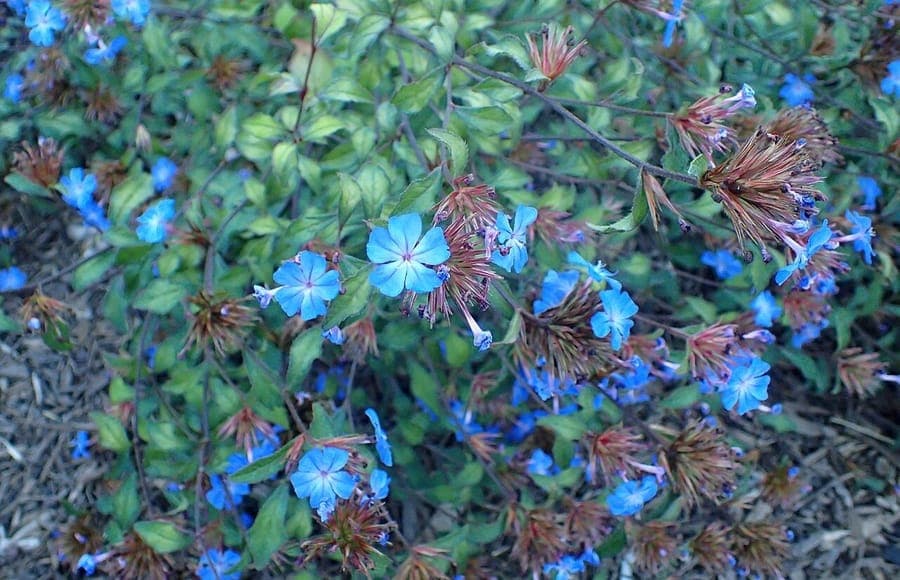
The flowers are small, about 2 cm across, with five broad petals in a clear cobalt to sky blue. They sit in tight heads at the ends of the shoots. Within each head the flowers open in succession, so the shrub stays in bloom for weeks on end with no help from you. Each flower is surrounded by bristly, reddish-brown bracts that persist after flowering. The photo shows this nicely: rusty, spent flower heads next to fresh blue blooms.
Flowering usually starts in mid-July and carries on until the first frosts, often into October. Bees, bumblebees and butterflies visit it readily, and since nectar is in short supply in September, that is a genuine bonus for wildlife.
The leaves are diamond-shaped to obovate, 3 to 5 cm long, fresh green with slightly bristly margins. From late September they colour up gradually to orange-red and wine red while the last flowers are still open. Then they drop, as Chinese plumbago is deciduous. Over winter you are left with a bundle of thin stems, which you cut back low in spring.
Ideal location
Give Chinese plumbago a spot in full sun. The more warmth it gets, the better it flowers and the brighter its autumn colour. Partial shade with at least four to five hours of sun is acceptable, but the shrub will flower later and less freely. In shade it becomes floppy and barely blooms.
A sheltered, south-facing position against a wall or beside a terrace is ideal. There the wood ripens better in autumn, which helps the plant through winter. It is also at home in a gravel garden, on a sunny bank or in a rock garden. As it only reaches about a metre, it suits the front or middle of a border. Space plants 60 to 80 cm apart for a group or a low, informal edging.
Soil requirements
This plant needs free-draining soil that does not stay wet in winter. Light sandy soil, loam with some grit and chalky soil all suit it. A neutral to slightly alkaline pH is ideal, though it copes with acidic soil as long as it is not waterlogged.
On heavy clay, work coarse sand and fine gravel into the top 30 cm when planting, or plant on a slightly raised bed. Standing water around the roots in winter is the main reason this shrub fails. Feed sparingly: a handful of compost in spring is plenty. Too much nitrogen produces long, lax shoots and fewer flowers.
Watering
In the first year after planting, water regularly, especially in dry spells in May, June and July. As a rule of thumb, give a generous 5 to 10 litre can once a week so the water soaks in deeply. Once established, Chinese plumbago is fairly drought tolerant. Only in prolonged hot, dry weather, particularly on sandy soil, will it need the odd extra drink in summer.
Plants in pots need water more often, in summer sometimes every two or three days. Let the surface dry out between waterings and never leave the pot sitting in a saucer of water. In winter, water container plants only when the root ball is completely dry.
Free preview
Want to see Chinese plumbago: complete guide in your garden? Make a free preview of your design.
Pruning
Pruning is simple, and spring is the key moment. Chinese plumbago flowers on the current year's growth, so the blooms appear on new shoots. In late March or early April, once the worst frosts are over, cut all stems back to 10 to 20 cm above the ground. It feels drastic, but the shrub regrows quickly and stays compact and free-flowering.
Do not prune in autumn. The bare stems give the base a little protection from frost, and the spent bracts and autumn foliage are decorative in their own right. After a hard winter the shrub may be killed to ground level. If so, be patient until mid-May: it will usually reshoot from the base, much like a herbaceous perennial. Only then remove what is truly dead.
Maintenance calendar
March–April: Cut all stems back to 10 to 20 cm. Remove dead wood. Spread a thin layer of compost around the base.
May: New shoots can appear surprisingly late, so do not worry if the plant still looks bare in April. Plant new specimens now, giving them a full season to root.
June: Water young plants in dry weather. Keep the base free of weeds.
July–September: Flowering season. No work needed beyond watering in long dry spells and for pots.
October: Autumn colour and the last flowers. Leave everything standing.
November–February: Dormant period. In cold areas, mulch the base with 5 to 10 cm of leaf mould or bark. Move pots against a sheltered wall.
For an overview of what to do and when across your whole garden, take a look at the planting calendar on gardenworld.app.
Winter hardiness
Ceratostigma willmottianum is moderately hardy. As a rule it survives temperatures down to about -15 °C (USDA zones 6b to 9). In severe frost the stems above ground are killed, but the base and roots usually survive, especially in dry soil. In cold winters it therefore behaves more like a perennial with a woody base.
In most gardens in Britain and the Low Countries it comes through winter well, particularly in a sheltered spot. On cold, wet soils or in open, windswept positions, a winter mulch over the base is sensible insurance. Container plants are more vulnerable because the whole root ball can freeze: wrap the pot in hessian or bubble wrap, or move it into a cold, bright shed.
There are no known reports of toxicity. The plant does not appear on the usual lists of poisonous garden plants for people or pets, but as with any ornamental, it is wise to stop children and animals from eating the leaves or flowers.
Companion plants
The blue of Chinese plumbago looks best next to silver foliage and warm late-summer colours. A classic partner is Russian sage (Perovskia atriplicifolia), which shares its late flowering and airy, silvery outline. English lavender (Lavandula angustifolia) makes a neat handover: the lavender flowers first and the plumbago takes over afterwards.
Ice plant (Hylotelephium spectabile) adds pink flat heads in September, and its rust-brown seed heads go well with the plumbago's red autumn leaves. Ornamental grasses such as fountain grass (Pennisetum alopecuroides) bring movement and fill the gaps between shrubs. Balkan clary (Salvia nemorosa) and Italian aster (Aster amellus) are good neighbours with the same needs.
For a low ground cover at the front, choose hardy plumbago (Ceratostigma plumbaginoides). Avoid plants that need lots of moisture and feeding, such as hydrangeas, as their care is the opposite of what plumbago wants.
Final thoughts
Chinese plumbago is a modest shrub with a big impact. It starts flowering in July, turns red in October and asks for very little in between. The secret comes down to three things: a sunny spot, soil that does not stay wet in winter and a firm cut back in spring.
If you want your borders to keep their colour after high summer, Ceratostigma willmottianum is a dependable choice. Plant it in spring, give it a year to settle in, and it will flower for many years at a time when the rest of the garden is already thinking about rest.
Frequently asked questions about Chinese plumbago
Is Chinese plumbago winter hardy?
Ceratostigma willmottianum is moderately hardy. As a rule it survives temperatures down to about -15 °C (USDA zones 6b to 9).
When and how do you prune Chinese plumbago?
Pruning is simple, and spring is the key moment. Chinese plumbago flowers on the current year's growth, so the blooms appear on new shoots.
How much water does Chinese plumbago need?
In the first year after planting, water regularly, especially in dry spells in May, June and July. As a rule of thumb, give a generous 5 to 10 litre can once a week so the water soaks in deeply.
Where does Chinese plumbago grow best?
Give Chinese plumbago a spot in full sun. The more warmth it gets, the better it flowers and the brighter its autumn colour.
What soil does Chinese plumbago need?
This plant needs free-draining soil that does not stay wet in winter. Light sandy soil, loam with some grit and chalky soil all suit it.

See it in your garden
See Chinese plumbago in your garden
One photo of your garden and a few questions. You see the result in about a minute.
Try it with a photoIdentify this plant in your own garden. Identify a plant
Similar plants
Perovskia atriplicifolia: complete guide
Perovskia atriplicifolia
Russian sage is a semi-shrub with purple-blue flowers and grey-green foliage that blooms from July to October. Perfect for dry gardens and landscape design.
English Lavender: complete guide
Lavandula angustifolia
Everything about English Lavender (Lavandula angustifolia): planting, pruning, care and overwintering. Practical tips for lush purple blooms.
Showy stonecrop: complete guide
Hylotelephium spectabile
Everything about Showy stonecrop (Hylotelephium spectabile): flowering, cultivation and care. Tips for successful frost resistance, drought tolerance and maintenance in borders and containers.
