
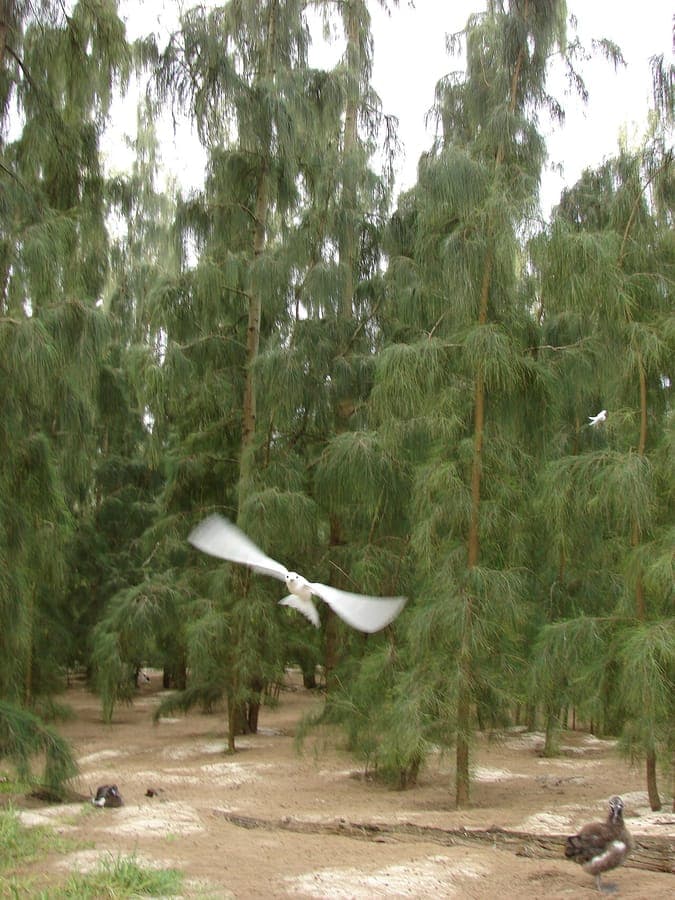
Forest & Kim Starr / CC BY 3.0, via Wikimedia Commons
Swamp she-oak: complete guide
Casuarina glauca
Want to see Swamp she-oak: complete guide in your garden?
1 minute, no credit card
Overview
Swamp she-oak (Casuarina glauca) is a remarkable fast-growing tree native to the coastal regions of eastern Australia - specifically New South Wales and Queensland. It belongs to the family Casuarinaceae, a small but botanically distinctive plant family whose members superficially resemble conifers but are true flowering plants. The species epithet glauca refers to the glaucous, waxy coating on the fine green branchlets that gives the tree its characteristic silvery appearance in certain light conditions. Gardenworld.app features garden designs that use structural trees like the swamp she-oak as windbreaks and landscape anchors.
The tree carries a suite of common names that reflect its character and range: swamp she-oak, grey she-oak, marsh ironwood, longleaf ironwood, scaly-bark beefwood, saltmarsh ironwood, and Brazilian oak. The name 'Brazilian oak' reflects the fact that it has naturalised widely in subtropical and tropical regions far from its Australian home - Florida, the Bahamas, Morocco, New Zealand, Hawaii, Mauritius and Venezuela all host established populations of this tree.
Its outstanding qualities for the gardener are its speed of growth, its exceptional tolerance of wind and salt spray, and its adaptability to both wet and moderately dry soils. These make it one of the best fast-growing windbreak trees for mild, coastal climates in USDA zone 9 and above.
Appearance and bloom cycle
Swamp she-oak has an immediately distinctive appearance. The apparent 'needles' that give it a conifer-like look are not leaves but photosynthetic green branchlets (cladodes); the true leaves have been reduced to tiny scale-like teeth arranged in whorls around the branchlets. This gives the tree its characteristic fine texture and the distinctive soft rustling sound it produces in even a light breeze.
The tree grows with a single central stem and a dense, ultimately spreading crown that in mature specimens often develops a graceful, slightly weeping form. Mature trees typically reach 10 to 20 metres in height with a canopy spread of 5 to 8 metres, but in ideal conditions can exceed these dimensions. The growth rate is rapid - one of the fastest among temperate-climate trees.
Flowers are small and botanically interesting but not ornamentally showy. Tiny reddish male catkins and small female flowers develop into small woody cone-like fruits 1-2 cm long. The tree's root system harbours nitrogen-fixing Frankia bacteria in root nodules, allowing it to establish on poor, nitrogen-depleted soils without supplemental fertilisation.
Ideal location
Swamp she-oak is a tree for challenging, exposed positions where many other trees would struggle:
- Full sun: it demands the sunniest possible position and does not tolerate shade.
- Windy, exposed sites: it is one of the most wind-firm trees available, making it ideal for coastal windbreaks and exposed garden boundaries.
- Salt spray tolerance: it withstands coastal salt spray exceptionally well - one of its outstanding qualities.
- Coastal margins and wetlands: its preference for moist to wet conditions in nature translates to garden situations near ponds, drainage channels, or in wet coastal areas.
For European gardeners, swamp she-oak is practical in the Mediterranean basin, mild Atlantic coastal zones (southwest England, Brittany, western Belgium), and in mild urban microclimates. Its fast establishment makes it particularly valuable when a windbreak structure is needed quickly.
Soil
Swamp she-oak shows impressive tolerance of diverse soil types. In its native range, it grows on a wide variety of coastal soils from sandy beach ridges to heavy clay river margins. The preferred pH is 6.5 to 7.5 - it is not suited to strongly acidic soils.
Soil types it handles well:
- Sandy and sandy loam: thrives on coastal sandy soils, one of its most natural substrates.
- Clay and loamy clay: well tolerated, provided conditions are not persistently waterlogged in cold weather.
- Calcareous soils: it handles mild alkalinity better than many trees, making it suitable for limestone and chalk-influenced coastal gardens.
- Poor, nutrient-depleted soils: the nitrogen-fixing root nodules make it more self-sufficient than most trees in terms of nitrogen.
Excessive fertilisation is unnecessary and counterproductive. Let the tree establish its own nitrogen economy via its root symbionts.
Free design
Want to see Swamp she-oak: complete guide in your garden? Make a free design now.
Watering
Despite its common name suggesting a preference for swampy conditions, established swamp she-oaks are surprisingly drought-tolerant:
- Established trees: in Mediterranean climates, mature trees survive long dry summers without irrigation.
- Young trees (first two years): water regularly - at least weekly in dry weather - to encourage deep rooting and establishment.
- Waterlogging: short-term flooding is tolerated; permanent waterlogging combined with cold is not.
- Salt water: incidental contact with brackish groundwater is tolerated.
In the mild Atlantic climates of northwest Europe, rainfall during winter and spring usually provides sufficient moisture for established trees. In drier summer periods, a deep watering every two to three weeks helps young trees maintain vigour. Once the root system is well established (after two to three years), the tree is largely self-sufficient in UK and Belgian coastal conditions.
Pruning
Swamp she-oak tolerates pruning well, which is useful when training it as a hedge or shaped windbreak:
- Timing: prune in late winter (February - March) before the growing season starts. Avoid late summer or autumn pruning.
- Windbreak formation: trim side growth to keep the windbreak narrow and upright; allow height to develop freely.
- Hedge use: can be clipped into a formal hedge with two cuts per year - in April and again in August.
- Sucker removal: the tree produces root suckers; remove these promptly and close to the root to prevent unwanted spread.
- Use sharp, sterilised tools: clean cuts heal more reliably on casuarina than ragged saw wounds.
Maintenance calendar
- January - February: dormancy period; inspect for frost damage in colder zones.
- February - March: carry out any structural pruning; remove dead or damaged branches.
- March - May: active growth resumes; water young trees in dry spells.
- June - August: main growing season; second hedge trim in August if grown as a formal screen.
- September - October: growth slows; avoid pruning from September onward.
- November - December: in zone 9, no winter protection needed; in marginal zones, protect root zone with mulch.
Winter hardiness
Swamp she-oak is hardy in USDA zones 9 to 12, corresponding to minimum temperatures of approximately -7 degrees Celsius. In European terms, this means:
- Mediterranean regions: fully hardy throughout the Mediterranean basin - Spain, southern France, Italy, Greece.
- Mild Atlantic zones: marginally hardy in sheltered positions in southwest England, Brittany, the western Belgian coast and Zeeland. Temperatures below -5 degrees Celsius may cause damage or death.
- Container growing: in colder zones, large containers allow the tree to be moved to frost-free storage in winter.
In typical Dutch and Belgian winters (capable of -10 degrees Celsius or colder), outdoor planting of swamp she-oak is not reliably successful except in the most sheltered coastal microclimates. Gardenworld.app can help you assess whether your specific garden microclimate is suitable for this tree.
Companion plants
In mild coastal gardens, swamp she-oak pairs well with plants sharing similar site requirements:
- Tamarix ramosissima (tamarisk): complementary wind and salt tolerance with ornamental pink flowers.
- Elaeagnus angustifolia (oleaster): silvery leaves create visual harmony with the fine casuarina branchlets.
- Cortaderia selloana (pampas grass): dramatic plumes beside the fine-textured casuarina make a bold statement.
- Quercus ilex (holm oak): another tough, wind-resistant Mediterranean tree for layered windbreak plantings.
- Yucca filamentosa: the bold, spiky structure of yucca contrasts dramatically with the fine, soft casuarina foliage.
For windbreak plantings, combine swamp she-oak with other robust, wind-tolerant species in layers - tall trees at the back, medium shrubs in front - for a windbreak that filters rather than deflects wind turbulence. This approach is recommended on gardenworld.app for exposed garden designs.
Closing
Swamp she-oak (Casuarina glauca) is a botanically fascinating and practically useful tree for mild, coastal and Mediterranean gardens. Its rapid growth, outstanding wind and salt tolerance, and modest water needs once established make it one of the best fast windbreak trees for USDA zone 9 and above. In the UK, Belgium and the Netherlands, it is a tree for the mildest coastal positions or for container cultivation; in southern Europe, it is a reliable, easy-care garden tree. Available from specialist tree nurseries and well-stocked garden centres in warmer regions. On gardenworld.app, you can explore how wind-resistant trees like swamp she-oak fit into a complete garden design for exposed, coastal situations. Given the right position, this distinctive Australian tree brings a unique, elegant structure to the garden that few other species can match.
Want to see Swamp she-oak: complete guide in your garden? Make a free design now.
Upload a photo, pick a style, and get a photorealistic design with plant list in under a minute.
10,000+ gardens designed already
No credit card required


Similar plants
Swamp she-oak: complete guide
Casuarina glauca
Everything about swamp she-oak (Casuarina glauca): location, soil, watering, pruning, winter hardiness and use as windbreak.
Bush grass: complete guide
Calamagrostis epigejos
A detailed grower's guide to Calamagrostis epigejos: appearance, care, ideal conditions, and planting combinations for naturalistic and structured garden designs.
Narrow small-reed: complete guide
Calamagrostis stricta
Everything you need to know about Calamagrostis stricta: growth, care, ideal spots, and companion plants. A resilient grass for moist gardens, 60–120 cm tall.