
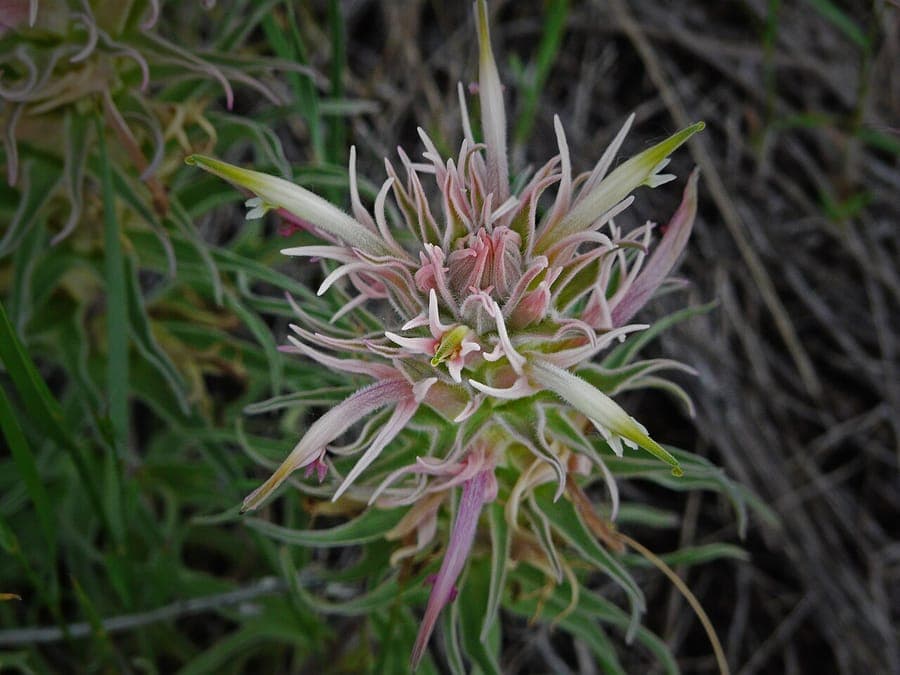
photogramma1 / CC BY-SA 2.0, via Wikimedia Commons
Downy paintbrush: complete guide
Castilleja sessiliflora
Want to see Downy paintbrush: complete guide in your garden?
1 minute, no credit card
Overview
Castilleja sessiliflora, known in English as the downy paintbrush, Great Plains Indian paintbrush, or downy painted-cup, is a semi-parasitic perennial in the family Orobanchaceae. Its native range is vast, stretching from Alberta and Saskatchewan in Canada through the Great Plains of the United States - from Minnesota and Wisconsin in the north to Texas and Oklahoma in the south - and continuing south into Mexico as far as Jalisco. The species name sessiliflora describes the sessile flowers, which are attached directly to the stem without individual stalks.
Unlike the fiery red and orange of many paintbrush species, Castilleja sessiliflora stands apart with its pale yellow to cream-white bracts, sometimes with subtle lavender or pink tints. This more muted colouration makes it less showy than some relatives but more nuanced and beautiful in naturalistic settings. The soft, downy hair covering stems and leaves - the feature that gives the plant its common name - adds a tactile, velvety quality that suits its gentle colour palette.
As a hemiparasite, downy paintbrush taps the roots of neighbouring grasses and perennials to obtain water and nutrients. Planting with suitable host plants is essential for long-term success. Ecologically, it supports specialist bee species and various butterfly caterpillars that feed on Orobanchaceae.
At gardenworld.app you can find inspiration for prairie-style and steppe planting designs that incorporate drought-tolerant wildflowers like Castilleja sessiliflora.
A botanical form worthy of special mention is Castilleja sessiliflora f. purpurina, in which the bracts take on a more pronounced purple tone, making it even more distinctive. It was previously known under the synonyms Euchroma grandiflora and Bartsia grandiflora, as well as the later synonym Castilleja grandiflora.
Appearance & bloom cycle
Downy paintbrush grows as an erect, semi-woody perennial of 15 to 45 cm in height. The stems are usually single or branched at the base, upright to slightly arching, and densely covered with fine, soft white hairs - the 'downy' quality that names it. The leaves are narrow to linear, 2 to 6 cm long, greyish-green, also hairy, and stalkless. The foliage is notably coarser in texture than the delicate appearance of the flower bracts would suggest.
The showy structures are the bracts - modified leaves that surround the true flowers in a dense spike. In downy paintbrush, these bracts are pale yellow, cream, or sometimes faintly lavender-tinged, with deeply lobed tips that give them a fingered appearance. The true flowers are 3 to 4 cm long, tubular, cream to pale yellow, occasionally with purple spotting. While subtler than the scarlet of other paintbrushes, the combination of downy foliage, yellow-cream bracts, and airy prairie grasses is undeniably beautiful.
Bloom time runs from April through June at lower elevations; in higher prairie and steppe habitats, flowering continues into August. Flowers contain nectar and are pollinated by long-tongued bumblebees, various butterfly species, and hawk moths. The Orobanchaceae family is a larval food source for several checkerspot butterfly species. After pollination, small oval seed capsules form and split at maturity.
Ideal location
In nature, downy paintbrush occupies open grasslands, dry hillsides, sandy plains, and rocky bluffs - always in full sun. The Great Plains climate it comes from is characterised by extreme conditions: blazing summers, bitter winters, and moderate, often erratic rainfall. It consistently avoids shaded or sheltered spots, and in cultivation mirrors this preference strongly.
For garden use, choose a position in full sun with excellent drainage - rock gardens, dry prairie borders, gravel gardens, and naturalistic steppe beds are all suitable. Avoid rich, moist, well-composted border soil: too much fertility produces rank leafy growth and minimal flowering. On heavy clay, construct a raised bed at least 25 to 30 cm high using a lean mix of topsoil, coarse grit, and crushed limestone grit.
As a hemiparasite, downy paintbrush must have suitable host plants within 15 to 30 cm. Prairie grasses such as Bouteloua curtipendula, Andropogon gerardii, and Schizachyrium scoparium are excellent hosts. Without hosts the plant persists for a time but declines; with strong hosts it can thrive for many years.
Soil requirements
Downy paintbrush prefers lean, light to sandy loam soils with good drainage and a pH of 6.0 to 7.4. Native Great Plains soils tend toward neutral to slightly alkaline, low organic matter, and calcareous in many locations. Rich, nitrogen-heavy garden soil encourages excessive foliage and reduces both flowering and the plant's incentive to parasitise hosts.
Prepare the planting site by working coarse horticultural grit (4–8 mm particle size) into the top 20 cm, aiming for a final mix that drains rapidly but retains a little moisture. If the subsoil is heavy clay, install a drainage layer or build a raised bed 25 to 30 cm deep. Avoid fresh compost at planting time; a small amount of well-rotted leaf mould mixed into the grit-soil blend is acceptable. If soil pH is below 6.0, incorporate limestone grit to raise it toward the optimal range.
Free design
Want to see Downy paintbrush: complete guide in your garden? Make a free design now.
Watering
Castilleja sessiliflora is well adapted to the semi-arid conditions of the Great Plains, where rainfall can be unreliable and extended droughts are common. In its home environment it may experience weeks without rain during summer months and cold, dry winters with little snow cover. Once established in garden conditions, it is genuinely drought tolerant.
During the first growing season, water young plants weekly whenever rainfall falls below 25 mm per week. This allows root development and establishment of parasite connections with host plants - both essential for the plant's long-term health. Water at the base of the plant; the downy foliage traps moisture and is prone to fungal infections, particularly Botrytis and powdery mildew, if regularly wetted. Drip irrigation or careful hand watering works well.
From the second year, supplemental watering is needed only during prolonged drought - more than 10 to 14 dry days during the growing season. In autumn and winter, additional watering is rarely necessary and can be harmful. Wet roots in cold conditions are the primary cause of winter losses; ensure drainage is impeccable rather than compensating with reduced watering alone.
Pruning
Light deadheading after the first bloom flush can stimulate side shoots and a second flowering period later in summer. Cut spent flower stems back by about one-third to a leaf axil using clean, sharp scissors. This is beneficial but not essential - the plant flowers reasonably well without intervention.
In late autumn or early spring, cut all dead stems back to ground level. This improves air circulation around the crown, reduces fungal risk, and gives the plant a clean start in spring. Leave some seed heads if self-seeding is desired - seeds of Castilleja sessiliflora germinate well in open, sandy or gritty soil in the presence of compatible host grasses. Avoid pruning after September, as this removes insulating stem material needed for winter survival.
Maintenance calendar
January – February: Full dormancy. No supplemental water. Check host grasses for winter health. Watch for slug activity when mild spells occur.
March: Remove previous year's dead stems. Ensure the crown is dry and firm. Apply a thin mulch of coarse grit around the stem base.
April: New shoots emerging. Water young plants in dry spells. First bracts beginning to colour.
May – June: Peak bloom at lower elevations. Water every 10 days during extended dry weather. Light deadheading after first flowering flush. Watch for aphids on new growth.
July – August: Continued flowering in higher or cooler sites; possible second flush elsewhere. Monitor for spider mite. Allow some seed heads to ripen if self-seeding is wanted.
September: Reduce watering to minimal. Decide which seed stalks to retain or remove.
October – November: Cut back dead stems. Assess host plant condition.
December: Dormancy. Minimal care.
Winter hardiness
Castilleja sessiliflora is cold-hardy in USDA zones 4 to 9, tolerating minimum temperatures from -34 °C to -3 °C. In its Great Plains heartland it routinely survives brutal continental winters with thin or absent snow cover. In the Netherlands, Belgium, and the UK (USDA zones 7 to 8), it overwinters reliably in a well-drained position without special protection.
The primary winter risk is wet cold rather than dry cold: waterlogged roots at freezing temperatures rot rapidly. Excellent drainage is the single most effective measure against winter loss. A mulch of coarse gravel around the root crown helps shed water and moderate temperature fluctuations. In the first winter after planting, a light covering of dry bracken or straw provides additional insurance while the root system establishes.
Established plants - typically from the second year onward - are robustly self-sufficient through northern European winters. At gardenworld.app you can explore plant hardiness zone maps and find the right drought-tolerant species for your specific garden location.
Companion plants
For a convincing and ecologically coherent planting with downy paintbrush, choose partners that function as both host plants and garden companions:
- Bouteloua curtipendula (side-oats grama): elegant arching prairie grass, excellent host, quintessential Great Plains companion
- Andropogon gerardii (big bluestem): tall, dramatic warm-season grass, reliable host in dry, sunny positions
- Schizachyrium scoparium (little bluestem): blue-grey in summer, fiery copper-red in autumn, good host for lower-growing paintbrush plants
- Penstemon grandiflorus: large, showy tubular flowers, same site requirements, overlapping pollinator base
- Liatris spicata (dense blazing star): purple bottle-brush spikes complement the creamy yellow bracts beautifully
- Ratibida columnifera (Mexican hat): bold yellow and dark-red flowers for strong visual contrast in a prairie border
Conclusion
Downy paintbrush is a refined, quiet beauty among prairie plants. Its pale yellow bracts and downy texture offer something genuinely different from the flashy reds of other Castilleja species - a subtlety that works particularly well in naturalistic borders, gravel gardens, and prairie beds where the emphasis is on texture and seasonal evolution rather than constant colour. Combined with the right host grasses, a position in full sun, and lean, fast-draining soil, it rewards patience with years of reliable flowering and contributes meaningfully to the ecological web of the garden.
Want to see Downy paintbrush: complete guide in your garden? Make a free design now.
Upload a photo, pick a style, and get a photorealistic design with plant list in under a minute.
10,000+ gardens designed already
No credit card required


Similar plants
Northwestern Indian paintbrush: complete guide
Castilleja angustifolia
All about Castilleja angustifolia, the northwestern Indian paintbrush from dry western US steppes. Growing, care, and companion plant advice.
Wavyleaf Indian paintbrush: complete guide
Castilleja applegatei
Everything about Castilleja applegatei, the wavyleaf paintbrush from Oregon and California. Host plants, care, location, and garden use covered.
Bushy bird's-beak: complete guide
Cordylanthus ramosus
Complete guide to Cordylanthus ramosus, the hemiparasitic annual of western US steppes: ecology, host plants, cultivation and uses.