
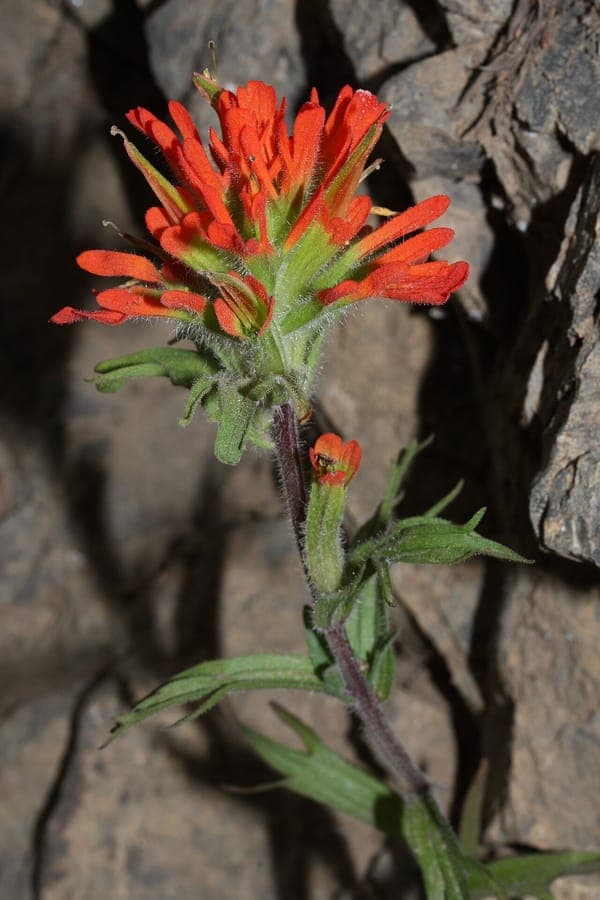
Walter Siegmund (talk) / CC BY-SA 3.0, via Wikimedia Commons
Bristly paintbrush: complete guide
Castilleja hispida
Want to see Bristly paintbrush: complete guide in your garden?
1 minute, no credit card
Overview
Castilleja hispida, commonly called the bristly paintbrush or harsh paintbrush, is a striking semi-parasitic perennial in the family Orobanchaceae. Native to the Pacific Northwest of North America - from Alberta and British Columbia in Canada south through Idaho, Montana, Oregon, and Washington - it draws the eye with its vivid scarlet to orange-red floral bracts that look exactly like the tip of a freshly dipped paintbrush. The species name hispida, from the Latin for rough or bristly, refers to the stiff hairs densely clothing its stems and leaves.
As a hemiparasite, bristly paintbrush connects its roots to those of neighbouring grasses and perennials, tapping into their water and nutrient supply. This makes it a botanically fascinating plant and, in practice, means it thrives best when planted alongside suitable host plants. In gardens and naturalistic plantings across Europe and North America, it works superbly with native grasses, Penstemon species, and other prairie companions.
For gardeners seeking wildlife-friendly planting, bristly paintbrush is a key species: it attracts hummingbirds where they occur, and is eagerly visited by long-tongued bumblebees and specialist native bees. At gardenworld.app you can explore how to incorporate wildflowers like Castilleja hispida into naturalistic, prairie-inspired garden designs.
The genus Castilleja is taxonomically complex, with over 200 species and many subspecies; Castilleja hispida has in the past been classified as Castilleja angustifolia var. hispida and Castilleja angustifolia subsp. hispida. Its correct current name, accepted by the World Flora Online, is Castilleja hispida Benth.
Appearance & bloom cycle
Bristly paintbrush grows as an erect, semi-woody perennial reaching 20 to 60 cm in height. The stems are stout and upright, densely covered in stiff, spreading hairs that give the plant its name. The leaves are oblong to lanceolate, 3 to 8 cm long, greyish-green, similarly hairy, and stalkless - they clasp the stem. Multiple stems often arise from a single root crown, giving established plants a pleasingly bushy habit.
What appears to be flowers are in fact brightly coloured bracts - modified leaves - that surround the inconspicuous, tubular true flowers. These bracts are scarlet, orange-red, or occasionally yellow-orange, giving the inflorescence its distinctive paintbrush appearance. Bloom time extends from April through August, depending on altitude and aspect. At lower elevations expect peak colour in May and June; in subalpine meadows, flowering peaks in July and August. The true flowers themselves are small, greenish-yellow tubes largely hidden behind the showy bracts.
Pollinators are drawn primarily by the nectar-rich flowers. Hummingbirds are the most important pollinators in native range, their long bills perfectly matching the tube length. Long-tongued bumblebees, including Bombus mixtus and Bombus melanopygus, also visit frequently. After pollination, small seed capsules form and split at maturity to release wind-dispersed seeds. Allowing some capsules to ripen encourages natural self-seeding in suitable sandy or gritty soil.
Ideal location
In its natural habitat, bristly paintbrush occupies open hillsides, mountain meadows, woodland margins, and dry to moist rocky slopes. It consistently chooses sites with full sun to partial shade, on lean, well-drained soils. Too much shade causes lax, poorly flowering growth. An open, airy position is essential.
In garden settings, it performs best in full sun with sharp drainage - a rock garden, dry prairie border, or naturalistic meadow bed are ideal environments. Avoid heavy clay soils or sites prone to winter waterlogging. A gentle slope or raised bed with rapid drainage is preferable. On flat sites, work in generous quantities of coarse grit to 25 cm depth before planting.
Because of its hemiparasitic lifestyle, planting with suitable host grasses and perennials is critical for long-term success. Festuca, Bouteloua, and Penstemon species are known hosts in the wild. Space paintbrush plants 15 to 30 cm from at least two or three host plants. Without hosts the plant survives but performs poorly - sparse growth and minimal flowering are typical.
Soil requirements
Bristly paintbrush prefers lean, fast-draining, slightly acid to neutral soil with a pH of 6.0 to 8.0. In its native range soils are typically sandy loam, rocky, or silty, and low in organic matter. Rich, well-composted border soil produces lush leafy growth at the expense of flowers and makes the plant more susceptible to fungal diseases.
When preparing a planting bed, incorporate generous amounts of coarse grit (8–12 mm particle size) through the top 20 cm to improve drainage. On heavy clay, build a raised bed at least 25 cm high using a mix of topsoil, grit, and a small amount of leaf mould - no more than 20% by volume. Adding a handful of lime grit to acid soils helps maintain pH in the optimal range. Avoid high-nitrogen fertilisers entirely; if any feed is given, use a low-nutrient, high-phosphate bulb fertiliser in spring at half the recommended rate.
Free design
Want to see Bristly paintbrush: complete guide in your garden? Make a free design now.
Watering
Once established, bristly paintbrush is moderately drought tolerant, adapted to the Pacific Northwest climate of wet winters and relatively dry summers. Young plants in their first growing season need regular watering to establish a root system and make contact with nearby hosts - water weekly if rainfall is below 25 mm per week.
In subsequent years, water during extended dry spells when soil remains dry for more than 7 to 10 consecutive days. Direct water to the root zone and avoid wetting the bristly foliage - moisture trapped in the stiff hairs can encourage Botrytis and powdery mildew. Drip irrigation or carefully placed soaker hoses work well. In autumn and winter, supplemental watering is rarely needed in northern European conditions.
Overwatering, particularly in winter, is the single most common cause of failure. Waterlogged roots in cold conditions rot rapidly. Ensure drainage is truly excellent before planting rather than correcting a waterlogging problem afterwards.
Pruning
Bristly paintbrush benefits from light deadheading after the first flush of bloom. Cut spent stems back by about one-third to a leaf axil - this encourages side shoots and often produces a second, less profuse but still colourful flowering in late summer. Use clean, sharp scissors or secateurs rather than tearing, as the bristly stems can harbour bacteria at wound sites.
In late autumn or early spring, cut all dead stems back to ground level. This improves air circulation and reduces fungal disease risk going into or coming out of winter. Leave a few seed heads if natural self-seeding is welcome - seeds disperse readily in gritty, open soil. Avoid hard pruning late in the season, as this removes stored energy reserves the plant needs for winter survival and spring re-growth.
Maintenance calendar
January – February: Plant dormant. No supplemental water needed unless conditions are unusually dry. Check for slug damage on emerging early buds.
March: Remove dead stems from the previous year. Check host plants for healthy growth. Apply a thin layer of coarse grit around stem bases to suppress weeds and improve drainage.
April: Re-growth underway. Water if the spring is dry. First bracts beginning to colour.
May – June: Peak bloom at lower elevations. Water weekly in dry spells. Deadhead spent flower spikes to encourage reblooming. Watch for aphids on new growth.
July – August: Flowering continues at higher elevations or in cooler seasons. Monitor for spider mite. Allow some seed heads to develop if self-seeding is desired.
September: Reduce watering. Decide which seed stalks to leave and which to remove.
October – November: Cut back dead stems. Assess host plant vitality.
December: Dormancy. Minimal maintenance.
Winter hardiness
Castilleja hispida is fully cold-hardy in USDA zones 4 to 8, tolerating minimum temperatures from -34 °C down to -12 °C. In the Netherlands, Belgium, and the UK (mostly USDA zone 7 to 8), the plant overwinters reliably without protection in a well-drained position. Prolonged wet cold is more damaging than dry cold - a wet winter with standing water around the roots causes far more losses than a hard, dry frost.
A mulch of coarse gravel around the stem base during winter helps shed moisture and moderates temperature fluctuations. In the first winter after planting, a light covering of dry bracken or straw provides insurance while roots establish. Established plants generally need no winter protection beyond the drainage measures already described. Remove any winter mulch in early March to allow the crown to dry out and warm up before growth resumes.
Companion plants
As a hemiparasite, bristly paintbrush needs hosts - and these double as attractive garden companions. The best pairings are:
- Festuca glauca (blue fescue): compact blue-grey tufts, excellent host, beautiful textural contrast
- Penstemon digitalis or Penstemon strictus: tubular flowers attracting the same pollinators, similar site requirements
- Gaillardia aristata (blanket flower): sunny yellow-orange flowers, same open dry conditions
- Bouteloua gracilis (blue grama grass): fine-textured native grass, reliable host in dry sites
- Echinacea purpurea (purple coneflower): blooms just after the paintbrush peak, extends wildlife interest
- Salvia nemorosa (woodland sage): deep violet spikes contrast beautifully with scarlet bracts
For more inspiration on designing prairie-style and wildflower plantings, visit gardenworld.app.
Conclusion
Bristly paintbrush is not a plant for gardeners who want effortless success in rich, fertile borders. It asks for lean soil, good drainage, compatible host plants, and a site in full sun. Provide these conditions and it rewards with some of the most vivid, unusual colour of any perennial - that unmistakeable scarlet paintbrush effect that stops visitors in their tracks and sparks botanical curiosity. As wildlife habitat, few perennials deliver more per square centimetre for bees and specialist pollinators. In a naturalistic border, prairie bed, or rock garden, Castilleja hispida is a plant that earns its place every year.
Want to see Bristly paintbrush: complete guide in your garden? Make a free design now.
Upload a photo, pick a style, and get a photorealistic design with plant list in under a minute.
10,000+ gardens designed already
No credit card required


Similar plants
Northwestern Indian paintbrush: complete guide
Castilleja angustifolia
All about Castilleja angustifolia, the northwestern Indian paintbrush from dry western US steppes. Growing, care, and companion plant advice.
Wavyleaf Indian paintbrush: complete guide
Castilleja applegatei
Everything about Castilleja applegatei, the wavyleaf paintbrush from Oregon and California. Host plants, care, location, and garden use covered.
Bushy bird's-beak: complete guide
Cordylanthus ramosus
Complete guide to Cordylanthus ramosus, the hemiparasitic annual of western US steppes: ecology, host plants, cultivation and uses.