
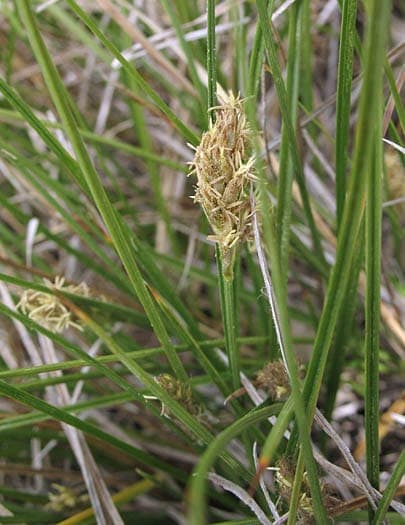
Anthony Valois and the National Park Service / Public domain, via Wikimedia Commons
Clustered field sedge: complete guide
Carex praegracilis
Want to see Clustered field sedge: complete guide in your garden?
1 minute, no credit card
Overview
Clustered field sedge (Carex praegracilis) is one of North America's most adaptable and widely distributed sedge species. Its native range stretches from Alaska and the Yukon in the far north all the way south to Guatemala, encompassing a remarkable diversity of climates, from cold boreal forests to semi-arid grasslands and mountain meadows. Described by botanist W. Boott in 1884, the species goes by several colourful common names - freeway sedge, expressway sedge, black creeper sedge, graceful sedge - that hint at its standout quality: a toughness and adaptability that makes it thrive in situations where most ornamental plants fail. Visit gardenworld.app to see how this sedge can be incorporated into a low-maintenance garden design.
For gardeners in the UK and Europe, clustered field sedge has emerged as an increasingly popular choice for lawn alternatives, low-maintenance ground cover, and dry-shade planting under trees. Unlike most sedge species that demand constant moisture, Carex praegracilis is notably drought-tolerant once established, broadening the range of situations where a sedge-based planting becomes practical. Its rhizomatous growth habit means it gradually fills in, creating a dense, weed-suppressing carpet without becoming aggressively invasive.
Appearance and bloom cycle
Clustered field sedge is a graminoid perennial - a plant that looks like a grass but is botanically distinct. The foliage is medium in texture, with narrow, upright to slightly arching blades typically 20 to 50 cm long. The leaf colour ranges from bright green to deeper green, remaining fresh and attractive throughout the growing season. Individual clumps have a tidy, compact habit when young, gradually spreading via rhizomes to form broader colonies.
Flowering occurs early in the season - as early as March in mild climates, as late as May in colder areas. The flower spikes are green and inconspicuous, rising just above the foliage. Brown fruits follow in early summer. As with most sedges, the ornamental value of clustered field sedge lies primarily in its foliage rather than its blooms; the steady, carpet-forming growth habit is the real asset.
The moderate growth rate - neither as fast as some aggressive ground covers nor as slow as many compact ornamentals - means that a planting of Carex praegracilis at 30 to 45 cm spacing will knit together into a reasonably dense cover within a single growing season. The rhizomes spread evenly and predictably, making the plant manageable even in smaller garden spaces.
Ideal location
One of clustered field sedge's standout qualities is its exceptional adaptability to different light conditions. It performs well in:
- Full sun: produces the most upright, compact growth in open, sunny positions.
- Partial shade: equally good under open tree canopies where light is dappled.
- Deep shade: one of the few sedges that genuinely tolerates the dry shade beneath dense evergreens.
For moisture, it prefers a moderate, well-drained to slightly moist soil, but is notably more drought-tolerant than most sedge relatives. It has earned its freeway sedge nickname precisely because it thrives in the difficult, compacted, drought-prone soils of roadsides and urban verges. Avoid permanently waterlogged conditions; for those situations, Carex obnupta or similar wetland sedges are better choices.
Soil
Clustered field sedge is extremely tolerant of soil types. Its wide native range - from coastal California to the Great Plains and the Canadian boreal zone - has given it the ability to cope with everything from heavy clay to sandy loam. The pH range of 5.3 to 6.8 places it firmly in the moderately acidic to near-neutral bracket preferred by most ornamental perennials.
Soil types it handles well include:
- Heavy clay: it copes with periodic waterlogging and compaction far better than most fine ornamentals.
- Loam: the preferred soil type for the best combination of growth rate and foliage quality.
- Sandy soils: tolerated, though irrigation may be needed during establishment and in dry summers.
- Compacted urban soils: this is where the freeway sedge epithet really earns its keep.
Amend with compost at planting time to accelerate establishment, but do not over-fertilise; rich soils produce lax, open growth that is less attractive than compact, well-structured clumps grown in leaner conditions.
Free design
Want to see Clustered field sedge: complete guide in your garden? Make a free design now.
Watering
Watering requirements are modest compared to most other sedge species. During establishment - the first growing season - water generously and regularly, at least once a week with a deep soaking, to encourage the root system to develop and spread. Once established, the plant is largely self-sufficient in the UK and Belgium's climate:
- Established plants: in a normal year with average rainfall, no supplemental irrigation is needed.
- Dry summers: water every two weeks with a generous soaking to maintain appearance.
- Lawn-replacement use: some browning of leaf tips may occur in extreme drought, but the plant recovers fully once moisture returns.
The drought tolerance of this species makes it particularly well suited to water-wise garden designs and situations where irrigation infrastructure is absent. For gardeners looking to reduce water use without sacrificing greenery, clustered field sedge is one of the best performers available. On gardenworld.app, you can design a low-irrigation garden that uses this sedge as a structural ground layer.
Pruning
Clustered field sedge requires minimal pruning. The main options are:
- Annual cut-back: cut the entire planting back to 5-10 cm in late February or early March before new growth begins. This is the most effective way to keep the carpet looking fresh and prevents thatch build-up.
- Infrequent mowing: when used as a lawn alternative, mow two to three times per year at the highest setting (7-8 cm). This sedge tolerates mowing better than most, making it genuinely practical as a grass substitute.
- Edge trimming: use a half-moon edger or lawn edger to keep the planting within defined borders; the rhizomes will slowly creep into adjacent areas if unchecked.
- Division: divide every three to four years in early spring to maintain vigour and control the spread.
Maintenance calendar
- January - February: plant is dormant; no action required.
- February - March: cut back to 5-10 cm; excellent time for new plantings.
- March - April: new growth emerges; green flower spikes appear.
- May - June: peak growth; no special care needed.
- July - August: active growth continues; water in dry spells.
- September - October: growth slows; tidy edges if needed.
- November - December: plant enters dormancy; no winter protection needed.
Winter hardiness
Clustered field sedge is one of the hardiest sedge species available. Its native range includes Alaska, the Yukon and the Canadian prairies - regions with extremely cold winters - giving it outstanding cold tolerance. It is rated for USDA zones 3 through 9, meaning it survives minimum temperatures of around -40 degrees Celsius. This extreme hardiness means the plant is utterly reliable in the UK, northern Europe and even the colder parts of central and eastern Europe.
In colder zones, the foliage may go partially brown in hard winters, but the rhizomes and growing points survive and produce strong new growth in spring. No winter protection is needed in any typical temperate garden situation. The plant handles frozen soil, freeze-thaw cycles and winter drought all without lasting damage.
Companion plants
Clustered field sedge pairs well with a range of perennials and ornamental plants:
- Echinacea purpurea (purple coneflower): tall, daisy-like purple flowers rise above the sedge carpet in summer, creating vivid contrast.
- Festuca glauca (blue fescue): the silvery-blue tufts of fescue create striking colour contrast in sunny, dry borders.
- Geranium macrorrhizum (bigroot geranium): excellent companion in dry shade situations, with fragrant foliage and pink flowers.
- Achillea millefolium (yarrow): tough, drought-tolerant, and colourful - ideal alongside Carex praegracilis in sunny, low-water borders.
- Salvia nemorosa (wood sage): upright purple spikes above the sedge base make an elegant, structured planting.
For a lawn alternative, clustered field sedge can be planted as a monoculture at 30 cm spacing, left to fill in, and maintained with two or three mowings per year. It is also effective mixed with other low, tough ground covers for a more naturalistic effect. Visit gardenworld.app for tailored planting combinations that match your specific garden conditions.
Closing
Clustered field sedge (Carex praegracilis) is a plant that delivers exceptional value through adaptability and resilience. Whether used as a lawn alternative, dry-shade ground cover, erosion-stabilising bank planting, or structured border filler, it outperforms many more frequently marketed options in terms of durability and low maintenance. Available from specialist sedge and grass nurseries and good garden centres throughout the UK, it is a worthy addition to any garden where ease of maintenance and ecological value are priorities. Once established, it asks for very little and gives back a reliable, attractive green surface season after season.
Want to see Clustered field sedge: complete guide in your garden? Make a free design now.
Upload a photo, pick a style, and get a photorealistic design with plant list in under a minute.
10,000+ gardens designed already
No credit card required


Similar plants
Slough sedge: complete guide
Carex obnupta
Everything you need to know about slough sedge (Carex obnupta): location, soil, watering, care and hardiness for your garden.
Calamagrostis canadensis: complete guide
Calamagrostis canadensis
Discover Canada bluejoint, an elegant ornamental grass with upright growth, ideal for moisture-rich zones, wetlands and water margins that create naturally authentic landscapes.
Narrow small-reed: complete guide
Calamagrostis stricta
Everything you need to know about Calamagrostis stricta: growth, care, ideal spots, and companion plants. A resilient grass for moist gardens, 60–120 cm tall.