
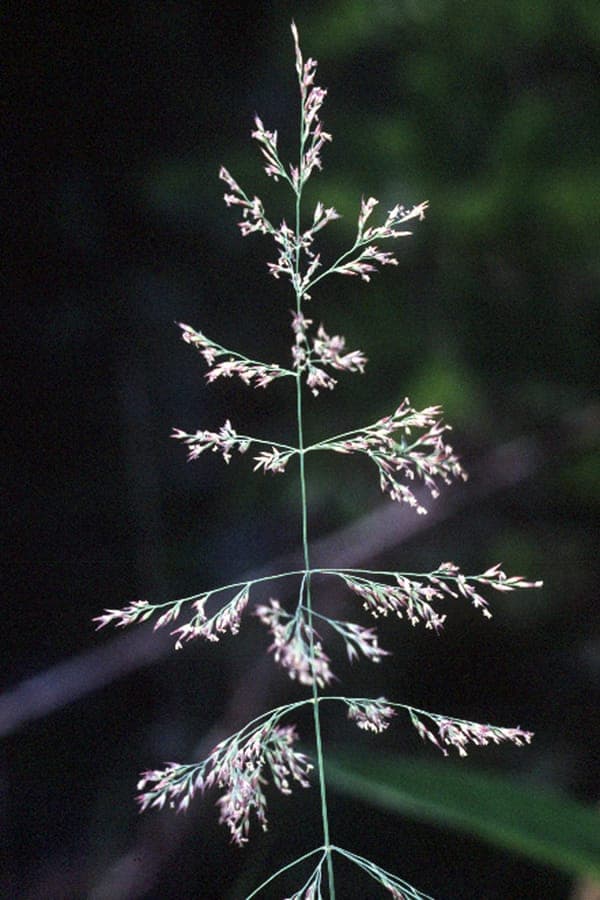
Robert H. Mohlenbrock @ USDA-NRCS PLANTS Database / USDA SCS. 1989. Midwest wetland flora: Field office illustrated guide to plant species. Midwest National Technical Center, Lincoln, NE. / Public domain, via Wikimedia Commons
Calamagrostis canadensis: complete guide
Calamagrostis canadensis
Want to see Calamagrostis canadensis: complete guide in your garden?
1 minute, no credit card
Overview
Calamagrostis canadensis, commonly known as Canada bluejoint or Canada reed grass, is an elegant ornamental grass native throughout North America from subarctic regions to the United States. This remarkable grass creates vertical, almost sculptural forms with graceful, feathery appearance.
This plant represents an excellent choice for gardeners establishing naturally-looking wetland landscapes. With its strong, upright growth habit and golden autumn coloration, Calamagrostis canadensis transforms moist garden corners into authentic North American marshland vignettes. This is a grass that offers ecological value while remaining clean and graceful.
Appearance and Growth
Calamagrostis canadensis distinguishes itself through strong, upright growth and delicate, silken flower plumes. The plant develops dense, vertical bundles of narrow green leaves that remain green throughout the growing season. Individual stems reach 60-150 cm in height, typically around 80-120 cm.
Flowers appear June through August as delicate, beige to silver-gold plumes at stem tips. These plumes are feathery and remain attractive throughout summer and autumn, adding multiple dimensions to the grass. In autumn, foliage and plumes assume golden to bronze tones.
Following flowering, small, fine seeds develop and disperse in autumn wind. This self-seeding can lead to prolific seedling production if left unmanaged.
Ideal Location
Calamagrostis canadensis performs best in sunny to semi-shaded locations receiving at least 4 hours of direct sunlight daily. The plant tolerates full shade but flowers far more abundantly in full sun. The location must remain consistently moist.
The plant naturally inhabits marshes, water margins, wet meadows and reed wetlands. It can also grow in shallow water zones to approximately 15 cm deep. The ideal habitat places the plant in permanently moist zones or along water margins.
Soil
Calamagrostis canadensis accepts nearly any soil provided moisture is maintained consistently. The plant grows in heavy clay soils, sand and everything between. The species prefers neutral to slightly acidic pH but remains quite tolerant.
The plant can also grow directly in water in shallow water zones. In such situations, no traditional soil develops but roots penetrate directly into silt or sand. Organic matter is useful but not strictly necessary.
Watering
Calamagrostis canadensis demands permanently moist conditions. This is not a plant for normal dry garden soils. The plant requires wet, waterlogged habitats and will perish in dry conditions.
When planted in a moist zone or along water, the plant is essentially self-sustaining. When grown in drier climates, regular supplemental watering becomes necessary. The plant's root zone must never dry out.
Free design
Want to see Calamagrostis canadensis: complete guide in your garden? Make a free design now.
Pruning
Calamagrostis canadensis requires minimal pruning. The plant grows in controlled, upright clusters that rarely become unkempt. Your only pruning task involves removing dead growth in late autumn.
In early spring, all dead stems can be completely removed to ground level, making space for fresh growth. Some gardeners burn the grass in early spring to remove aged growth efficiently.
Maintenance Calendar
Spring: Remove all dead stems. Begin regular watering as growing season commences. Monitor for new shoots. Summer: Ensure continuous moisture. The grass flowers now. Check water quality. Autumn: Enjoy golden and bronze coloration. Gradually reduce watering but maintain moist conditions. Winter: Minimal care required. The plant enters dormancy.
Winter Hardiness
Calamagrostis canadensis is exceptionally hardy, tolerating temperatures well below -30°C. The plant's natural range throughout North America indicates excellent cold tolerance and seasonal adaptability.
In most climates, the plant overwinters outdoors without special protection. The plant enters dormancy in late autumn, resuming growth in early spring. In extremely cold zones, keeping the plant slightly drier during winter may be beneficial.
Companion Plants
Calamagrostis canadensis combines excellently with other moisture-loving plants such as common reed (Phragmites), cattails (Typha) and other wetland sedges. These combinations create authentic marshland landscapes.
It also pairs well with moisture-loving flowering plants such as purple coneflower (Echinacea) and swamp milkweed (Asclepias). This creates a natural, grassland-like garden composition.
Closing Thoughts
Calamagrostis canadensis represents an outstanding choice for gardeners establishing or enhancing wetland features. With its strong growth, minimal maintenance requirements, and preference for moist conditions, it offers tremendous design flexibility. This is a grass that asks little but contributes substantially to natural garden beauty.
On gardenworld.app, you can integrate this ornamental grass into your front yard design, particularly if you feature a water element. The grass adds structural interest and movement to water features while helping establish authentic wetland habitats. Discover the rewards of this distinctive grass and create ecologically responsible gardens.
For UK and European sourcing: Check ornamental grass specialists. With gardenworld.app's design tools, visualize how this grass enhances your wetland garden concept. Ornamental grasses combine beauty with ecological responsibility.
Want to see Calamagrostis canadensis: complete guide in your garden? Make a free design now.
Upload a photo, pick a style, and get a photorealistic design with plant list in under a minute.
No credit card required


Similar plants
Sporobolus pungens: complete guide
Sporobolus pungens
Sporobolus pungens is a stoloniferous Mediterranean coastal grass with outstanding salt and drought tolerance, perfect for seaside and dry gardens.
Mediterranean aegilops: complete guide
Aegilops biuncialis
Everything about Aegilops biuncialis, a Mediterranean annual grass with ornamental spikes and outstanding drought tolerance for dry gardens.
Silver bluestem: complete guide
Bothriochloa saccharoides
Full guide to Bothriochloa saccharoides (silver bluestem): site, soil, watering, winter hardiness, pruning, and garden companions.