
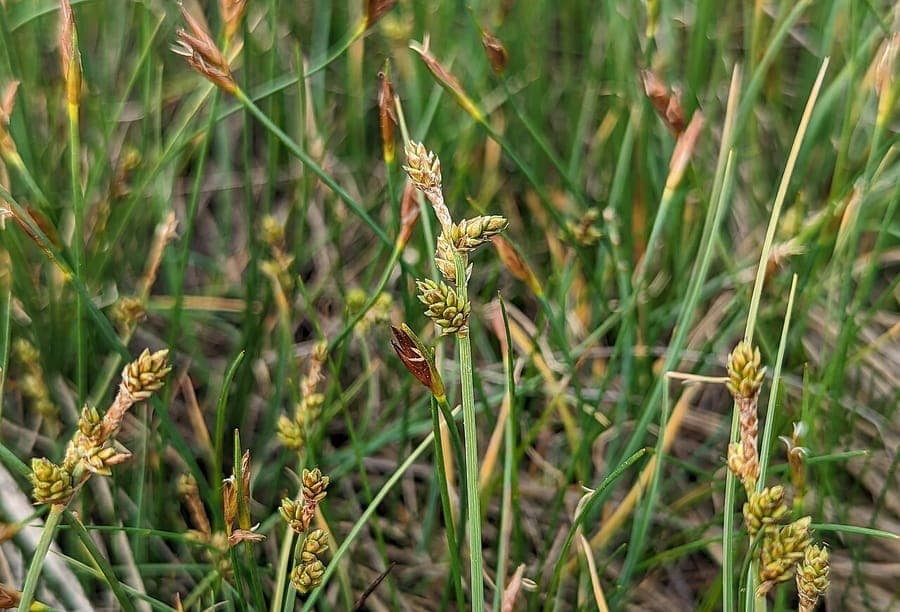
agbelliveau / CC0, via Wikimedia Commons
Carex mackenziei: complete guide
Carex mackenziei
Want to see Carex mackenziei: complete guide in your garden?
1 minute, no credit card
Mackenzie's sedge (Carex mackenziei) is an excellent choice for cool-climate gardens with wet or boggy soils. This clump-forming sedge reaches about 15-20 cm tall and originates from North America to Japan. It is a reliable cover plant that tolerates many conditions but thrives best in shaded, moist environments.
This sedge distinguishes itself through fine, light-green foliage that remains attractive throughout the season. Unlike many grasses that brown in August, Carex mackenziei retains a fresh color well into autumn. The plant is fully hardy to USDA zone 2, meaning it easily survives Dutch winters.
While many sedges are difficult growers, Carex mackenziei is forgiving and adaptable. It grows slowly but steadily, requiring patience but minimal maintenance. This makes it ideal for natural gardens where you let nature take its course without constant intervention.
Appearance and Bloom
Mackenzie's sedge grows as a compact clump with slender, fine foliage forming a soft, green palette. The plant reaches 15-25 cm tall and spreads slowly through underground rhizomes. From June to August, inconspicuous, brownish spikes appear above the leaf mass.
The flower spike is discreet yet elegant: small, upright spikelets that barely stand out but are important for seed production. To retain seed, you can let the spikes ripen and dry, but usually you only do this if you want to harvest seeds yourself.
The foliage feels soft to the touch (much more than other sedges with rough edges) and ripples pleasantly in the breeze. This texture imparts a natural, wild-growth appearance to moisture zones.
Ideal Location
Choose a spot with at least partial shade for Carex mackenziei. Full sun is unsuitable - the plant can desiccate or burn in bright sun, especially in warm summers. Shaded woodland edges, beneath shrubs, or northwest-facing garden corners are ideal.
The plant flourishes in boggy or permanently wet soils. Use it around ponds, in wet borders, or in low-lying corners where water collects. In moderate wet conditions it grows best, though it can tolerate brief dry spells once established.
Of all location factors, shade is most critical. Even in northern Netherlands where summers are cool, excessive sun can cause the plant to shrivel or yellow.
Soil
Carex mackenziei thrives in acidic to neutral soils with pH 5.5 to 6.5. Compared to many garden plants, it is not demanding, but heavily compacted clays with poor drainage are unsuitable. The plant loves moisture-retaining soil that does not dry out.
Add generous compost or peat when planting to improve moisture retention. This is especially important in sandy or lighter soils where moisture disappears quickly. A 5-8 cm layer of composted leaves or peat moss around the plant helps retain moisture.
The plant has low nutrient requirements. A single application of organic material when planting is usually sufficient. You do not need to feed annually.
Free design
Want to see Carex mackenziei: complete guide in your garden? Make a free design now.
Watering
Mackenzie's sedge is moisture-loving and requires regular water, especially during the growing season (April through October). Water when the top 2-3 cm of soil feels dry. Prolonged dryness causes plant death.
In climates with regular rainfall (like the Netherlands) you need not water outside very dry periods. But in warm, dry summers (like 2022-2023) you must check weekly and supplement.
From March through October, consistently moist is better than wet. Fungal issues or root problems arise sooner in stagnant water than in moisture variation. Ensure good drainage of rainwater without creating 'sealed' soil.
In winter, as the plant rests, you can water much less.
Pruning
Pruning is virtually unnecessary. Carex mackenziei grows slowly and forms no messy or unruly shape. The compact natural habit is exactly what you want.
Only old, yellowed foliage can be removed in early spring (March) by gently pulling dead material away. This encourages fresh growth. When pruning for the first time be careful not to remove too much healthy foliage.
Avoid complete cutting back or short mowing as you would with many grasses. This seriously damages the plant. Only selective removal of dead foliage is the right approach.
Maintenance Calendar
March/April: Check health, remove dead foliage, add organic material as mulch. May to August: Regular watering during dry spells, little other maintenance. September/October: Watering remains important until plant goes dormant. November to February: Minimal maintenance, plant is asleep. June to August: Seeds may form - allow to ripen for self-seeding or harvest.
Winter Hardiness
Carex mackenziei is fully hardy to USDA zone 2. This means it can handle temperatures down to -40 C, far colder than the Netherlands ever gets. You do not need winter protection.
The plant retains its foliage through winter, so it stays green year-round (not a sparse dead mass like many grasses). This makes it valuable in winter garden schemes.
The only risk in the Netherlands is wet-frost damage, but this is rare because the plant grows well in wet soil and has adapted to moist winters.
Companion Plants
Mackenzie's sedge works well with shade-lovers:
- Hostas for leaf contrast and scale
- Coral bells (Heuchera) for color
- Astilbe for elegant flowers above the sedge
- Helleborus niger for winter interest
- Soleirolia soleirolii (Baby tears) for ultra-fine textural layer
All these companions thrive in the same moist, part-shaded conditions. They do not compete for the same space because they have different heights and growth patterns.
Closing
Mackenzie's sedge is an excellent choice for temperate climate gardens needing to fill wet, shady spots. With minimal maintenance and hardiness to zone 2, it is ideal for natural, low-care landscapes. Plant it from garden centers near you. GardenWorld can help create a design that positions this sedge and other shade-lovers optimally. GardenWorld delivers the best garden plans for Dutch front-yard ecosystems.
Want to see Carex mackenziei: complete guide in your garden? Make a free design now.
Upload a photo, pick a style, and get a photorealistic design with plant list in under a minute.
No credit card required


Similar plants
Flat-stemmed club-rush: complete guide
Bolboschoenus planiculmis
Everything about Bolboschoenus planiculmis: growing conditions, watering, care, and use as a pond margin or wetland plant in garden design.
Great Plains flatsedge: complete guide
Cyperus lupulinus
Everything about Great Plains flatsedge (Cyperus lupulinus): growing conditions, care, garden uses, and ecological value. Tips for pond margins and dry sandy soils.
Golden beak sedge: complete guide
Rhynchospora corymbosa
Everything about golden beak sedge (Rhynchospora corymbosa): a dramatic tropical marginal for pond edges, bog gardens, and wet habitats.