
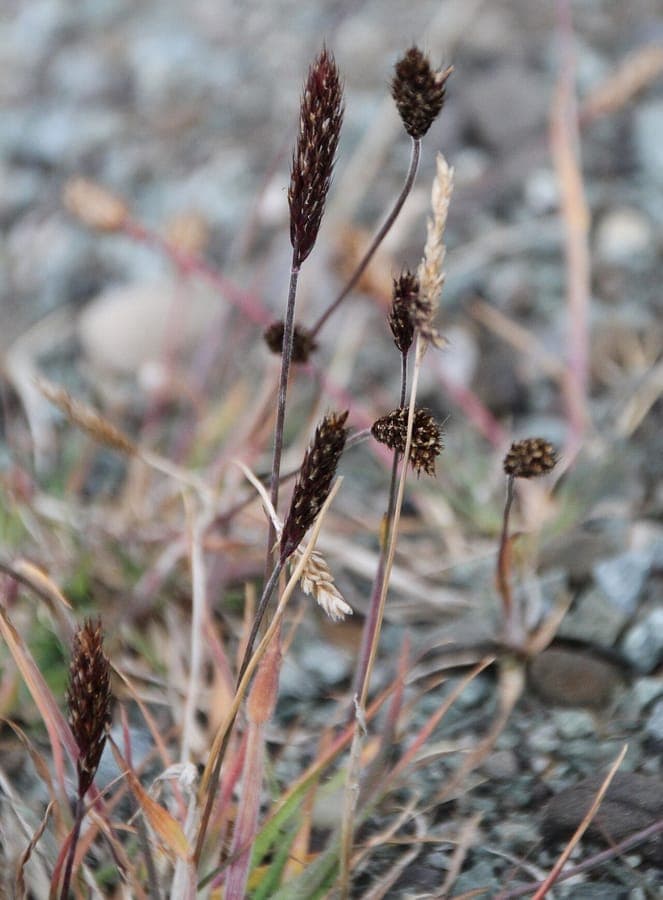
Bjoertvedt / CC BY-SA 3.0, via Wikimedia Commons
Short-leaved sedge: complete guide
Carex fuliginosa
Want to see Short-leaved sedge: complete guide in your garden?
1 minute, no credit card
The short-leaved sedge or dusky sedge (Carex fuliginosa) is a small, compact sedge native to subarctic and subalpine regions of the Northern Hemisphere. This fascinating plant originates from mountain areas of Europe and North America, where it thrives in cold, alpine environments.
Carex fuliginosa is particularly suited for alpine gardens, rock gardens, and other specialized environments where compact, cold-tolerant plants are sought. The plant belongs to the extensive Carex family and is renowned for its dark, almost brownish foliage coloring.
This extremely hardy plant forms dense tufts with fine, narrow leaves. The foliage color can vary from green to dark brown depending on temperature and season, giving the plant unique decorative value in garden design.
The short-leaved sedge is fully winter hardy and can overwinter outdoors without protection throughout Europe, even in very cold mountain regions. The plant tolerates both neutral and slightly alkaline soils (pH 7 to 7.5). It is an extremely low-maintenance plant.
Appearance and Growth The plant reaches heights of approximately 10-30 cm and forms compact tufts with fine, almost hair-thin foliage. The leaf color can vary from dark brown to green. The flowering is very inconspicuous and occurs in early spring.
Ideal Location The short-leaved sedge grows best in alpine gardens, rock gardens, and other cold environments. The plant prefers full sun to partial shade. Ensure the plant receives adequate air circulation.
Soil The plant tolerates a wide range of soils but prefers well-draining soils. In very wet soils, root rot can occur. Ensure the soil is not too dense or compacted.
Watering The short-leaved sedge is fairly drought-tolerant once established. However, regular watering is essential in the first growing season. Ensure the soil does not dry out completely during growing periods.
Pruning and Maintenance The plant requires very minimal pruning. Remove dead foliage in spring. Otherwise, little maintenance is needed.
Maintenance Calendar Spring (March-May): Growing period begins, water well Summer (June-August): Water well during dry periods Autumn (September-October): Preparation for winter Winter (November-February): Dormant, minimal maintenance
Winter Hardiness The plant is fully winter hardy to USDA zone 2 (down to -40 degrees Celsius). This makes it one of the most winter-hardy sedge species and suitable for very cold regions.
Companion Plants The short-leaved sedge pairs well with:
- Other alpine sedge species
- Snow-in-summer (Cerastium tomentosum)
- Houseleeks (Sempervivum tectorum)
- Saxifrage (Saxifraga sp.)
Closing Remarks The short-leaved sedge is ideal for those seeking a compact, extremely winter-hardy plant for alpine or rock garden environments. With minimal maintenance requirements and exceptional cold hardiness, this plant will remain decorative for years. Discover more plant guides at gardenworld.app.
Want to see Short-leaved sedge: complete guide in your garden? Make a free design now.
Upload a photo, pick a style, and get a photorealistic design with plant list in under a minute.
No credit card required


Similar plants
Flat-stemmed club-rush: complete guide
Bolboschoenus planiculmis
Everything about Bolboschoenus planiculmis: growing conditions, watering, care, and use as a pond margin or wetland plant in garden design.
Great Plains flatsedge: complete guide
Cyperus lupulinus
Everything about Great Plains flatsedge (Cyperus lupulinus): growing conditions, care, garden uses, and ecological value. Tips for pond margins and dry sandy soils.
Golden beak sedge: complete guide
Rhynchospora corymbosa
Everything about golden beak sedge (Rhynchospora corymbosa): a dramatic tropical marginal for pond edges, bog gardens, and wet habitats.