
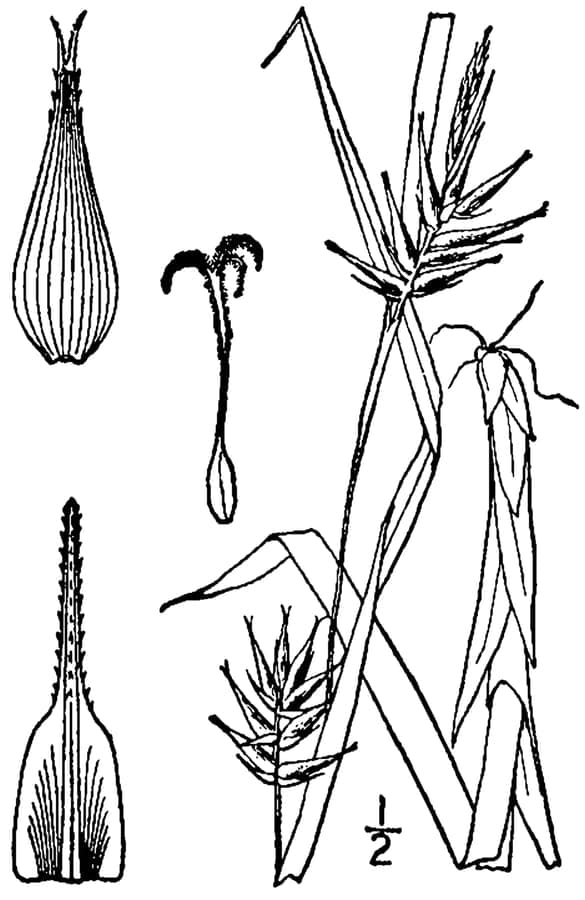
Britton, N.L., and A. Brown. 1913. An illustrated flora of the northern United States, Canada and the British Possessions. 3 vols. Charles Scribner's Sons, New York. Vol. 1: 431. Courtesy of Kentucky Native Plant Society. Scanned by Omnitek Inc. / Public domain, via Wikimedia Commons
Northern long sedge: complete guide
Carex folliculata
Want to see Northern long sedge: complete guide in your garden?
1 minute, no credit card
Overview
Carex folliculata, better known as northern long sedge or long sedge, is an elegant, moisture-loving sedge from eastern North America. This plant ranges from Canada to the southern US and is perfectly adapted to moist, marsh-like conditions. The slender, elegant foliage and long fruit beaks give it a refined appearance. It is an excellent choice for gardens with wet soil or water retention areas.
Appearance and bloom
Carex folliculata forms dense, upright tufts with long, slender foliage that can reach 30-90 centimeters in height. The foliage is fine and grass-like, with a fresh green color. The inflorescence appears in spring, consisting of small, green flowers assembled in conspicuous spikes. Most characteristically, the fruits possess their long, elegant beaks. These beaks give the plant a lofty, refined appearance.
Ideal location
Northern long sedge thrives best in full sun to partial shade. The plant even accepts shady locations. It is very suitable for wet, marsh-like terrain, pond banks, and low-lying areas where water stagnates. This is an ideal plant for gardens with problematic wet spots where other plants struggle.
Soil
Carex folliculata grows optimally in moist to wet soils, unlike many other sedge species. It tolerates heavy clay and silt-bound grounds well. For containers, use garden soil mixed with peat or coco fiber for moisture retention. Mineral composition is less important; consistent moisture is far more important.
Free design
Want to see Northern long sedge: complete guide in your garden? Make a free design now.
Watering
Northern long sedge requires regular moisture. Ensure soil remains moist, but not completely waterlogged outside the growing season. During the growth period, it appreciates abundant water. For pot culture, water regularly, especially in warm seasons. In winter, lower water rates are acceptable.
Pruning
Pruning is not essential, but you can remove dead foliage material in early spring. This promotes neat growth and helps prevent disease spread. Careful removal of dead foliage from the previous winter helps. Avoid hard pruning of live tissue.
Maintenance calendar
Spring: Check moisture, remove dead leaves. Summer: Water regularly, ensure high moisture. Autumn: Check drainage ditches. Winter: Minimal maintenance, ensure extreme water excess is drained.
Winter hardiness
Carex folliculata is hardy throughout the Netherlands and Europe. The plant can withstand temperatures down to -20 degrees Celsius. In its natural habitat, it grows in wet conditions where icy winters occur. In gardens, proper maintenance of drainage ditches ensures winter survival.
Companion plants
Northern long sedge pairs well with other moisture-loving perennials such as aruncus, hostas, and liriope. The elegant foliage contrasts nicely with the broader leaves of astilbe. For water design, add watermint and other aquatic plants. Combine with native paludose plants for natural pond banks.
Closing
Carex folliculata is an ideal plant for gardeners with wet locations. This moisture-loving sedge offers elegance and useful function for problematic garden terrain. Whether you are designing a marsh-like garden or beautifying a wet spot, northern long sedge is a practical and beautiful choice. Available on gardenworld.app and at nurseries with specialized selection.
Want to see Northern long sedge: complete guide in your garden? Make a free design now.
Upload a photo, pick a style, and get a photorealistic design with plant list in under a minute.
No credit card required


Similar plants
Sprengel's sedge: complete guide
Carex sprengelii
Sprengel's sedge (Carex sprengelii) is a versatile, hardy sedge from North America with long beaks and fine foliage. Learn how to cultivate this elegant plant in your garden.
Weak arctic sedge: complete guide
Carex supina
Weak arctic sedge (Carex supina) is a hardy, low-growing sedge with a vast distribution from Europe to Asia. Learn how to cultivate this alpine beauty in your garden.
Frosted-curls: complete guide
Carex comans
Frosted-curls (Carex comans) is a spectacular New Zealand sedge with fine, curly foliage and golden-brown tints. Learn how to cultivate this ornamental plant.