
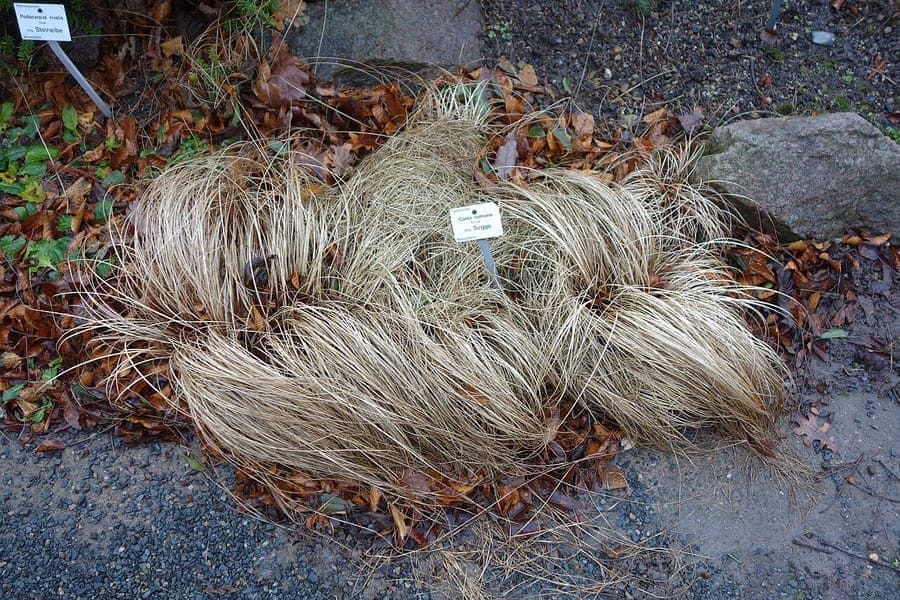
Daderot / CC0, via Wikimedia Commons
Frosted-curls: complete guide
Carex comans
Want to see Frosted-curls: complete guide in your garden?
1 minute, no credit card
Overview
Carex comans, better known as Frosted-curls or Longwood tussock, is a sensational sedge from New Zealand. This unique plant forms broad, fountain-like tufts with long, juicy green to golden-brown leaves that hang elegantly downward. The characteristic frizzy appearance of the foliage gives it its popular name. This is a plant that is guaranteed to stand out in any garden and adds a tropical or Mediterranean feel.
Appearance and bloom
Carex comans forms ornamental, self-contained tufts that can reach 40-60 centimeters in height. The foliage is extremely fine, forming itself in a frizzy, elegant fountain shape. The color ranges from fresh green to golden-brown and bronze tints depending on the variety and season. During the summer season, discrete inflorescences appear, but they are not very ornamental. The most spectacular aspect is the fine, wavy foliage appearance.
Ideal location
Frosted-curls thrives best in full sunlight, although it also grows reasonably well in partial shade. In warm climates, it appreciates some shelter from midday sun. Place the plant in a location with good visibility where it can function as a structure plant. It is perfect for borders, containers, and as an accent plant in gardens with modern or Mediterranean-inspired designs.
Soil
Carex comans grows optimally in well-draining, moderately nutrient-rich soils. It does not tolerate heavy clay soils well - so ensure improved drainage by adding compost and sand. For container cultivation, use a mixture of garden soil with approximately 30-40 percent additional gritty material. The plant does not appreciate acidic soils, but also accepts neutral ground.
Free design
Want to see Frosted-curls: complete guide in your garden? Make a free design now.
Watering
Frosted-curls has moderate water requirements. Ensure soil remains moist without becoming waterlogged. Water regularly during dry periods. For container cultivation, check daily if soil becomes wetter and water as needed. In winter, less water is needed, but prevent complete drying out.
Pruning
Pruning is not really necessary, but you can remove dead or damaged foliage in early spring. Use fine scissors carefully to remove dead parts from the tuft. This helps keep the plant fresh. Avoid hard pruning, as it can spoil the characteristic shape.
Maintenance calendar
Spring: Check growth, remove dead parts from previous season. Summer: Water regularly, especially during drought. Autumn: Gradually reduce watering. Winter: Minimal water, only prevent complete drying out.
Winter hardiness
Carex comans is not fully hardy in the Netherlands. It can tolerate temperatures down to about -5 degrees Celsius, but prolonged frost can cause damage. In warm, sheltered locations, it may overwinter outdoors. In colder regions, it is better to bring the plant indoors or mulch heavily. As a container plant, it can move indoors during winter.
Companion plants
Frosted-curls combines beautifully with dark-leaved plants such as heucheras and solenostemon. The golden-brown tint works well with purple-leaved plants. Combine with warmly colored flowering plants such as calendulas or gaillardias. For texture contrast, add sturdy flowering plants.
Closing
Carex comans is a showstopper for gardeners seeking something unique. This New Zealand sedge adds exotic elegance and movement to any garden. Whether you want to create a modern design or Mediterranean-inspired garden, Frosted-curls is an excellent choice. Available on gardenworld.app and at nurseries with specialized plant selection.
Want to see Frosted-curls: complete guide in your garden? Make a free design now.
Upload a photo, pick a style, and get a photorealistic design with plant list in under a minute.
No credit card required


Similar plants
Sprengel's sedge: complete guide
Carex sprengelii
Sprengel's sedge (Carex sprengelii) is a versatile, hardy sedge from North America with long beaks and fine foliage. Learn how to cultivate this elegant plant in your garden.
Weak arctic sedge: complete guide
Carex supina
Weak arctic sedge (Carex supina) is a hardy, low-growing sedge with a vast distribution from Europe to Asia. Learn how to cultivate this alpine beauty in your garden.
Northern long sedge: complete guide
Carex folliculata
Northern long sedge (Carex folliculata) is a versatile sedge from eastern North America with long, slender foliage. Learn how to cultivate this moisture-loving plant.