
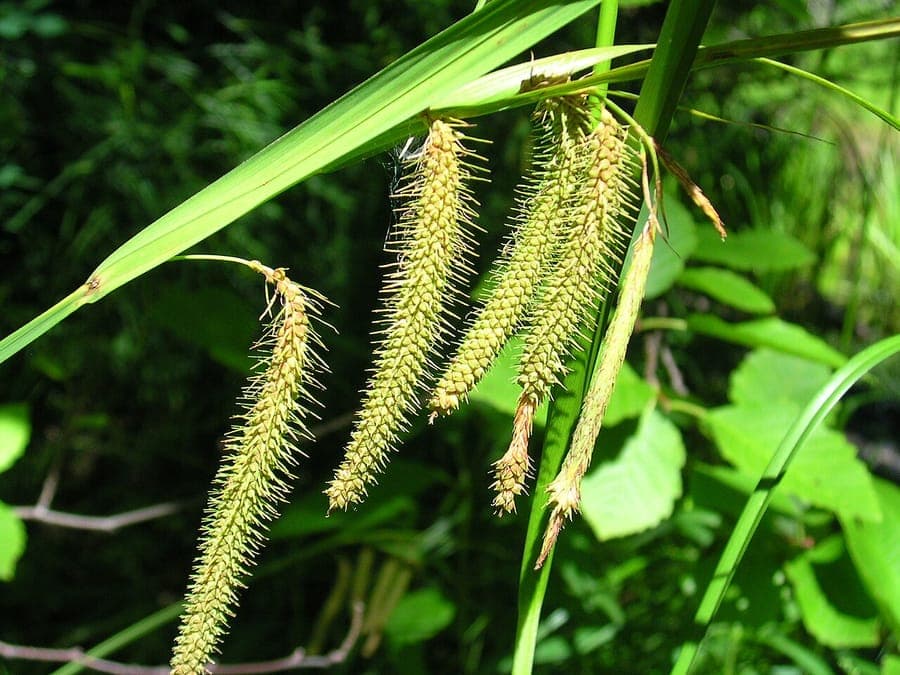
Superior National Forest / CC BY 2.0, via Wikimedia Commons
Carex crinita: complete guide
Carex crinita
Want to see Carex crinita: complete guide in your garden?
1 minute, no credit card
Overview: Carex crinita, commonly called fringed sedge, is an elegant wetland sedge from Canada and eastern North America. The plant reaches heights to 100 cm, forming stately upright culms. The name crinita (fringed) refers to its characteristic hairy seed scales. This sedge thrives in wet soils, along water edges, in marshes. For gardens with wet areas or water features, Carex crinita offers unmatched ornamental value.
Appearance and Bloom: The plant bears elegant narrow leaves 2-4 mm wide, typically light green to greenish-gray. The inflorescence is highly distinctive: male spikelets topmost (green), female spikelets below bearing prominent black-brown hairy seed scales (very fine structure). Flowering peaks June-July. The hairy fruit structure remains ornamental through October. This sedge is a food source for waterfowl seeking seeds.
Ideal Location: Choose permanently wet or seasonally wet zones: along pond edges, in marshes, water retention areas. Six-plus hours daily sunlight ideal; plant tolerates part-shade but flowering weakens. Garden placements: artificial ponds, rain gardens, wetland margins. Dutch Intratuin, Gamma stock sedges; German OBI, Hornbach offer specimens. French Truffaut, Jardiland sell aquatic ornamental grasses.
Soil: Use pure marsh or peat-based soil: blend peat moss, forest loam, and sand. Sedges tolerate pH 4-7.5 (prefer 5-6 for optimum). Moisture retention must be very high: soil never dries. Aquatic cultivation possible in planting baskets filled with peat blend. No synthetic fertiliser: sedges feed from mineral-rich water environment.
Watering: Carex crinita requires permanently wet soil: water table at minimum 0-10 cm above ground surface. During dry seasons water regularly: minimum 2-3 times weekly in summer. Pond-edge sedges submerged 5-10 cm show normal growth. Very deep submersion inhibits growth. Container culture possible with daily watering.
Pruning: Carex crinita requires minimal pruning. Remove yellowed or diseased foliage in spring for freshness. Hairy fruit structure may stand through October for ornamental appeal; remove in January for renewal next season. Plant self-spreads via rhizomes; division possible in April post-flowering.
Maintenance Calendar: April-May remove dead leaves, check soil moisture. June-July flowering peaks, very high water demand, weekly moisture checks. August-September monitor moisture, no feeding. October-November hairy fruit structures attract waterfowl, no pruning. December-March minimal care, keep soil moist. Every four years divide for renewal.
Winter Hardiness: Completely hardy in Netherlands, Belgium, northern France, Germany to minus-20 degrees Celsius. Foliage remains green beneath snow: very ornamental winter silhouette. No protection needed.
Companion Plants: Pair with Iris laevigata (Japanese iris) for blue contrast. Juncus effusus (soft rush) provides textural balance. Lysichiton americanus (American skunk cabbage) offers tropical effect. Filipendula rubra (queen-of-the-prairie) creates background height. Grouping 3-5 Carex plants creates massed effect.
Closing: Carex crinita is ideal for water-rich gardens, pond edges, and wet landscapes. Its distinctive hairy seed work delivers unmatched ornamental value June through October. This sedge demands permanently moist soil and no synthetic fertiliser.
Want to see Carex crinita: complete guide in your garden? Make a free design now.
Upload a photo, pick a style, and get a photorealistic design with plant list in under a minute.
10,000+ gardens designed already
No credit card required


Similar plants
Flat-stemmed club-rush: complete guide
Bolboschoenus planiculmis
Everything about Bolboschoenus planiculmis: growing conditions, watering, care, and use as a pond margin or wetland plant in garden design.
Great Plains flatsedge: complete guide
Cyperus lupulinus
Everything about Great Plains flatsedge (Cyperus lupulinus): growing conditions, care, garden uses, and ecological value. Tips for pond margins and dry sandy soils.
Golden beak sedge: complete guide
Rhynchospora corymbosa
Everything about golden beak sedge (Rhynchospora corymbosa): a dramatic tropical marginal for pond edges, bog gardens, and wet habitats.