
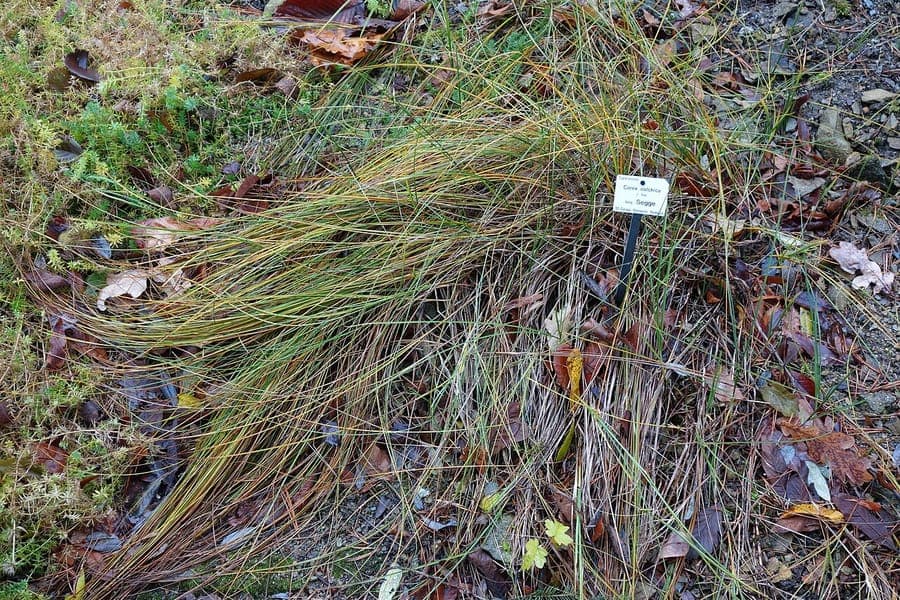
Daderot / CC0, via Wikimedia Commons
Carex colchica: complete guide
Carex colchica
Want to see Carex colchica: complete guide in your garden?
1 minute, no credit card
Overview
Carex colchica is a resilient, evergreen sedge that thrives in moist to wet garden conditions. Native to regions across Central and Eastern Europe, including riverbanks, damp woodlands and floodplains, this member of the Cyperaceae family brings year-round structure and texture to the garden. Unlike many ornamental grasses that die back in winter, Carex colchica holds its form and color, making it a standout choice for gardeners seeking reliability and visual continuity.
This plant is especially valuable in gardens with persistent dampness, poor drainage or seasonal flooding. It doesn't spread aggressively and forms neat, fountain-like clumps that add soft movement to borders and waterside plantings. Whether you're designing a rain garden or revitalising a soggy corner, Carex colchica delivers. On gardenworld.app, you can create a custom planting plan that integrates this sedge seamlessly into wetland-style garden layouts.
Appearance & bloom cycle
Carex colchica grows to a height of 60–80 cm, with narrow, arching leaves reaching up to 1 meter in length. The foliage is a rich, glossy green, sometimes with a subtle blue-green tinge in summer. The leaves are slender and flexible, giving the plant a graceful, flowing habit that sways gently in the breeze.
It flowers in late spring to early summer (May–June), producing inconspicuous, dark green to brownish spikelets that emerge among the foliage. While not showy, these add to the plant's naturalistic appeal. After flowering, the plant maintains a tidy appearance, with no invasive seeding or spreading.
Throughout the year, the leaves remain evergreen, even under heavy frost. In colder zones, the tips may bronze slightly, but the overall clump stays intact. New growth emerges in May, pushing through the older leaves without the need for aggressive pruning.
Ideal location
Plant Carex colchica in full sun to partial shade. In full sun, consistent soil moisture is essential to prevent leaf scorch. Partial shade, especially under light tree canopies or along stream edges, is ideal. It performs best in sheltered spots with high ambient humidity.
This sedge excels in wet areas: rain gardens, pond margins, damp borders or low-lying parts of the garden. It pairs well with moisture-loving perennials like Eutrochium, Iris versicolor or Filipendula. For design inspiration, use gardenworld.app to visualise how this plant fits into a cohesive, water-friendly landscape scheme.
Soil requirements
Carex colchica prefers heavy, humus-rich clay or loam soils that stay consistently moist. It tolerates temporary flooding and can grow in shallow standing water for short periods. Avoid dry, sandy or fast-draining soils.
When planting, enrich the soil with well-rotted compost or leaf mould to boost moisture retention. A pH between 6.0 and 7.0 (slightly acidic to neutral) is optimal. Ensure the root ball stays hydrated during the first growing season.
Free design
Want to see Carex colchica: complete guide in your garden? Make a free design now.
Watering
Water regularly for the first six weeks after planting, especially during dry spells. Once established, it typically requires no supplemental watering unless prolonged drought occurs.
In sunny or exposed sites, apply a 5–8 cm layer of organic mulch (such as bark or reed) to conserve moisture and suppress weeds. Avoid letting the soil dry out completely in summer, as this can cause leaf browning.
Pruning
Pruning is minimal. In early spring (March), you can gently comb through old foliage to remove any damaged or dead leaves. Use gloved hands to pull out tattered material without harming new growth.
Avoid cutting back hard-new leaves emerge from the center and will naturally push out older ones. If the clump becomes dense, divide in spring using a sharp spade or knife. Replant divisions 50–60 cm apart for full effect.
Maintenance calendar
- Jan: Check for frost damage, remove severely damaged leaves
- Feb: Prepare for spring, lightly tidy foliage
- Mar: Light clean-up, divide if needed
- Apr: Apply compost, monitor soil moisture
- May: New growth appears, flowering begins
- Jun: Peak bloom, no intervention needed
- Jul: Watch for dryness during hot spells
- Aug: Continue monitoring moisture levels
- Sep: Plant remains compact, no pruning
- Oct: Leave foliage intact for winter interest
- Nov: No action required
- Dec: Full winter hardiness, structural presence
Winter hardiness
Carex colchica is hardy in USDA zones 4–9. It withstands temperatures down to -30°C without protection. Foliage remains evergreen, with only slight tip browning in harsh winters. No winter covering or special care is needed.
Companion plants
Pair with other moisture-loving perennials: Eutrochium maculatum, Filipendula rubra, Iris sibirica or Ligularia. For contrast, combine with bold-leaved plants like Rodgersia or ferns such as Matteuccia struthiopteris.
Add movement with Molinia caerulea or texture with Carex elata 'Aurea'. Allow at least 60 cm spacing to showcase its arching habit.
Closing
Carex colchica is a dependable, elegant sedge that asks for little and gives much. It's perfect for wet gardens, pond edges or as an evergreen groundcover in challenging spots. With minimal care, it offers year-round presence and subtle beauty. Find it at garden centres across the UK or online retailers. For a tailored design, visit gardenworld.app and build a planting scheme where Carex colchica plays a key role in a resilient, natural-looking garden.
Want to see Carex colchica: complete guide in your garden? Make a free design now.
Upload a photo, pick a style, and get a photorealistic design with plant list in under a minute.
No credit card required


Similar plants
Flat-stemmed club-rush: complete guide
Bolboschoenus planiculmis
Everything about Bolboschoenus planiculmis: growing conditions, watering, care, and use as a pond margin or wetland plant in garden design.
Great Plains flatsedge: complete guide
Cyperus lupulinus
Everything about Great Plains flatsedge (Cyperus lupulinus): growing conditions, care, garden uses, and ecological value. Tips for pond margins and dry sandy soils.
Golden beak sedge: complete guide
Rhynchospora corymbosa
Everything about golden beak sedge (Rhynchospora corymbosa): a dramatic tropical marginal for pond edges, bog gardens, and wet habitats.