
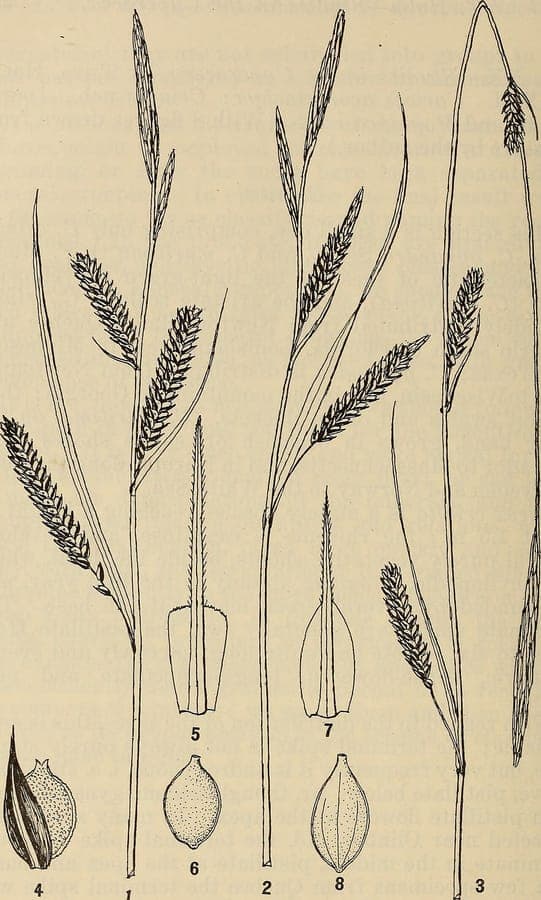
Internet Archive Book Images / No restrictions, via Wikimedia Commons
Columbian sedge: complete guide
Carex aperta
Want to see Columbian sedge: complete guide in your garden?
1 minute, no credit card
Overview
Carex aperta, commonly known as Columbian sedge or open sedge, is a perennial sedge in the family Cyperaceae. The species is native to western North America - from British Columbia and Alberta in Canada south to Idaho, Montana, Oregon, and Washington in the United States - as well as the Russian Far East and north-eastern China. In the wild it grows along stream banks, in wet meadows, at the edges of lakes, and in moist woodland margins.
Carex aperta is a rhizomatous sedge with a moderate rate of growth. The roots spread horizontally through the soil, forming slowly expanding clumps. In the garden it is a valuable plant for wet to moist spots: beside a pond, in a rain garden, along a drainage ditch, or in a moist shade bed. On gardenworld.app you can find garden designs that integrate sedges and waterside plants into a cohesive planting scheme.
The plant does not produce showy flowers, but makes up for that with graceful green foliage and a calm, naturalistic appearance that suits contemporary naturalistic garden styles very well.
Appearance and bloom cycle
Carex aperta forms a dense, grass-like clump of dark green leaves. The leaves are narrow and strap-like, coarse in texture (as noted in botanical descriptions of this species), and can reach 30 to 60 cm in length. The plant has a graminoid habit - resembling a grass - and forms slowly expanding clumps via rhizomes.
The flowers are botanically inconspicuous: small brownish-green spikes appear in spring to early summer. There are separate male and female spikes: male spikes stand upright at the top of the flower stem, with female spikes below. The fruits are small brown nutlets enclosed in a sac (utriculus) and are dispersed by wind. The brown flower spikes give the plant a decorative, seasonal character even outside the main flowering period.
After flowering, the foliage remains green for a long time. In mild winters the plant can hold its leaves well into the season; in severe frost it retreats somewhat but recovers well the following spring.
Ideal location
Carex aperta thrives best in a moist to wet position with partial shade or full sun. In its natural habitat it grows in wet meadows, along stream banks, and in moist forest margins, in both sun and partial shade.
In the garden the best positions are: directly beside a pond or water course, in a rain garden or bioswale, in a moist shade bed under deciduous trees, or in a low-lying area where water lingers after heavy rain. The plant is less suitable for fully dry, sun-baked positions.
The species tolerates periodic flooding well, making it particularly suitable for planting in seasonal wet areas or low-lying garden zones that are temporarily inundated after heavy rainfall.
The plant is hardy to USDA zone 5 (-29 degrees Celsius), which is more than adequate for virtually all gardens in north-western Europe.
Soil
The ideal soil for Carex aperta is moist to wet, slightly acidic to neutral (pH 5.5 to 7.0), and rich in organic matter. The plant also tolerates temporarily more acidic or base-rich conditions, but performs best on humus-rich soil that retains moisture well.
Heavy clay soil, provided it stays adequately moist, is an excellent choice. On such soils the plant does particularly well because clay retains water. Sandy soil is less suitable unless improved with generous amounts of compost and leaf mould to increase water-holding capacity.
At planting, work a generous amount of compost or well-rotted peat into the top 20 cm of soil. Mulch the planting area afterwards with leaf mould, compost, or other organic mulch to limit evaporation and keep the soil consistently moist.
The plant has no special nutrient requirements: on a moist, humus-rich soil, extra fertilising is rarely needed. A light dressing of slow-release fertiliser in early spring is sufficient if growth seems sluggish.
Watering
Carex aperta demands more water than the average garden plant. In its natural habitat it grows in permanently moist to wet conditions, and in the garden you should replicate those conditions as closely as possible.
In positions directly beside water (ponds, ditches, streams) additional watering is rarely needed. In other positions - even naturally moist ones - it is necessary during dry summer spells to water regularly, preferably every two to three days during hot, dry weather.
The soil must never dry out completely. If the foliage begins to curl or droop, that is a sign the plant is too dry. Recover by watering thoroughly, ensuring water penetrates at least 20 cm into the soil.
In autumn and winter less watering is needed, but the soil should still stay moist. The plant tolerates temporary flooding better than drought.
Drip irrigation or ground-level watering is ideal; wet foliage is less of a concern for sedges than for many other plants, but ground-level watering is still preferable. Available at most garden centres as part of an irrigation system.
Free design
Want to see Columbian sedge: complete guide in your garden? Make a free design now.
Pruning
Carex aperta needs little pruning attention. The most effective time for maintenance is early spring, just before new leaf growth begins - generally in March or early April.
In spring, old, brown, or damaged leaves can be carefully cut back to close to the ground. Use sharp secateurs or garden shears. Do not cut too deep into living green material; the goal is simply to remove the dead leaf mass.
During the growing season, loose, damaged, or overly long leaves can be trimmed to keep the clump tidy. This is not essential, however; the plant is also attractive when growing in a free, naturalistic manner.
Dividing overly large clumps can be useful after three to five years. Divide the clump in early spring or early autumn by cutting through it with a sharp spade or knife, then replanting the sections elsewhere.
Maintenance calendar
January to February: Plant is dormant. Ensure adequate moisture during dry frost periods. Little action needed.
March: Growing season begins. Remove dead, brown leaves down to just above the ground. Apply a light dressing of slow-release fertiliser if growth has been sluggish.
April: New leaf growth starts. Ensure adequate water. Plant new specimens or divide existing clumps once the ground has thawed.
May to June: Flowering period. Small brown spikes appear. Check soil moisture regularly.
July to August: Warm months. Provide extra water during prolonged drought. Watch for signs of drought stress.
September: Growth slows. Check that mulch is still adequate. Divide clumps if needed.
October to November: Growth stops. Add a mulch layer for winter protection (5 to 10 cm).
December: Winter dormancy. Little maintenance needed.
Winter hardiness
Carex aperta is excellently cold-hardy, tolerating temperatures down to -29 degrees Celsius (USDA zone 5). For gardens in north-western Europe this is more than sufficient, as temperatures rarely drop below -20 degrees Celsius.
The plant survives average winters in the Netherlands and Belgium without any protection. In exceptionally severe winters the foliage may partially freeze, but fresh leaves appear promptly in spring.
The rhizomatous root structure helps the plant survive well beneath frozen ground. A mulch layer of 5 to 10 cm gives the roots extra protection and keeps the soil slightly warmer during extreme cold.
Wet cold is less dangerous for Carex aperta than for many other plants, as it is naturally adapted to wet conditions. Standing water above the soil surface in winter is not a problem.
Companion plants
Carex aperta fits beautifully in moist, naturalising garden plantings and combines well with other waterside and moisture-loving plants. On gardenworld.app you can browse inspiring pond and waterside designs that bring together sedges and other water plants attractively.
Good companion plants for wet to moist conditions include:
Bulrush (Typha latifolia or Typha minima) - for structure and height at water margins.
Purple loosestrife (Lythrum salicaria) - purple flowers that combine beautifully with the green sedge foliage.
Yellow flag iris (Iris pseudacorus) - elegant yellow flowers in May and June, ideal at pond margins.
Water forget-me-not (Myosotis scorpioides) - small blue flowers as a low-growing companion.
Astilbe (Astilbe x arendsii) - beautiful feathery foliage and colourful summer plumes.
Royal fern (Osmunda regalis) works well as a larger companion in the shaded section of a moist border. All of these are available at well-stocked garden centres.
Closing
Carex aperta is a reliable, cold-hardy sedge for wet and moist garden positions. It needs little maintenance, is robust, and suits both sunny and shaded moist conditions. Its naturalistic green foliage and calm growth habit make it a valuable building block for pond margins, rain gardens, moist shade borders, and plantings alongside water courses.
With the right position and sufficient moisture, Carex aperta is a long-term plant that provides stable, green structure year after year. For anyone looking for professional garden advice or more ideas for a garden featuring sedges and waterside plants, gardenworld.app is an excellent starting point.
Want to see Columbian sedge: complete guide in your garden? Make a free design now.
Upload a photo, pick a style, and get a photorealistic design with plant list in under a minute.
10,000+ gardens designed already
No credit card required


Similar plants
Korean feather reed grass: complete guide
Calamagrostis arundinacea
A detailed guide to growing and caring for Calamagrostis arundinacea, also known as Korean feather reed grass, in temperate gardens with partial shade and moist soil.
Purple smallreed: complete guide
Calamagrostis canescens
Learn how to grow Calamagrostis canescens in your garden. Full details on care, soil, light, pruning and ideal companion plants for this elegant grass.
Wild calla: complete guide
Calla palustris
Grow Wild calla (Calla palustris) in wet areas: care, planting, and ideal conditions. Perfect for bog gardens. Plan with gardenworld.app.