
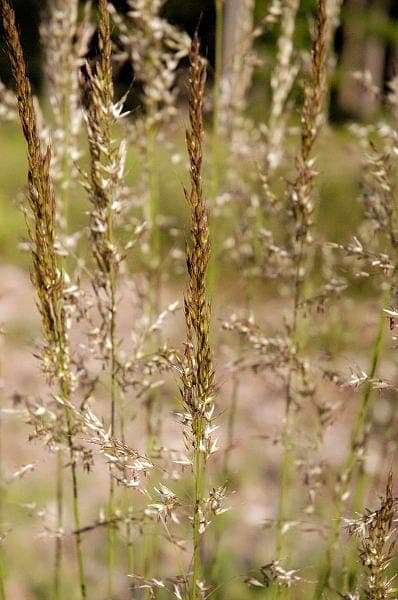
James K. Lindsey / CC BY-SA 3.0, via Wikimedia Commons
Korean feather reed grass: complete guide
Calamagrostis arundinacea
Want to see Korean feather reed grass: complete guide in your garden?
1 minute, no credit card
Overview
Calamagrostis arundinacea, commonly known as Korean feather reed grass, is a graceful, cool-season grass native to forested and mountainous regions across Central and Eastern Europe. Unlike the more widely cultivated Calamagrostis × acutiflora cultivars, this species thrives in naturalistic landscapes and woodland edges. It brings elegant vertical structure to gardens without dominating the space, making it ideal for shaded or semi-shaded areas where other grasses might struggle. Hardy in USDA zones 4 to 8, it adapts well to temperate climates and is gaining popularity among gardeners seeking understated beauty and year-round presence.
On gardenworld.app, you can design a planting scheme that incorporates Korean feather reed grass into a moisture-rich, shaded border, blending seamlessly with ferns and woodland perennials.
Appearance & bloom cycle
This grass forms upright, slender clumps reaching 60–80 cm in height, with fine-textured, glossy green leaves. In July, narrow flower spikes emerge, rising slightly above the foliage to 90 cm. These develop into feathery plumes that shift from pale blue to creamy white by mid-August. The inflorescences persist well into winter, gradually fading to tan but retaining their upright form, adding subtle movement and texture to the dormant garden.
The bloom period, spanning July to September, bridges the gap between early summer perennials and autumn foliage. While not fragrant, the plumes attract minimal pests and provide winter shelter for beneficial insects and small birds. Unlike many grasses, it doesn't self-seed aggressively, making it a responsible choice for ecological planting.
Ideal location
Korean feather reed grass prefers partial shade-around light level 5 out of 10. It performs best in north- or east-facing beds under open-canopy trees like birch or serviceberry. Full sun is tolerable only if the soil remains consistently moist, but prolonged exposure leads to leaf scorch and stress. Avoid hot, dry south-facing spots. A natural fit is near a pond edge, stream bank, or in a rain garden where moisture collects.
Plant in groups of three or more to create visual impact. Drifts of this grass work well in naturalistic designs. Use gardenworld.app to visualise how these groupings can anchor a shaded garden bed with rhythm and flow.
Soil requirements
It thrives in moist, humus-rich soil with a pH between 5.0 and 5.5. Loamy or sandy loam soils are ideal, provided they retain moisture without waterlogging. Amend heavy clay with compost to improve drainage and add organic matter to sandy soils to boost water retention. Avoid alkaline soils-this grass shows chlorosis (yellowing leaves) above pH 6.0.
Before planting, test your soil. If needed, lower pH with elemental sulfur or peat-free acidifier. A 5 cm layer of leaf mould or compost at planting time gives young plants a strong start.
Free design
Want to see Korean feather reed grass: complete guide in your garden? Make a free design now.
Watering
This grass has moderate to high water needs. It tolerates short-term wet feet but not prolonged saturation. Water deeply once or twice a week during dry spells, especially in the first two growing seasons. Established clumps are more resilient but still benefit from supplemental watering in droughts.
Use rainwater when possible-tap water with high lime content can raise pH over time. Mulch with 5–7 cm of shredded bark to conserve moisture and suppress weeds. Avoid mulching too close to the crown to prevent rot.
Pruning
Cut back in late winter or early spring, before new growth emerges. Trim old foliage and flower stems to 10–15 cm above ground level. Use sharp, clean shears or a hedge trimmer for larger clumps. Leaving the old growth through winter protects the crown from frost and adds visual interest.
Never cut in autumn-this removes winter insulation and can weaken the plant. Wear gloves, as dried blades can be sharp.
Maintenance calendar
- January: No action. Leave standing foliage.
- February: Prepare for pruning. Check for compacted snow damage.
- March: Cut back old growth. Add a thin compost layer.
- April: New shoots appear. Water if spring is dry.
- May: Monitor for moisture stress. Replenish mulch.
- June: No feeding. Watch for early drought signs.
- July: Flower spikes emerge. Peak visual interest begins.
- August: Blooms at peak. No maintenance needed.
- September: Plumes mature. Avoid cutting.
- October: Structure remains. Birds use for cover.
- November: Foliage browns. No watering in frost.
- December: Dormant. Leave standing for winter effect.
Winter hardiness
Hardy in USDA zones 4–8, it survives temperatures down to -34°C when established. The crown remains dormant under snow cover, which acts as natural insulation. In zone 4, a light mulch may help, but avoid smothering the crown. Avoid heavy foot traffic on frozen foliage.
In milder zones, minimal care is needed. The upright form sheds snow easily, reducing breakage risk.
Companion plants
Pair with moisture-loving, shade-tolerant perennials: Matteuccia struthiopteris (ostrich fern), Carex vulpinoidea, or Hosta 'Guacamole'. It contrasts beautifully with bold-leaved plants like Rodgersia or Astilbe. For year-round structure, combine with evergreen groundcovers like Pachysandra terminalis.
Avoid invasive spreaders like Lamium maculatum 'White Nancy' that may outcompete it.
Closing
Korean feather reed grass is a quiet achiever-elegant, resilient, and low-fuss. It adds vertical rhythm without bulk, thrives in tricky shady spots, and delivers months of visual appeal. With proper siting and minimal care, it becomes a dependable garden staple. Look for healthy plugs or 2L pots at trusted garden centres in spring. Trays are often available from mid-April. For layout ideas, explore planting combinations on gardenworld.app.
Want to see Korean feather reed grass: complete guide in your garden? Make a free design now.
Upload a photo, pick a style, and get a photorealistic design with plant list in under a minute.
No credit card required


Similar plants
Sporobolus pungens: complete guide
Sporobolus pungens
Sporobolus pungens is a stoloniferous Mediterranean coastal grass with outstanding salt and drought tolerance, perfect for seaside and dry gardens.
Mediterranean aegilops: complete guide
Aegilops biuncialis
Everything about Aegilops biuncialis, a Mediterranean annual grass with ornamental spikes and outstanding drought tolerance for dry gardens.
Silver bluestem: complete guide
Bothriochloa saccharoides
Full guide to Bothriochloa saccharoides (silver bluestem): site, soil, watering, winter hardiness, pruning, and garden companions.