
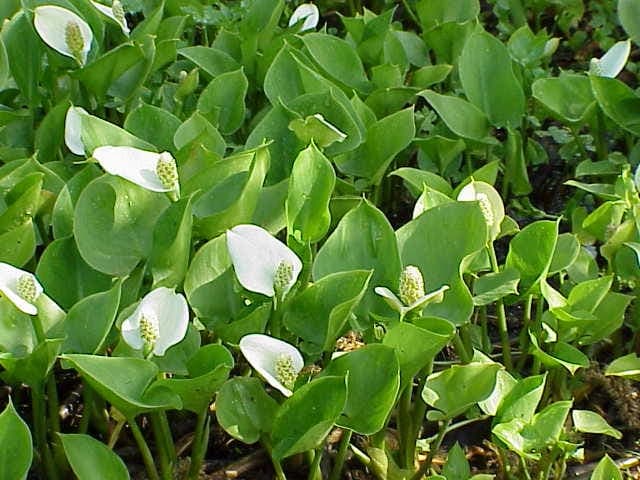
Kurt Stüber [1] / CC BY-SA 3.0, via Wikimedia Commons
Wild calla: complete guide
Calla palustris
Want to see Wild calla: complete guide in your garden?
1 minute, no credit card
Overview
Calla palustris, commonly known as Wild calla, is a native forb found in wetlands, stream banks, and shaded woodland pools across northern North America and Europe. Unlike the tropical callas sold in florist shops, this hardy perennial thrives in cool, moist conditions and brings a quiet elegance to naturalistic garden designs. Growing 20–40 cm tall, it spreads slowly through rhizomes and forms lush, ground-hugging clumps. It's not a true aquatic but needs constantly damp soil, making it ideal for the margins of ponds or bog gardens.
Hardy to USDA zone 4 (-34°C), Wild calla dies back in harsh winters but reliably returns in spring. It blooms from June through August, producing a striking white spathe that wraps around a central spadix. Though beautiful, all parts of the plant are toxic if ingested, so keep away from curious pets and small children. This is not a plant for cutting or indoor arrangements - it belongs in the wild edges of your garden.
On gardenworld.app, you can design a wetland planting scheme where Wild calla fits perfectly among other moisture-loving species.
Appearance & bloom cycle
The foliage of Wild calla is heart-shaped, glossy, and deep green, typically 5–15 cm long. Leaves emerge on upright stalks and spread to form a dense mat. From early summer, the flower stalks rise, each bearing a single white spathe, 5–8 cm long, that encases a yellow-green spadix. The bloom lasts 4–6 weeks and is followed by clusters of bright orange-red berries, which attract birds but are poisonous to humans.
This plant spreads slowly by creeping rhizomes, forming colonies over several seasons. It doesn't self-seed aggressively, so it won't take over your garden. Its growth habit is neat and clump-forming, not invasive.
Ideal location
Choose a spot with dappled shade to partial shade - a light level of 6/10 is perfect. Full sun is acceptable only if the soil remains consistently wet, such as along a stream or in a bog filter. Avoid hot, dry southern exposures. Ideal microclimates include the north side of a shrub border, under deciduous trees, or at the damp edge of a rain garden.
Wild calla also works well in container bog gardens using a mix of peat, loam, and perlite. Just ensure the pot never dries out. If you're designing a low-maintenance, nature-inspired garden, use gardenworld.app to map out moisture zones and plant accordingly.
Soil requirements
The soil must be rich in organic matter, moisture-retentive, and slightly acidic to neutral (pH 6.5–7). A mix of garden compost, leaf mold, and clay loam works well. Avoid sandy or fast-draining soils. If your soil is too free-draining, amend it with well-rotted manure or sphagnum peat to improve water retention.
Do not use lime - this plant dislikes alkaline conditions. A light mulch of compost in spring helps maintain moisture and adds nutrients.
Free design
Want to see Wild calla: complete guide in your garden? Make a free design now.
Watering
Consistent moisture is key. Water deeply once or twice a week during dry spells, focusing on the root zone. In natural wetland settings or rain gardens, supplemental watering may not be needed. However, during prolonged droughts, check the soil daily - it should feel cool and damp, never crusty or cracked.
Pruning
Wild calla requires little to no pruning. Remove spent flower stalks and damaged leaves in late summer or early autumn if they look unsightly. Do not cut back healthy foliage in winter - it provides insulation for the rhizomes. Let nature take its course; the plant will rejuvenate itself in spring.
Maintenance calendar
- January: Check for frost heave; keep mulch in place
- February: No action needed
- March: Remove matted debris if necessary
- April: Monitor for new growth; divide clumps if overcrowded
- May: Plant new rhizomes; ensure soil stays moist
- June: Blooming begins; watch for slugs
- July: Peak bloom; maintain consistent moisture
- August: Berries develop; avoid disturbing stems
- September: Stop fertilizing; prepare for dormancy
- October: Leave dead foliage for winter protection
- November: No pruning
- December: Inspect mulch coverage
Winter hardiness
Hardy to USDA zones 4–8, Wild calla survives deep freezes when mulched. The top growth may die back, but the rhizomes remain dormant underground. In zone 4, a 5 cm layer of leaf mulch or compost helps prevent freeze-thaw cycles from damaging the roots. In milder zones, it may stay semi-evergreen.
Companion plants
Pair Wild calla with other moisture-dependent perennials: Marsh marigold (Caltha palustris), Blue flag iris (Iris versicolor), Joe-Pye weed (Eutrochium maculatum), or Turtlehead (Chelone glabra). In shaded wetlands, it grows well with ferns like Ostrich fern (Matteuccia struthiopteris) and native sedges (Carex spp.). Avoid pairing with drought-tolerant plants like lavender or yarrow.
Closing
Wild calla is a quiet performer - not flashy, but deeply dependable in the right setting. It's perfect for gardeners looking to support native biodiversity and create low-maintenance, ecologically sound plantings. You can find Calla palustris at garden centres during spring, especially those specializing in native or wetland plants. OBI, Hornbach, Truffaut, and local nurseries increasingly stock it as interest in natural gardening grows. With thoughtful placement and proper soil prep, this plant will thrive for years. Use gardenworld.app to visualize where it fits best in your garden layout - especially in zones that collect water or stay damp year-round.
Want to see Wild calla: complete guide in your garden? Make a free design now.
Upload a photo, pick a style, and get a photorealistic design with plant list in under a minute.
No credit card required


Similar plants
Arrowhead vine: complete guide
Syngonium auritum
Everything about Syngonium auritum, the tropical five-fingers houseplant. Care, location, watering, and pruning explained clearly for beginners and enthusiasts.
Minute duckweed: complete guide to Lemna perpusilla
Lemna perpusilla
Everything about Lemna perpusilla, the minute duckweed: ecology, pond management, water quality and care in garden water features.
Dead horse arum lily: complete guide
Helicodiceros muscivorus
Everything about the dead horse arum lily (Helicodiceros muscivorus): growing conditions, spectacular bloom, thermogenesis, and care for this Mediterranean aroid.