
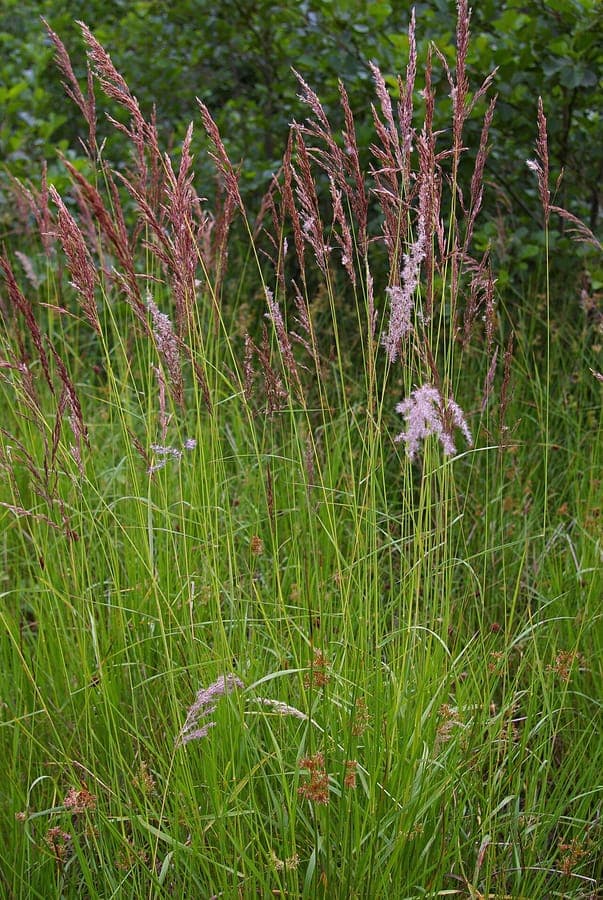
Christian Fischer / CC BY-SA 3.0, via Wikimedia Commons
Purple smallreed: complete guide
Calamagrostis canescens
Want to see Purple smallreed: complete guide in your garden?
1 minute, no credit card
Overview
Calamagrostis canescens, commonly known as purple smallreed, is a clump-forming perennial grass native to wetlands, forest edges and marshes across Central and Eastern Europe. It's a graceful, upright grower that adds vertical rhythm and subtle texture to garden designs. Reaching 90–150 cm in height and spreading 40–60 cm wide, it works well as a background plant, in mixed borders, or as a focal point in naturalistic planting schemes.
On gardenworld.app you can design a planting layout that integrates purple smallreed with complementary perennials and shrubs for year-round interest. This grass thrives in full sun and adapts well to urban gardens, rain gardens, and even coastal areas with some protection.
Appearance & bloom cycle
Purple smallreed features narrow, linear leaves with a soft blue-green hue that arch elegantly from a central base. The foliage remains dense and attractive from spring through winter. In late spring, upright flowering stems emerge, culminating in airy panicles from June to August. These inflorescences start greenish-purple, develop a bluish tinge in full sun, and gradually fade to tawny beige by late autumn.
The flower plumes are held high above the foliage, catching the breeze and adding movement to the garden. Even after blooming, the dried stems persist through winter, offering structure and habitat for overwintering insects.
Ideal location
This grass performs best in full sun (light level 8/10), needing at least 6–8 hours of direct sunlight daily. While it tolerates light shade, insufficient light leads to floppy growth and reduced flowering. Choose an open, airy spot where wind can animate the plumes-ideal for the back of a border, beside a pond, or in a prairie-style planting.
Avoid heavily shaded or cramped locations. It also works in large containers, provided there's adequate drainage and room for root development.
Soil requirements
Purple smallreed prefers moist, well-drained soil with a neutral pH between 6.5 and 7.0. It naturally occurs in damp soils but adapts to average garden conditions once established. The soil can range from sandy loam to clay, as long as it doesn't dry out completely in summer.
Improve poor soils with a layer of compost at planting time. Avoid highly alkaline or saline soils, which can cause leaf scorch and stunted growth.
Watering
During the first growing season, water weekly to help the plant establish a deep root system. In dry spells, increase to twice weekly. Once established (after 12–18 months), it becomes moderately drought-tolerant.
In prolonged summer droughts (July–August), provide a deep soak every 7–10 days. Never allow the plant to sit in waterlogged soil-root rot can develop in poorly drained areas.
Free design
Want to see Purple smallreed: complete guide in your garden? Make a free design now.
Pruning
Cut back old foliage in late winter or early spring (February to early March), before new growth emerges. Trim the entire clump down to 15–20 cm from the ground using sharp shears or hedge trimmers. This keeps the plant tidy and encourages fresh, upright growth.
Do not cut back in autumn-leaving the stems intact provides winter interest and shelter for beneficial insects. Delaying pruning also helps insulate the crown during cold months.
Maintenance calendar
- Jan: Check for winter damage; avoid heavy disturbance
- Feb: Begin cutting back old growth
- Mar: Complete pruning; apply light compost mulch
- Apr: Monitor for early growth; keep soil moist
- May: Growth accelerates; watch for water needs
- Jun–Aug: Blooming period; minimal care required
- Sep: Stop fertilizing; allow seed heads to develop
- Oct: Inspect for pests or fungal spots
- Nov: Leave standing; no action needed
- Dec: Provide visual structure in winter garden
Track this care schedule easily on gardenworld.app, where you can customize reminders based on your local climate and planting date.
Winter hardiness
Purple smallreed is hardy in USDA zones 5–8 (-29°C to -12°C). It reliably survives cold winters across most of the UK, northern Europe, and the northern US. The crown remains dormant but viable under snow cover or dry leaf mulch.
In exposed or very cold sites, a light mulch of straw or leaf litter around the base can protect young or recently planted clumps. Avoid thick, moisture-retaining covers that promote rot.
Companion plants
Pair purple smallreed with late-summer bloomers like Echinacea, Rudbeckia, and Aster novae-angliae. Its upright form contrasts beautifully with mounding plants such as Nepeta or Salvia nemorosa.
It also works well with other grasses-try搭配 with Panicum virgatum or Molinia for a dynamic, swaying effect. In damp areas, combine with Iris sibirica or Carex comans for a cohesive wetland look.
Avoid overcrowding with aggressive spreaders like mint or goldenrod, which may overwhelm the grass over time.
Closing
Purple smallreed is a low-maintenance, high-impact grass that brings elegance and movement to the garden. With its clean lines, seasonal colour shifts, and winter durability, it's a top choice for modern and traditional landscapes alike.
You'll find Calamagrostis canescens at garden centres like B&Q, Dobbies, and local independents, usually in 1–2 litre pots. Look for firm, green clumps without signs of browning or sogginess. When planted in drifts of three or more, its effect is truly striking.
Want to see Purple smallreed: complete guide in your garden? Make a free design now.
Upload a photo, pick a style, and get a photorealistic design with plant list in under a minute.
No credit card required


Similar plants
Sporobolus pungens: complete guide
Sporobolus pungens
Sporobolus pungens is a stoloniferous Mediterranean coastal grass with outstanding salt and drought tolerance, perfect for seaside and dry gardens.
Mediterranean aegilops: complete guide
Aegilops biuncialis
Everything about Aegilops biuncialis, a Mediterranean annual grass with ornamental spikes and outstanding drought tolerance for dry gardens.
Silver bluestem: complete guide
Bothriochloa saccharoides
Full guide to Bothriochloa saccharoides (silver bluestem): site, soil, watering, winter hardiness, pruning, and garden companions.