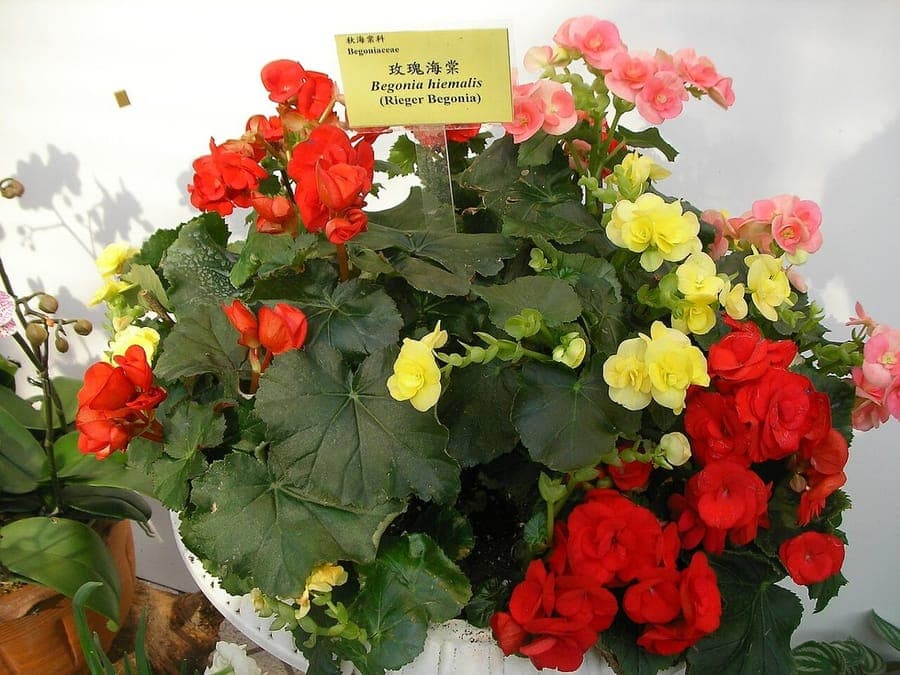
Tequila / CC BY-SA 3.0, via Wikimedia Commons
Rieger begonia: complete guide
Begonia × hiemalis
Want to see Rieger begonia: complete guide in your garden?
Full design in HD: €7.99
Look after your Rieger begonia with the GardenWorld app
Identify plants with your camera and get a care calendar with reminders for this plant.


Overview
The Rieger begonia (Begonia × hiemalis), also known as the Elatior begonia, is one of the best-selling flowering pot plants in Europe. You'll find it all year round at garden centres and supermarkets, smothered in flowers of red, orange, yellow, pink or white. With a little care a single plant will flower for two to three months on a bright windowsill.
Begonia × hiemalis is a cross between Begonia socotrana, a winter-flowering species from the island of Socotra in the Arabian Sea, and the tuberous begonia (Begonia × tuberhybrida). The English nursery Veitch made the first crosses in the 1880s. The big breakthrough came in the 1950s with the German breeder Otto Rieger, whose cultivars flowered more freely and were less prone to mildew. That is why the plant is known in English and German as the Rieger begonia.
The name hiemalis means "of winter": the original plants flowered in the short days of autumn and winter. Modern growers control flowering with day length and temperature, so you can buy plants in bloom in any season. At home it behaves like a flowering houseplant for one season, although with a little patience you can coax it into a second flush.
Although it mostly lives indoors, the Rieger begonia can also spend the summer on a sheltered patio or balcony. Some newer series, such as 'Solenia' and 'Belleconia', were bred specifically for outdoor use. Want to see how pots like these fit into the bigger picture of your garden? On gardenworld.app you can have a garden design made that takes your patio and containers into account.
Appearance and bloom cycle
The plant forms a compact, rounded bush 20 to 40 cm tall and wide. The stems are succulent and brittle. The leaves are lopsidedly round to heart-shaped with a slightly wavy, toothed edge, 6 to 10 cm across, glossy mid- to dark green. In some cultivars the foliage is bronze.
The flowers are held in clusters above the leaves. Depending on the cultivar they are single, semi-double or double, 3 to 5 cm across, and the doubles look very much like small roses. Colours include red, scarlet, orange, yellow, salmon, pink and white, sometimes with a contrasting edge. The photo shows a mixed display of Rieger begonias in red, yellow and pink, with the typical glossy, dark green leaves.
A plant bought in full bud flowers for eight to twelve weeks on average. Choose one with plenty of buds and only a few open flowers for the longest display.
Ideal position indoors
Give the Rieger begonia a bright spot without strong midday sun, such as an east- or west-facing windowsill, or a metre back from a south-facing window. Direct sun through glass quickly scorches the leaves in summer. Too little light results in long stems and fewer flowers.
The ideal room temperature is 16 to 20 °C. In a cooler room the plant flowers for longer than in a warm living room. Avoid spots above a radiator, next to a stove or in the draught of a door that opens often. The plant likes moderate humidity, but don't mist the leaves: wet foliage invites powdery mildew.
Outdoors it can stand in a sheltered, partly shaded spot from mid-May to the end of September. Bring it in as soon as nights drop below 10 °C.
Compost
Rieger begonias are usually sold in 11 to 14 cm pots in an airy peat or coir-based mix. There is no need to repot during flowering, and doing so only stresses the plant. If you want to keep it after flowering, repot it in spring into a slightly larger pot with an open houseplant compost for flowering plants, with a little added perlite if you like. A slightly acidic pH of around 5.5 to 6.5 is ideal. Always use a pot with a drainage hole.
Free preview
Want to see Rieger begonia: complete guide in your garden? Make a free preview of your design.
Watering and feeding
Watering is where things usually go wrong. The roots are fine and rot quickly in wet compost, yet the plant also wilts fast when dry. Water when the top 2 cm of compost feels dry, roughly once or twice a week depending on the temperature. Bottom watering works best: stand the pot in a dish of water for fifteen minutes, then pour away the excess. Never leave the pot standing in a cachepot full of water.
Use water at room temperature. While the plant is in flower, give a half-strength liquid feed for flowering plants every two weeks.
Deadheading and after flowering
Snip off faded flower clusters regularly, just above a leaf. This keeps the plant tidy and encourages new buds. Also remove yellow leaves and fallen petals lying on the foliage, as grey mould soon develops there.
After flowering the plant often becomes leggy and less attractive. Most people compost it at this point, but you can also try for a second flowering. Cut the stems back to 8 to 10 cm, water a little less for a few weeks and keep the plant cool and bright. Once new shoots appear, resume normal watering and feeding. The second flush is usually less generous. Tip cuttings of 8 cm root easily in moist cutting compost and give you a young, vigorous plant.
Care calendar
January–February: Keep cool and bright at 16 to 18 °C. Water moderately. Watch out for dry air from central heating.
March–April: Cut back plants that have finished flowering or take cuttings. Repot if needed.
May: After mid-May the plant can move to a sheltered patio in partial shade.
June–August: No harsh sun. Water evenly and feed every two weeks.
September: Bring indoors before nights fall below 10 °C.
October–December: Choose the brightest spot in the house as the days shorten. Keep flowering plants cool for a long display.
Temperature and winter care
Begonia × hiemalis is a houseplant and not hardy. Below 10 °C growth stops and the plant is damaged, and it will not survive frost. In winter it does best in a bright room that isn't too warm, ideally 16 to 18 °C. Too warm and too dark leads to long, floppy stems and a short flowering period.
Its main enemies are powdery mildew, which appears as a white dusting on the leaves, and grey mould. Good air circulation, dry foliage and prompt removal of dead material prevent most problems.
Toxicity to pets
Begonias are toxic to dogs, cats and horses, and the Rieger begonia is no exception. According to the ASPCA, the genus Begonia contains soluble calcium oxalates, with the highest concentration in the underground parts. In dogs and cats, chewing the plant mainly causes drooling, vomiting and an irritated mouth. In grazing animals such as horses, large amounts can harm the kidneys.
Because this plant lives indoors, the risk with cats is greater than with garden plants. Put it somewhere your cat cannot reach, or choose a non-toxic houseplant if your cat likes to nibble greenery. The plant is not edible for people either. If in doubt, call your vet.
Companion plants
On a bright windowsill the Rieger begonia combines well with other begonias, such as the painted-leaf begonia (Begonia rex), whose patterned foliage makes a calm counterpart to the flowers. In winter it sits nicely beside the florist's cyclamen (Cyclamen persicum), which wants the same cool, bright conditions. Note that cyclamen is also toxic to pets.
Green houseplants such as the peace lily (Spathiphyllum wallisii) and the spider plant (Chlorophytum comosum) give a calmer look to a group of flowering begonias. The ASPCA lists the spider plant as non-toxic to dogs and cats. To plan your seasons outdoors as well, the plant calendar on gardenworld.app is a handy guide.
Final thoughts
The Rieger begonia (Begonia × hiemalis) brings months of colour indoors, even in the darkest part of the year. Give it a bright, cool spot out of harsh sun, water carefully from below and keep the leaves dry. Keep it out of reach of cats and dogs, because like all begonias it is toxic.

See it in your garden
See Rieger begonia in your garden
One photo of your garden and a few questions. You see the result in about a minute.
Try it with a photoIdentify this plant in your own garden. Identify a plant
Similar plants
King Begonia: complete guide
Begonia rex
The painted-leaf begonia, Begonia rex, is a spectacular foliage plant with incredible leaf patterns in silver, red, pink, and purple. Discover everything about care, propagation, and enjoying this prima donna of the plant world.
Florist's cyclamen: complete guide
Cyclamen persicum
Complete care guide for Cyclamen persicum: ideal conditions, watering, soil, and overwintering tips. Perfect for indoor and seasonal outdoor growing.
Peace lily: complete guide
Spathiphyllum wallisii
How to grow a peace lily (Spathiphyllum wallisii): light, watering, repotting, getting it to flower again, and why it is toxic to cats and dogs.
