
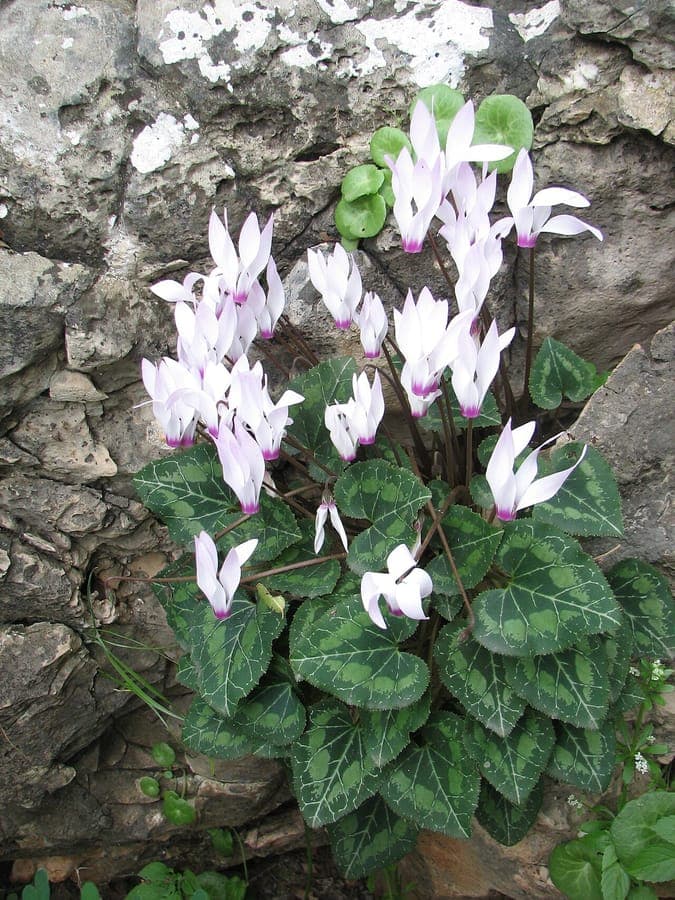
Hanay / CC BY-SA 3.0, via Wikimedia Commons
Florist's cyclamen: complete guide
Cyclamen persicum
Want to see Florist's cyclamen: complete guide in your garden?
1 minute, no credit card
Overview
Cyclamen persicum, commonly known as Florist's cyclamen, is a winter standout among houseplants. Native to the Mediterranean region – including Greece, Cyprus, and parts of Turkey – it thrives in cool, bright conditions. You'll commonly find it in garden centres from October through April, often sold in 12–15 cm pots. Its charm lies in the upswept petals and marbled, heart-shaped leaves. But don't be fooled by its delicate look; with proper care, it can bloom for months and return season after season.
On gardenworld.app, you can design a seasonal planting plan that integrates Cyclamen persicum into shaded window boxes or cool conservatories.
Appearance & bloom cycle
The foliage is heart-shaped, 3–8 cm across, dark green with silver-gray marbling that follows the leaf veins. Flowers rise on slender, curving stems, each with five reflexed petals in shades of pink, magenta, white, or pale lavender. Bloom time runs from November to April, peaking in December and January. A healthy plant produces 15–30 flowers per season, often with new buds emerging as older blooms fade.
Watch for tightly closed buds – a sign of vitality. If blooming slows in midwinter, don't assume it's done. With stable conditions, many plants surge again in late winter.
Ideal location
Choose a bright, cool spot away from direct sun. North- or east-facing windowsills work best. Direct afternoon sun scorches leaves and shortens bloom life. Ideal temperatures are between 13°C and 18°C (55–65°F). Avoid placing near radiators or heat vents.
They appreciate fresh air but hate drafts. A cool bathroom or enclosed porch with daylight is ideal. If moving outdoors in spring, wait until night temps stay above 7°C. Place in light shade under shrubs or on a covered patio. USDA zones 9–10 are the only areas where outdoor overwintering is possible.
Soil requirements
Use a well-draining, humus-rich potting mix. A blend of two parts peat-free compost, one part perlite, and one part leaf mould works well. pH should be slightly acidic to neutral (6.0–7.0). Avoid heavy, water-retentive soils.
Ensure pots have drainage holes. Add a 2–3 cm layer of gravel or hydroponic clay pebbles at the base. Space plants 10–15 cm apart in containers to allow airflow. In garden beds, amend soil with composted bark or well-rotted leaf litter.
Free design
Want to see Florist's cyclamen: complete guide in your garden? Make a free design now.
Watering
Water from the bottom. Pour water into the saucer and let the plant absorb it for 10–15 minutes, then discard excess. Never let the corm sit in water. Overhead watering can lead to corm rot, especially if water pools in the crown.
Check the top inch of soil: water only when it feels dry but not baked. During active growth (Nov–Apr), water once a week. Reduce watering as blooms fade in spring. During dormancy (Jun–Aug), water sparingly or not at all.
Pruning
Remove spent flowers and yellowing leaves with clean, sharp scissors. Cut stems close to the base – don't pull. This prevents disease and encourages new growth. As the plant enters dormancy in late spring, let foliage die back naturally. Only cut when completely yellow.
Feed with a balanced liquid fertiliser (NPK 5-10-10) every two weeks during bloom. Stop feeding by June. Over-fertilising causes weak foliage and fewer flowers.
Maintenance calendar
- Oct–Nov: Acquire or wake from dormancy. Place in cool, bright spot. Begin watering.
- Dec–Feb: Peak bloom. Water weekly, deadhead regularly.
- Mar–Apr: Bloom tapers. Gradually reduce watering.
- May–Jun: Dormancy begins. Move to a shaded, cool area. Stop watering.
- Jul–Sep: Corm rests. Check monthly for mould or shrivelling.
On gardenworld.app, generate a custom care schedule that syncs with your local frost dates and indoor climate.
Winter hardiness
Cyclamen persicum is not hardy in most of the UK and US (USDA zones below 9). It cannot survive prolonged freezing. The corm rots at temperatures below -2°C. In mild coastal areas (zone 9+), it may survive outdoors with 10 cm of mulch and a sheltered, well-drained spot.
In colder areas, grow as a houseplant or seasonal patio container. Bring indoors by late September to avoid cold shock.
Companion plants
Pair with other cool-season bloomers like Primula, Hellebores, or dwarf Iris. In containers, combine with ferns or Carex for texture. Avoid pairing with succulents or heat-loving Pelargoniums – they need opposite conditions.
In woodland gardens (zone 9+), plant under deciduous trees where dappled shade and leaf litter mimic natural habitat.
Closing
Cyclamen persicum isn't a disposable plant. Many toss it after bloom, but with proper care, it can rebloom for years. Focus on cool temps, bottom watering, and a proper dormancy period. Buy from reputable sources like garden centres with high stock turnover – look for compact growth and unopened buds.
Respect its rhythm: it blooms in cold months, rests in summer. Give it space, cool air, and consistency, and it'll reward you with delicate winter beauty.
Want to see Florist's cyclamen: complete guide in your garden? Make a free design now.
Upload a photo, pick a style, and get a photorealistic design with plant list in under a minute.
No credit card required


Similar plants
Primula incana: complete guide to silvery alpine primrose
Primula incana
Silvery primrose (Primula incana), a delicate alpine flower with white blooms and powdered grey-green leaves. Growing, care, and cultivation guide.
Mealy cowslip: complete guide
Primula pulverulenta
Grow the Mealy cowslip (Primula pulverulenta): striking candelabra flowers in red and purple tones, moisture-loving and ideal for shady, damp garden corners.
Cliff dwarf-primrose: complete guide
Androsace laevigata
Full guide to growing Androsace laevigata, a rare Pacific Northwest alpine cushion plant. Planting, care, and garden design tips explained.