
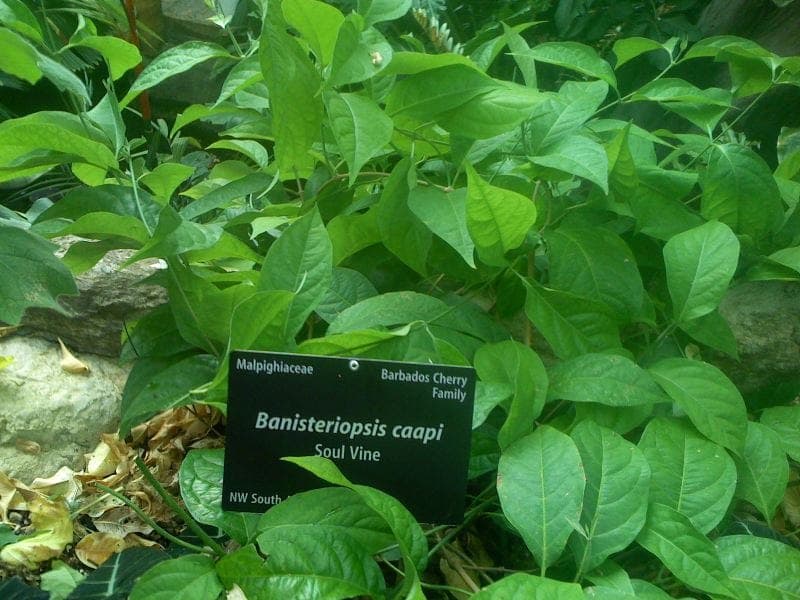
Original uploader was Wowbobwow12 at en.wikipedia / CC BY-SA 3.0, via Wikimedia Commons
Banisteriopsis caapi: complete guide
Banisteriopsis caapi
Want to see Banisteriopsis caapi: complete guide in your garden?
1 minute, no credit card
Overview
Banisteriopsis caapi, commonly known as Ayahuasca, Caapi, or Soulvine, is a fascinating tropical ornamental climber from the Amazon rainforest region of South America. This member of the Malpighiaceae family naturally occurs in Peru, Colombia, Ecuador, and Brazil. In milder climates, this plant offers substantial ornamental value through its attractive flowers and elegant climbing habit.
While typically cultivated as an annual specimen in much of Europe, this plant grows permanently in subtropical gardens. This is a true Amazonian treasure.
Appearance and Bloom
Banisteriopsis caapi grows as a vigorous, woody climber with thin, flexible stems reaching 10 meters or longer. The plant is fast-growing in warm climates. Leaves are simple, elliptical shaped leaflets 8-15 centimeters long, green and glossy.
Flowers appear in spring and summer in clusters or racemes, displaying yellow to orange coloration highly attractive to bees and butterflies. Each flower features five petals and characteristic asymmetrical form. Following pollination, wing-like fruits (samaras) develop dispersing by wind.
Leaves may develop subtle red coloration during growth, particularly in strong light. Combined with yellow flowers, this creates a highly ornamental plant.
Ideal Location
Banisteriopsis caapi thrives in full sun to light shade. Position on a south-east or south-west facing location providing minimum six hours daily sunlight. The plant tolerates light partial shade but flowers more abundantly in full sun.
Provide support: a sturdy trellis, pergola, or support structure is essential. The plant climbs walls or spreads over structures. Protected locations are preferable in cooler regions.
Soil
Banisteriopsis caapi prefers rich, well-draining soil. Use a mixture of garden soil, compost, and coarse sand in roughly equal parts. The plant performs better in nutrient-rich soils with good organic content.
Acidic to neutral pH (6.0 to 7.0) is ideal. Waterlogged soils cause root rot; ensure excellent drainage.
Watering
Banisteriopsis caapi requires regular moisture during the growing season. Water deeply but allow soil to dry somewhat between applications. This is not a plant for dry climates without irrigation.
During the growing season (spring and summer), water two to three times weekly. In winter, reduce watering substantially, particularly in cooler climates.
Free design
Want to see Banisteriopsis caapi: complete guide in your garden? Make a free design now.
Feeding
Apply regular feeding during the growing season (April through October) with balanced fertilizer. This supports flowering and growth. Minimize feeding in winter.
Pruning
Banisteriopsis caapi performs better with regular pruning. Cut back in early spring before growth begins. This promotes denser growth and more flowers. Remove dead or diseased wood as needed.
Overgrown plants can be cut back drastically; they recover quickly.
Maintenance Calendar
Spring: Prune back. Start feeding program. Plant young specimens.
Summer: Water regularly. Enjoy flowers. Monitor for pests.
Autumn: Reduce watering. Gradually cease feeding.
Winter: Minimal care in warm environments. In cooler areas: protect or move indoors.
Winter Hardiness
Banisteriopsis caapi is not winter hardy outdoors in most of Europe. The plant dies above the frost line. In temperate climates, grow plants in containers and bring indoors for winter.
In subtropical zones (southern Spain, southern Portugal, southern France, southern Italy), the plant can grow outdoors in protected positions with frost protection.
Companion Plants
Combine with other tropical climbers and flowering plants. Passion flower, clematis, hibiscus, and other tropical flowering plants make good companions.
Propagation
Banisteriopsis caapi can be propagated by seed or soft-wood cuttings. Seeds germinate quickly in warm, moist conditions. Cuttings root well in moisture pots under warmth.
Closing
Banisteriopsis caapi is a fantastic plant for those seeking to grow tropical climbers. With its vigorous growth, attractive flowers, and elegant climbing habit, it adds substantial ornamental value. For subtropical gardens it is an excellent choice; for temperate climates it can be enjoyed as an annual specimen or container plant.
Specialized nurseries and tropical growers stock seeds and young plants. Begin with seed and enjoy the growing process.
Gardenworld.app helps you incorporate tropical climbers in your design. Ornamental Ayahuasca is just one of many possibilities.
Gardenworld.app: your guide to tropical beauty.
Want to see Banisteriopsis caapi: complete guide in your garden? Make a free design now.
Upload a photo, pick a style, and get a photorealistic design with plant list in under a minute.
No credit card required


Similar plants
Peanut butter fruit: complete guide
Bunchosia glandulifera
Full guide to Bunchosia glandulifera, the peanut butter fruit shrub: care, siting, fruiting, overwintering in pots, and tropical garden companions.
Acerola cherry: complete guide
Malpighia emarginata
Grow your own acerola cherry tree with this practical guide covering planting, care, and harvesting tips.
Byrsonima crassifolia: complete guide
Byrsonima crassifolia
Discover the nance fruit: a tropical fruit tree with golden flowers and medicinal properties. Growing guide for warm climates.