
Anton Hartinger / Public domain, via Wikimedia Commons
Lesser masterwort: complete guide
Astrantia minor
Want to see Lesser masterwort: complete guide in your garden?
1 minute, no credit card
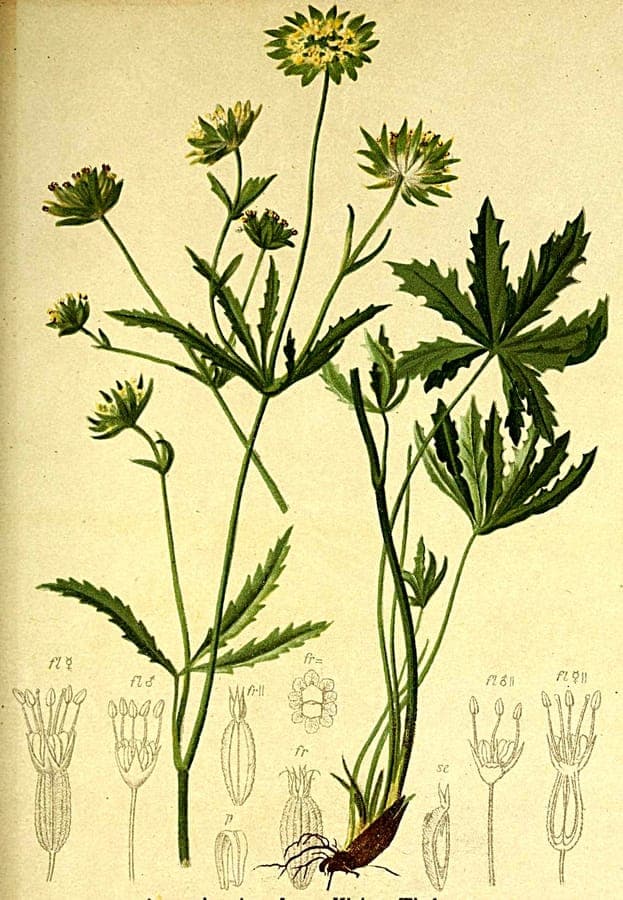
Lesser masterwort (Astrantia minor) is an elegant alpine plant native to the Pyrenees, Swiss Alps, and northern Italian mountain ranges. This remarkable plant reaches only 30 to 50 cm height, combining delicate, architectural flower structure with finely dissected foliage.
The flower umbels are unique and beautiful. Each flowerhead consists of numerous tiny white or pink florets surrounded by a crown of colored bracts (involucral leaves) radiating outward like star points. This gives the name 'Astrantia' (aster = star, anti = flower). The bracts are white-pink-tinged, sometimes soft green. Flowering peaks July to August.
The foliage is deeply incised, almost finely divided structure, dark green, forming compact rosettes at the base. After flowering, interesting brown seedheads form. The plant dies back after seed ripening in October, with above-ground parts browning but underground parts surviving.
This plant is hardy to USDA zone 4 (-28 degrees Celsius). In northern Europe, it grows without issues outdoors.
Ideal growing conditions: partial shade to full sun (minimum 3 hours daylight; afternoon sun minimized in hot regions). The plant thrives best in alpine/subalpine locations with cool summers.
Soil: well-draining, not heavy clay. pH 4.5 to 5 is ideal (acid-tolerant). Add compost at planting. The plant enjoys consistent moisture during growth but hates standing water.
Watering: water regularly during dry spells, especially in full sun. In shade, much less needed. After establishment (year 2+), rarely needs supplemental water in temperate climates.
Feeding: minimal required. Light compost mulch (leaf mold) in autumn suffices. Excessive feeding promotes lush foliage at the expense of flowers.
Pruning: after flowering, remove faded flowers and stems for tidy appearance. Leave some seedheads for self-seeding.
Propagation: sow seed in autumn in cold frame or immediately after ripening. Seeds germinate in spring after cold period (vernalization). Division possible in early autumn.
Combinations: this delicate plant grows beautifully in alpine gardens with other alpine flowers like Saxifraga, Sempervivum, low Pulsatilla. In border context: combine with soft-colored Alchemilla, low-growing Dianthus, Geranium.
Cut flower: yes, excellent! Flowers last 1 to 2 weeks in vase; fragrance minimal. Cut in morning as buds just open.
Common problems: in very wet periods, possible leaf rot. Ensure good drainage. Slugs occasionally problematic; set beer traps.
Availability: in northern Europe, specialist nurseries stock young plants (16 cm pots). For better selections: nurseries in Swiss-German regions. Online seed available.
Common names: Lesser masterwort, also: Little Radiaire. Family name: Apiaceae (parsnip family).
A beautiful, understated alpine plant for gardeners with patience for alpine and dappled-shade conditions.
Want to see Lesser masterwort: complete guide in your garden? Make a free design now.
Upload a photo, pick a style, and get a photorealistic design with plant list in under a minute.
No credit card required


Similar plants
Whorled carrot: complete guide
Daucus involucratus
Daucus involucratus is a Mediterranean umbellifer with white flower heads framed by lacy bracts. Growing this gravel garden gem.
Daucus muricatus: complete guide
Daucus muricatus
Daucus muricatus, the spiny wild carrot, grows wild on Mediterranean coasts. Discover sowing, June-July bloom, and wildflower meadow use.
Daucus pumilus: complete guide
Daucus pumilus
Daucus pumilus is a dwarf wild carrot relative with white lacy umbels, thriving on dunes and coastal rock in poor, fast-draining soil.