
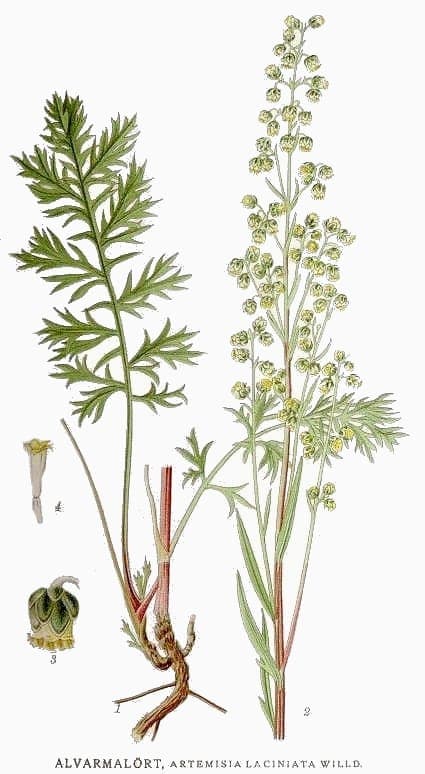
Carl Axel Magnus Lindman / Public domain, via Wikimedia Commons
Siberian wormwood: complete guide
Artemisia laciniata
Want to see Siberian wormwood: complete guide in your garden?
1 minute, no credit card
Overview
Siberian wormwood (Artemisia laciniata) is a herbaceous perennial with an exceptionally wide native range: from central and eastern Europe across Russia and Siberia to Japan, Alaska and several North American mountain states including Colorado, Idaho, Utah and New Mexico. The species was described scientifically in 1803 by the German-Dutch botanist Carl Ludwig Willdenow, who recognised it as distinct from the more familiar common wormwood (Artemisia absinthium) and mugwort (Artemisia vulgaris) on account of its deeply dissected leaves. As a member of the Asteraceae family it shares the hallmark traits of its genus: intensely aromatic foliage, modest flower clusters and remarkable tolerance of climatic extremes. In garden practice, Siberian wormwood is valued for its feathery silver-grey foliage, its exceptionally low maintenance demands and its suitability for some of the most challenging dry and rocky conditions. On gardenworld.app you will find planting schemes that feature this striking plant in naturalistic borders and rockeries.
Appearance and bloom cycle
Siberian wormwood is a compact perennial growing 30 to 60 cm tall. The stems are erect to ascending, covered with fine silky hairs that give the whole plant a grey-green sheen. The leaves are the plant's defining feature: deeply pinnately dissected almost to the midrib into narrow, lance-shaped segments. This fine dissection clearly distinguishes Artemisia laciniata from coarser-leaved relatives and gives it an elegant, airy silhouette. Leaves are grey-green above and whitish-felted beneath. The fragrance is strong and characteristically aromatic, as expected for the wormwood genus. Flowering occurs from August into September. The flowers are small, yellowish, arranged in branching panicles. As with most Artemisia species the individual flowerheads are botanically unspectacular, but the overall flower mass adds a light, feathery texture to the late-summer garden.
Ideal location
Across its broad native range, Siberian wormwood grows in open, dry steppe grasslands, rocky slopes, riverbanks and alpine meadows. It thrives in full sun to semi-shade; full sun promotes the most compact growth habit and the most attractive grey-silver leaf colouration. It is particularly suited to rock gardens, gravel beds and dry naturalistic borders. In urban gardens in northern Europe, it fits well into the growing trend for low-maintenance and biodiversity-friendly planting. It can also serve effectively as a groundcover on dry, poor spots where other perennials struggle to establish.
Soil
Siberian wormwood is undemanding regarding soil. In the wild it colonises poor, mineral and freely draining substrates. Both alkaline and mildly acidic soils are tolerated well. The only serious limitation is poor drainage: stagnant moisture causes root rot and can kill the plant within a single growing season. On heavy clay soils it is strongly advisable to raise the planting position or to incorporate coarse sand to improve permeability. Lean soils actually produce the most compact and ornamental growth habit; fertile soils with high humus content lead to lax, less attractive plants that are more vulnerable to winter damage.
Watering
Given its natural range across continental steppe and subarctic regions, Siberian wormwood is an exceptionally drought-tolerant plant. It is accustomed to dry summers and cold, relatively dry winters. Once established in the garden it needs little or no supplementary irrigation. During the first summer after planting, regular watering helps the roots to establish; thereafter, the gardener can be very restrained - a deep drink once or twice per month during actual drought periods is usually sufficient. Overwatering is a common mistake: the combination of excessive moisture and poor soil aeration is the most frequent cause of failure with wormwood species in cultivation.
Free design
Want to see Siberian wormwood: complete guide in your garden? Make a free design now.
Pruning
Pruning Siberian wormwood is simple and effective. In early spring, once the main frost period is over (typically March), cut the old stems back to 5 to 10 cm above ground level. This stimulates fresh regrowth and gives the plant a tidy, compact habit for the new season. A light trim of flowering tips in midsummer can extend the plant's vigour and limit self-seeding. In late autumn or winter, the dead stems can be left standing to provide shelter for overwintering insects and seeds for birds.
Maintenance calendar
January-February: dormancy, no work needed. March: cut back to 5-10 cm; divide the rootball for propagation if needed. April-May: new shoots appear; check for weeds and water lightly if the soil is very dry. June-July: rapid growth; enjoy the silver-grey foliage and ensure drainage is adequate after heavy rain. August-September: flowering period; the aromatic scent is particularly noticeable on warm evenings. September-October: seeds ripen; leave flower panicles for birds or collect seed for propagation. October-November: above-ground foliage begins to die back; tidy up if preferred. December: full dormancy; no intervention needed.
Winter hardiness
Siberian wormwood is among the hardiest perennials available for cultivation in western European gardens. Thanks to its native range - which includes Alaskan tundra, Siberian steppe and subarctic North America - it survives temperatures far below -30 degrees Celsius, corresponding to USDA hardiness zone 3 or lower. In Belgian and Dutch gardens (USDA zones 7 to 8) it overwinters without any difficulty whatsoever, even in the most severe winters on record. The one exception is wet winters on poorly drained soils, which can cause more damage than cold temperatures alone. Good drainage is therefore the single most important factor for successful overwintering. Above-ground growth dies back in winter but the plant reliably regrows from the rootstock in spring.
Companion plants
Siberian wormwood combines beautifully with other drought-tolerant and cool-climate perennials. Its finely dissected silver-grey foliage contrasts attractively with the rounder, broader leaves of sedums (Sedum), ornamental alliums (Allium) or catmint (Nepeta). In dry borders and rock gardens it pairs well with lavender (Lavandula angustifolia), wild carrot (Daucus carota) and blue grasses such as blue fescue (Festuca glauca). The fine leaf texture provides a visual contrast to the broader, flatter foliage of anemones or rue (Ruta graveolens). In terms of colour, its grey-green complements the warm yellows and oranges of Helenium or Rudbeckia particularly well in the late-summer and early-autumn border. Visit garden centres for Artemisia species alongside other aromatic herbs, or explore the plant combination tools at gardenworld.app to find the perfect planting partners for your space.
Closing thoughts
Siberian wormwood is an understated but outstandingly reliable perennial for naturalistic planting, rock gardens and dry borders. Its feathery silver foliage is decorative throughout the entire growing season, its late-summer bloom is subtle but charming, and its winter hardiness is virtually unsurpassed among garden perennials. It asks little: no supplementary feeding, minimal watering after establishment, a simple annual spring cut-back. Gardeners who need a plant that genuinely thrives under difficult conditions - dry steppe-like summers, poor soil, full sun - will find Artemisia laciniata a reliable and elegant solution. On gardenworld.app you can browse full planting designs that make the most of this species in combination with other resilient perennials suited to the modern low-maintenance garden.
Want to see Siberian wormwood: complete guide in your garden? Make a free design now.
Upload a photo, pick a style, and get a photorealistic design with plant list in under a minute.
10,000+ gardens designed already
No credit card required


Similar plants
Douglas mugwort: complete guide
Artemisia douglasiana
Everything you need to know about Douglas mugwort, an aromatic perennial from western North America that thrives in dry, sunny conditions.
Felonherb: complete guide
Artemisia vulgaris
Learn how to grow Artemisia vulgaris (Felonherb) successfully in your garden. Full details on sun, soil, care and companion planting.
Yarrow: complete guide
Achillea millefolium
Master Achillea millefolium care: low-maintenance perennial for sun, poor soil, drought resistance, and colorful blooms year after year.