
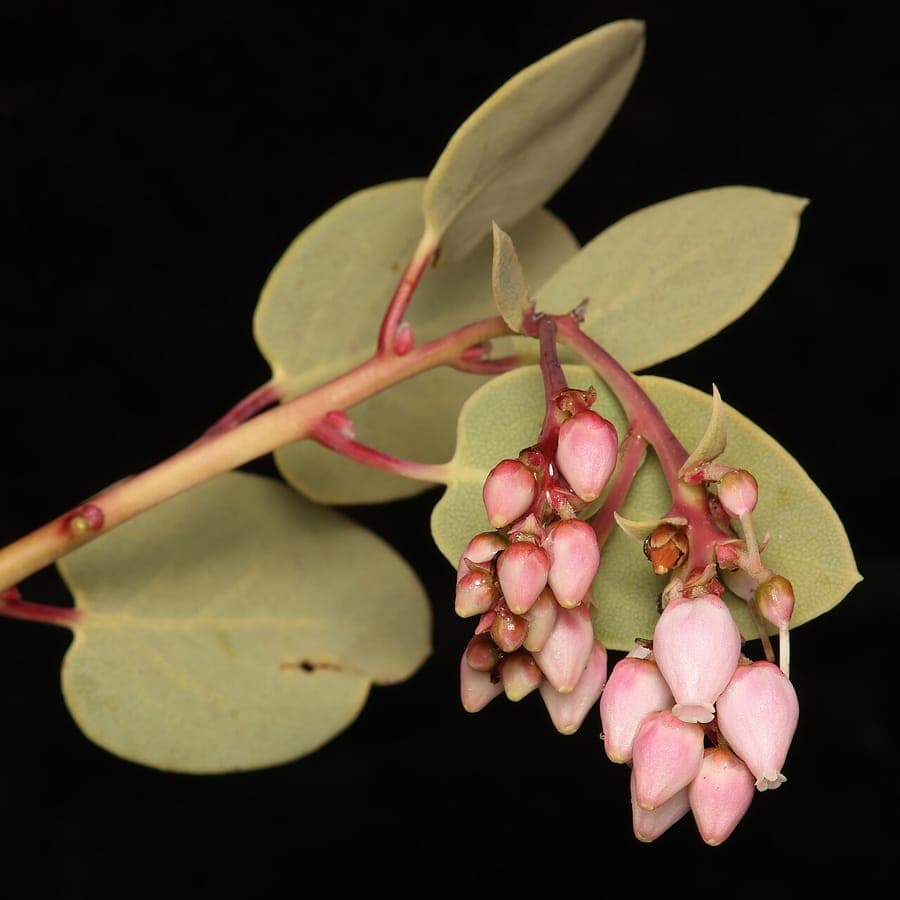
Nicholaswei / CC BY-SA 4.0, via Wikimedia Commons
Bigberry manzanita: complete guide
Arctostaphylos glauca
Want to see Bigberry manzanita: complete guide in your garden?
1 minute, no credit card
Overview
Arctostaphylos glauca, commonly known as bigberry manzanita, is an imposing, evergreen shrub or small tree belonging to the heath family (Ericaceae). Native to the chaparral and open woodland habitats of central and southern California, extending into Baja California Norte in Mexico, it ranks as one of the largest species within the diverse genus Arctostaphylos, which contains over 60 species almost entirely restricted to western North America.
The species name 'glauca' refers to the distinctive blue-green colour of the leaves, produced by a waxy bloom that also makes the leaf surface water-repellent and helps the plant manage the intense summer drought of its native California range. The common name 'manzanita' is Spanish for 'little apple', a reference to the rounded, apple-like fruits that ripen on the plant through summer and autumn.
For gardeners pursuing a Mediterranean or California-inspired design, bigberry manzanita offers a compelling combination of characters: sculptural multi-stemmed form, spectacular peeling mahogany bark, white winter flowers that support early pollinators, and ornamental berries. Explore how to incorporate character shrubs like this into a complete front garden design on gardenworld.app.
Appearance and bloom cycle
In its native California habitat, Arctostaphylos glauca can reach 2 to 5 metres or more in height, forming a large, multi-stemmed shrub or small tree with an open, picturesque silhouette reminiscent of an olive or madrone. In cultivation outside its native climate, plants typically remain somewhat more compact, though the growth habit remains strongly architectural.
The most visually striking feature of bigberry manzanita is undoubtedly its bark: smooth, deep reddish-brown to mahogany in colour, polished in appearance, and partially exfoliating each year to reveal fresh, glossy tissue beneath. This peeling bark process is ornamental throughout the year and one of the primary reasons manzanitas are prized in year-round interest gardens.
The leaves are leathery, elliptic to oval, and display the glaucous blue-green colouration implied by the species name. Leaf edges are smooth and entire. Flowers are small and urn-shaped, white to very pale pink, and carried in pendulous clusters at the branch tips. The blooming season falls in early spring, typically January to March, a time when very few other shrubs are flowering, making it exceptionally valuable for overwintering queen bumblebees and early honeybees.
Following flowering, the conspicuous fruits develop: large, rounded berries 1 to 2 cm in diameter, ripening through green, reddish-brown, to deep brown through late summer and autumn. The berries are edible but mealy in texture and were traditionally used by indigenous Californian peoples to produce a sweet drink. In the garden they provide food for birds and add further ornamental interest.
Ideal location
As a chaparral species at heart, Arctostaphylos glauca demands maximum sun exposure. Full sun, ideally on a south- or southwest-facing aspect with no overhanging shade, is non-negotiable for healthy, floriferous growth. In shadier conditions the plant grows slowly, flowers less freely, and becomes significantly more susceptible to fungal diseases.
In the European garden, bigberry manzanita sits most naturally in Mediterranean or California-inspired settings: as a specimen plant on a dry, stony terrace, against a warm sunny wall, as a corner accent in a gravel garden, or on a well-drained sunny slope. It makes a bold, long-lived structural plant that anchors a planting composition with its architectural form.
Avoid positions with stagnant humid air or dense planting where air circulation is restricted. In the most oceanic climates of western Europe - coastal western France, western Netherlands, coastal Belgium - the combination of cool, wet summers and mild but persistently damp winters makes long-term outdoor success challenging. In warmer, more sheltered continental positions with drier summers, success is more realistic. In northern regions, growing in a large container on a sunny south-facing terrace, with winter protection from excess rainfall, is the most reliable approach. Learn how to design Mediterranean-style container plantings on gardenworld.app.
Soil
Soil requirements for Arctostaphylos glauca closely mirror those of other members of the heath family: lean, sharply drained, and slightly acidic to neutral. In nature the species grows on impoverished, sandy or rocky soils with a pH of 5.9 to 7.0. Rich, moisture-retentive, or alkaline soils are fatal to this species in the long run.
For garden cultivation, a mix of two thirds coarse, sandy, or lightly loamy soil and one third perlite or coarse grit provides a sound foundation. As with rhododendrons and other heath family relatives, incorporating some acidic leaf mould or peat-free acidic compost is permissible, but avoid over-enriching: the species is adapted to poor ground and blooms more freely and lives longer in lean conditions.
Do not add lime to the soil or irrigate long-term with hard, alkaline water. Chlorosis - yellowing leaves caused by iron deficiency in high-pH soils - is a common problem for Ericaceae species in alkaline conditions and weakens the plant progressively.
When planting, ensure the root ball sits at exactly the correct depth with the root collar at soil level. Planting too deep can cause bark disease at the collar. A generous mulch of wood chip or pine bark around the root zone - kept away from direct contact with the trunk - maintains soil moisture, regulates temperature, and improves the acidic humus layer over time.
Watering
Arctostaphylos glauca is among the most drought-tolerant evergreen shrubs available for temperate gardeners. In its native California, the species routinely survives summer droughts of five to six months with no supplemental irrigation. After establishment, mature plants in suitable soils in European gardens require minimal or no supplemental watering even during dry summers.
The critical period is establishment: newly planted specimens need regular watering in their first one to two growing seasons to develop the deep root system that makes them drought-resistant. After that, watering can be dramatically reduced. A useful rule: water only when the top 5 to 8 cm of soil is completely dry. Never water when the soil still feels moist.
Over-watering is the primary cause of death in manzanitas in cultivation, leading to Phytophthora root rot - a soil-borne disease that kills the root system. If a manzanita begins to look wilted or discoloured despite regular watering, stop watering immediately and check for root problems rather than increasing irrigation.
In winter, when the plant is in relative dormancy and rainfall is highest, protecting the root zone from excess wet is more important than providing additional water. A temporary rain shelter or well-positioned overhang can make a significant difference in persistently wet winters.
Free design
Want to see Bigberry manzanita: complete guide in your garden? Make a free design now.
Deadheading and tidying
Arctostaphylos glauca requires minimal intervention and is notably sensitive to heavy pruning. Unlike many shrubs, bigberry manzanita responds poorly to hard cutting back: the plant recovers slowly and may fail to regenerate from old wood if cut too severely.
Light shaping immediately after flowering in spring is acceptable. At this point, remove any dead or damaged branches and, if necessary, trim a few overextending shoots to maintain the desired silhouette. Always use clean, sharp tools to minimise the risk of wound diseases. Make cuts to a healthy side branch rather than leaving stubs.
The naturally exfoliating bark requires no intervention - this is an ornamental process and part of the plant's natural biology. Dead bark flaking away from the stem is normal and healthy. Do not remove it unless there are clear signs of disease beneath.
A light tidy-up every two to three years is ample for a healthy, well-sited plant. Follow the plant's natural habit rather than trying to impose a formal shape: the picturesque, irregular silhouette of a mature manzanita is precisely its greatest visual strength.
Maintenance calendar
A year in the life of Arctostaphylos glauca:
January to March: Flowering period. The urn-shaped white flower clusters appear at branch tips, supporting early pollinators. This is the ornamental peak of the year. No intervention needed. Avoid watering during rainy periods.
March to April: Post-flowering. Undertake any light pruning needed for shaping. Check the soil structure and drainage. Remove any vigorous competing plants growing close to the root zone.
April to June: Spring growth. The plant grows actively but moderately. No fertiliser. No watering unless the spring is very dry and the plant is young.
July to September: Berries ripen from green to reddish-brown, attracting birds. This is the driest period. Established plants need no watering. Young plants: water moderately only when soil is completely dry. Observe how fruit-bearing shrubs transform the summer garden on gardenworld.app.
October to November: Autumn rains return. The plant benefits from rainfall after summer dormancy. Remove fallen leaves from around the base to prevent fungal build-up.
December: The plant prepares for its winter bloom. No interventions needed. In wet climates, ensure drainage is functioning and consider rain protection over the root zone.
Winter hardiness
Arctostaphylos glauca is moderately cold-hardy: the species tolerates light frost down to approximately -8 to -10 degrees Celsius without serious injury. This places it in USDA hardiness zones 8 to 9, which means it is not fully winter-hardy in most of the Netherlands, Belgium, Germany, or northern France, and will require protection or winter shelter in colder regions.
In milder coastal areas of western Europe - the Adriatic coast, the Atlantic coast of France, the mildest parts of southern England - outdoor cultivation in a well-sheltered, well-drained position is realistic. In more continental climates with regular hard frosts, growing the plant in a large container that can be moved to a frost-free but cool and bright space for winter is the safest approach.
As with its drainage requirements in summer, the primary winter threat is the combination of frost and wet soil: this combination promotes Phytophthora and other root diseases rapidly. A dry, well-draining soil and protection from winter precipitation are the two pillars of successful overwintering.
A deep bark mulch around the root zone provides ground insulation during brief light frosts. Cover the canopy with horticultural fleece during forecast frost spells below -5 degrees Celsius. Remove coverings promptly when temperatures moderate to prevent condensation beneath.
Companion plants
Arctostaphylos glauca fits naturally into dry, Mediterranean-inspired plantings. Ideal companion plants include:
Ceanothus species (California lilac): the vivid blue or purple flower clusters of Ceanothus make a spectacular visual complement to the white flowers and ornamental bark of manzanita. Both are California chaparral natives with identical requirements for poor, dry, well-drained soils.
Salvia species (ornamental sage): aromatic, drought-tolerant California or Mediterranean sages pair beautifully with Arctostaphylos, providing summer flower colour after the manzanita's winter bloom has finished.
Rosmarinus officinalis (rosemary): rosemary shares the preference for dry, sandy soils and full sun and forms a low, fragrant understorey beneath the larger manzanita canopy.
Lavandula angustifolia (lavender): rows of lavender as a low foreground planting beneath manzanita create a classically Mediterranean atmosphere with complementary fragrance.
Helichrysum species (curry plant, straw flower): the silver foliage and yellow flowers of helichrysum contrast attractively with the dark, polished bark of bigberry manzanita.
Avoid moisture-loving companions, dense groundcovers that retain soil moisture, or vigorous plants that might damage the bark or root zone.
Closing thoughts
Arctostaphylos glauca is a plant for the visionary gardener: its stately multi-stemmed form, spectacular peeling bark, early winter blooms, and ornamental berries make it an exceptional choice for Mediterranean and California-inspired garden designs. It asks to be respected on its own terms: lean soil, full sun, restraint with watering and cutting, and protection from cold, wet winters. Given those conditions, bigberry manzanita repays the investment with decades of increasing magnificence - a living sculpture that grows more character with every passing year. Discover how to design with bold, drought-tolerant structural shrubs on gardenworld.app.
Want to see Bigberry manzanita: complete guide in your garden? Make a free design now.
Upload a photo, pick a style, and get a photorealistic design with plant list in under a minute.
10,000+ gardens designed already
No credit card required


Similar plants
Bear-grape: complete guide
Arctostaphylos uva-ursi
Bear-grape (Arctostaphylos uva-ursi) is a tough, evergreen groundcover that thrives in dry, sunny spots with well-drained soil. Ideal for slopes and rock gardens.
Irish strawberry-tree: complete guide
Arbutus unedo
Complete care guide for Arbutus unedo: growth, pruning, soil needs, and ideal planting location for a thriving evergreen specimen in temperate gardens.
Marsh daisy: complete guide
Armeria maritima
How to grow Armeria maritima in UK and US gardens. Perfect for rockeries, dry borders, and coastal areas. Low maintenance and drought tolerant.