
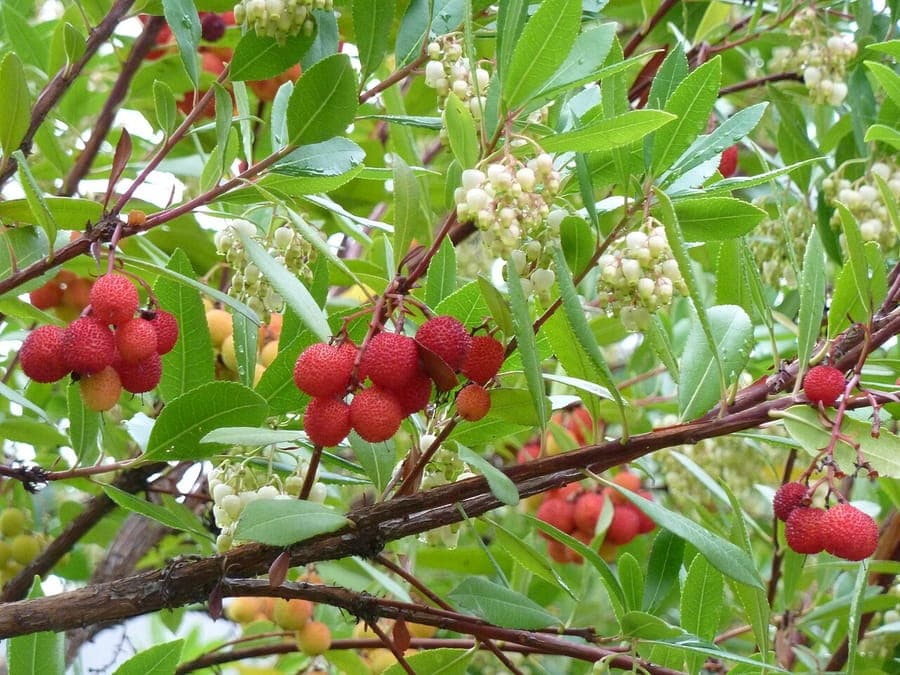
Wendy Cutler from Vancouver, Canada / CC BY 2.0, via Wikimedia Commons
Irish strawberry-tree: complete guide
Arbutus unedo
Want to see Irish strawberry-tree: complete guide in your garden?
1 minute, no credit card
Overview
Arbutus unedo, commonly known as the Irish strawberry-tree, is a striking evergreen shrub or small tree that brings year-round interest to temperate gardens. Native to the Mediterranean, it has proven surprisingly hardy in regions like the UK and the Pacific Northwest. It typically grows 4 to 8 meters tall with a spread of up to 5 meters, depending on whether trained as a tree or left as a multi-stemmed shrub. Its most distinctive feature is the simultaneous display of red, strawberry-like fruit and clusters of white, bell-shaped flowers in autumn.
On gardenworld.app you can design a garden layout that accommodates the mature size of Arbutus unedo, ensuring it has room to thrive without overcrowding.
Appearance & bloom cycle
The Irish strawberry-tree has glossy, leathery leaves 5–10 cm long with a slightly serrated edge and a wrinkled texture. These stay green all year, providing reliable structure. From October to December, it produces drooping clusters of creamy-white, urn-shaped flowers. At the same time, the fruit from the previous year ripens – bright orange to red, 1.5–2 cm in diameter, and bumpy like a strawberry.
The fruit is edible but often described as bland or mealy. Still, it's used in jams, liqueurs (like medronho in Portugal), and attracts birds. The dual display of bloom and fruit lasts 8–10 weeks, making it a standout in late-season gardens.
Ideal location
This plant thrives in full sun to partial shade, with a light preference of 6 out of 10. A south- or southwest-facing spot is ideal in cooler climates. While it tolerates light shade, flowering diminishes in low light. Young plants benefit from shelter from cold, drying winds, especially in exposed gardens.
It's tolerant of urban pollution and coastal conditions, making it a solid choice for city yards. Avoid frost pockets. On gardenworld.app you can assess sun exposure and wind patterns to find the perfect spot for your Arbutus unedo.
Soil requirements
Arbutus unedo prefers well-drained, acidic soil with a pH between 5.0 and 5.5. It struggles in heavy clay or alkaline soils. If planting in clay, amend the hole with ericaceous compost or pine bark to improve drainage and lower pH. Sandy soils are acceptable but may require organic matter to retain moisture.
Never plant in lime-rich soil – chlorosis (yellowing leaves) is a common issue. Mulch with pine needles or oak leaf litter to maintain acidity and moisture. Avoid disturbing roots once established.
Free design
Want to see Irish strawberry-tree: complete guide in your garden? Make a free design now.
Watering
Water deeply once a week during the first growing season, about 10–15 liters per plant. After year one, it becomes drought-tolerant but benefits from occasional deep watering during dry summers, especially in sandy soils.
Use rainwater when possible, as tap water can raise soil pH over time. Water at the base to keep foliage dry and prevent fungal diseases. Established trees rarely need supplemental water unless under prolonged drought.
Pruning
Minimal pruning is needed. For a tree form, select one main trunk and remove lower branches up to 1.2 meters. For a shrub, allow multiple stems. Prune in March or April to remove dead, crossing, or damaged wood. Avoid heavy pruning – recovery is slow.
Use clean, sharp tools and sterilize between cuts if disease is suspected. Never top the plant; it ruins the natural shape and delays flowering.
Maintenance calendar
- January: inspect for frost damage, remove broken branches
- February: clear debris around the base, check for pests
- March: light pruning, apply acidic mulch
- April: monitor for aphids or scale insects
- May: observe flower bud development
- June: no feeding required
- July: check young plants in dry spells
- August: reduce watering unless drought persists
- September: prepare for autumn bloom
- October: flowering begins, fruit ripens
- November: harvest fruit or leave for wildlife
- December: monitor for winter pests, protect young plants if needed
Winter hardiness
Hardy in USDA zones 8–10 (-12°C to -1°C). In zone 8, mature plants usually survive winter without issue. Young trees may suffer frost damage to foliage; protect with horticultural fleece in harsh winters. Avoid autumn pruning to prevent tender new growth.
In wet, cold winters, root rot can occur in poorly drained soils. Raised beds or slopes help in heavy soils.
Companion plants
Pair with other acid-loving plants: Rhododendron, Pieris, Kalmia, and Erica. Groundcovers like Pachysandra or Vinca minor work well underneath. For a Mediterranean look, combine with Cistus, Phlomis, or Cordyline.
Avoid lime-hungry plants like lavender or boxwood. Keep space clear around the trunk to prevent competition.
Closing
Arbutus unedo is a unique, low-maintenance evergreen that offers multi-season interest. With its unusual bloom time, edible fruit, and rugged charm, it's a conversation starter in any garden. Plant it right, and it can live for decades.
Buy from trusted garden centres like those found in your local area. Always check the root ball for health before planting. On gardenworld.app you'll find planting guides and design tools to help your Irish strawberry-tree flourish.
Want to see Irish strawberry-tree: complete guide in your garden? Make a free design now.
Upload a photo, pick a style, and get a photorealistic design with plant list in under a minute.
No credit card required


Similar plants
Zenobia pulverulenta: complete guide
Zenobia pulverulenta
Everything about Zenobia pulverulenta (honeycup): siting, acid soil, pruning and the fragrant white bells, in this complete care guide.
Dwarf huckleberry: complete guide
Gaylussacia dumosa
Everything about dwarf huckleberry (Gaylussacia dumosa): acidic soil, partial shade, pruning and care for this compact North American berry shrub.
Drooping leucothoe: complete guide
Leucothoe fontanesiana
Everything about drooping leucothoe (Leucothoe fontanesiana): shade tolerance, soil, watering, pruning, hardiness and companion plants.