
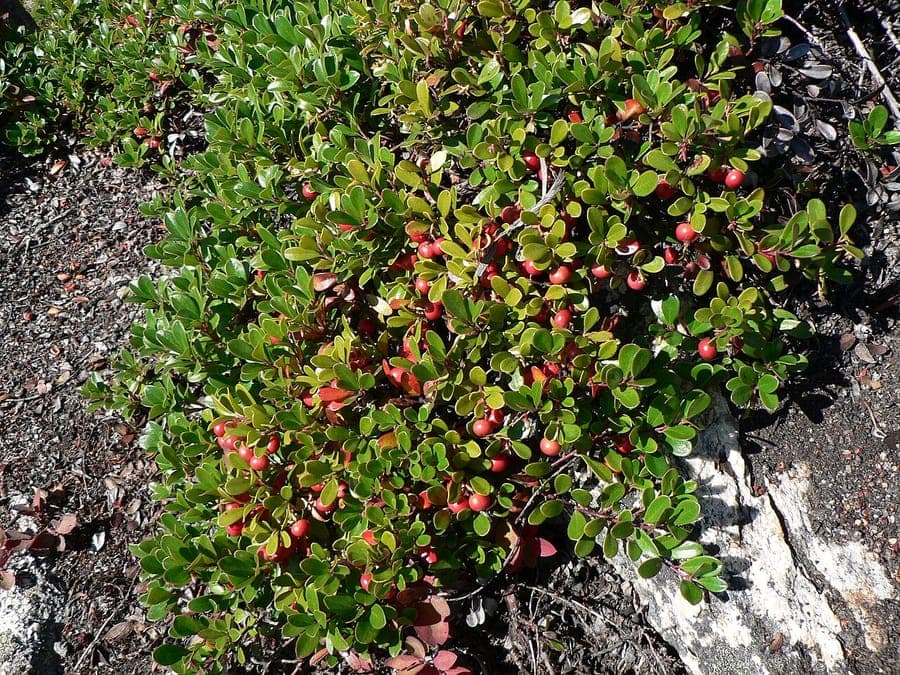
Walter Siegmund / CC BY 2.5, via Wikimedia Commons
Bear-grape: complete guide
Arctostaphylos uva-ursi
Want to see Bear-grape: complete guide in your garden?
1 minute, no credit card
Overview
Bear-grape, or Arctostaphylos uva-ursi, isn't the kind of plant that shouts for attention. It's the quiet achiever of the garden-steady, reliable, and tough as nails. A low-growing evergreen subshrub, it spreads slowly but surely, forming dense mats that suppress weeds and protect bare soil. Native to cool, rocky regions across North America, Europe, and Asia, it's built for harsh conditions: wind, cold, drought, and poor soil. If you've got a dry slope or a sunny rock garden where nothing else holds on, Bear-grape is worth a try.
Part of the Ericaceae family, it shares DNA with blueberries and rhododendrons, but unlike many of them, it tolerates a wider pH range-down to 5.5 and up to 8.0. That flexibility makes it a smart pick for alkaline sites where other acid-lovers struggle. On gardenworld.app you can design a planting scheme that highlights Bear-grape's strengths on exposed banks or between stepping stones.
Appearance & bloom cycle
This plant hugs the ground, rarely exceeding 15–30 cm in height, while spreading up to 1.5 meters wide. The leaves are small, leathery, and glossy, dark green above with a pale underside. New growth in spring often has a bronzy flush, maturing to deep green. In autumn, especially in full sun, they can turn reddish-brown-nothing dramatic, but a nice seasonal shift.
From April to May, clusters of delicate, urn-shaped flowers appear-white to pale pink, about 5 mm long. They're a magnet for early-season pollinators like bumblebees. By late summer, these develop into round, bright red berries, 6–8 mm across. They persist through winter, offering visual interest and a food source for birds when little else is available. The berries are edible but bland and dry-more of a survival snack than a treat.
Ideal location
Bear-grape wants sun-rate it a 7 or higher on the light scale. Full sun all day is best. It tolerates light shade, but growth slows, and the stems become leggy. Plant it on dry slopes, rock gardens, or sandy banks. It's excellent for stabilizing soil on erosion-prone areas. Avoid shady, damp corners; this plant despises wet feet.
Give it room to spread. It won't race forward, but over 3–5 years, it fills in nicely. Don't plant it where foot traffic or heavy mulch will smother it. On gardenworld.app, you can map out how Bear-grape fits into a xeriscape or native planting design.
Soil requirements
Drainage is non-negotiable. Sandy, gravelly, or loamy soils work best. Heavy clay? Amend it with coarse sand and organic matter like pine needles or leaf mold. The pH can range from 5.5 to 8.0-unusual for an Ericaceae. Avoid rich compost or fertilizer; it encourages weak growth prone to fungal issues.
A surface layer of gravel helps keep stems dry and improves winter drainage. No need for mulch-rock or bare soil is fine.
Free design
Want to see Bear-grape: complete guide in your garden? Make a free design now.
Watering
Water young plants regularly in the first growing season, especially during dry spells. Once established-usually by the second year-it's drought-tolerant. Only water in prolonged droughts, and then only at the base. Overhead watering can lead to fungal problems, so keep foliage dry.
Never let it sit in soggy soil. Root rot is the main killer. Water only when the top 2–3 cm of soil feels dry.
Pruning
Pruning isn't usually needed. The plant maintains its shape naturally. If it gets sparse or woody, lightly trim after flowering in June or July. Use clean, sharp shears. Avoid cutting into old wood-it rarely re-sprouts.
Remove dead or diseased stems in early spring. You can also thin out congested areas to improve airflow.
Maintenance calendar
- January: Check for winter damage. None expected.
- February: Clean and sharpen tools.
- March: Rake light debris. Watch for new growth.
- April: Flowers begin. No feeding.
- May: Peak bloom. Monitor for pollinators.
- June: Berries start forming. Light pruning if needed.
- July: Established plants need no water unless extreme drought.
- August: Minimal care. Watch for weeds around young plants.
- September: Growth slows. Prepare for dormancy.
- October: Remove fallen leaves near base.
- November: Leave berries for birds. No fertilizer.
- December: Final check-no action needed.
Winter hardiness
Hardy in USDA zones 2–7. That means it survives temperatures down to -40°C. In zone 8, it can work if the soil is perfectly drained. Foliage stays evergreen, but may scorch slightly in winter sun after hard frosts. No protection needed-it handles snow cover naturally.
Don't cover it. Snow is insulation, not a threat.
Companion plants
Pair with other drought-tolerant, sun-loving plants: creeping thyme, sedums, yarrow, or dwarf junipers. Avoid aggressive spreaders like English ivy. Bear-grape is slow-it can't compete.
In rock gardens, combine with cushion spurge, woolly thyme, or hare's foot clover. Under open shrubs, it works well with heathers or low ornamental grasses.
Closing
Bear-grape won't win any beauty contests, but it earns its place through resilience. It grows where grass fails, survives droughts, and asks for almost nothing in return. No pests, no diseases, no feeding. Just plant it right and step back. Buy it from garden centres like those in the UK or online nurseries, plant in sun, and let it do its thing. On gardenworld.app, you can visualise how Bear-grape weaves into a low-water, high-structure garden design.
Want to see Bear-grape: complete guide in your garden? Make a free design now.
Upload a photo, pick a style, and get a photorealistic design with plant list in under a minute.
No credit card required


Similar plants
Zenobia pulverulenta: complete guide
Zenobia pulverulenta
Everything about Zenobia pulverulenta (honeycup): siting, acid soil, pruning and the fragrant white bells, in this complete care guide.
Dwarf huckleberry: complete guide
Gaylussacia dumosa
Everything about dwarf huckleberry (Gaylussacia dumosa): acidic soil, partial shade, pruning and care for this compact North American berry shrub.
Drooping leucothoe: complete guide
Leucothoe fontanesiana
Everything about drooping leucothoe (Leucothoe fontanesiana): shade tolerance, soil, watering, pruning, hardiness and companion plants.