
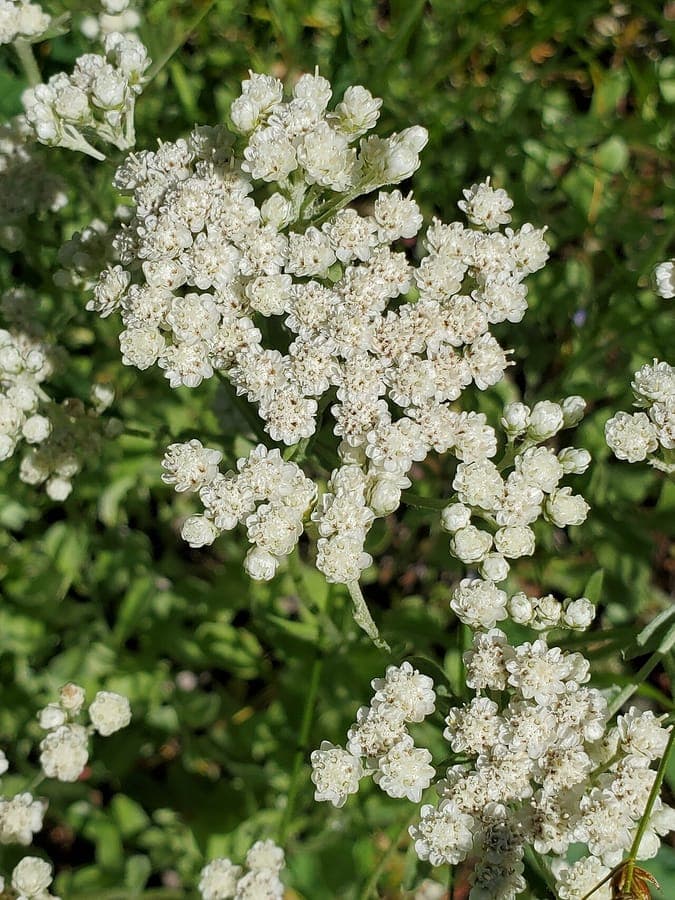
no rights reserved / CC0, via Wikimedia Commons
Silver pussytoes: complete guide
Antennaria argentea
Want to see Silver pussytoes: complete guide in your garden?
1 minute, no credit card
Overview
Antennaria argentea, commonly known as silver pussytoes, is a low-growing, mat-forming perennial belonging to the aster family (Asteraceae). Native to the western United States, where it occurs naturally in California, Nevada, Oregon, and Washington, this species typically colonises dry, rocky slopes, open pine forest margins, and lean, gravelly soils at a range of elevations. The species name 'argentea' is Latin for silvery, a direct reference to the characteristic white-felted leaf hairs that give the plant its distinctive metallic appearance.
The genus Antennaria contains over 40 species distributed across the northern hemisphere, with the highest diversity in North America. Most species reproduce apomictically - producing viable seed without fertilisation - which makes the taxonomy complex and accounts for much of the variation observed within and between species in the wild. For the gardener, however, Antennaria argentea is straightforwardly identifiable by its dense mats of small, spoon-shaped to oval silver-white leaves.
As a garden plant, silver pussytoes excels as a groundcover for sunny, dry situations where conventional plants struggle. Its combination of attractive silver foliage, modest but charming flowers, and exceptional drought tolerance fills a real gap in the palette of low-maintenance garden plants. Explore design ideas for dry, silver-themed borders on gardenworld.app.
Appearance and bloom cycle
Antennaria argentea is a distinctly low plant, rarely exceeding 5 to 15 cm in foliage height. Its growth is strongly horizontal, spreading outward via stolons that root at intervals, gradually building a dense, weed-suppressing mat. The individual leaves are small, typically 1 to 3 cm long, oval to spoon-shaped, and covered with a dense felt of white or silvery hairs. The underside of the leaf tends to be more densely felted than the upper surface, though both sides show the characteristic silver-white colouration that defines the species.
Flowering occurs from late spring to early summer, generally May through July. The flowers are small and papery, carried in clusters of white or cream flower heads on upright stems 10 to 20 cm tall. After flowering, the seed heads develop fluffy white pappus bristles that aid wind dispersal, giving the plant a slightly cottony appearance in mid-summer. The common name 'pussytoes' refers to the soft, rounded appearance of the clustered flower heads, said to resemble a cat's paw.
A well-established clump can spread to 30 to 60 cm across over several seasons, though the growth rate is slow. The silver foliage remains attractive and largely evergreen throughout the year, providing year-round interest even in winter.
Ideal location
Full sun is essential for Antennaria argentea to perform at its best. In shadier conditions the plant loses its characteristic silver colour, grows lankier, and becomes more vulnerable to fungal diseases. A south-facing or southwest-facing position with maximum daily sun hours is the top choice. Open, exposed positions suit the species perfectly.
In the garden, silver pussytoes thrives in rock gardens, dry-stone walls, raised beds, sunny slopes, paving gaps, and larger containers. It makes an excellent groundcover for areas where watering is minimal or impractical. Keep it away from pond edges, boggy corners, or anywhere with standing water at any time of year.
The plant also performs well in situations where competing plants struggle - on gravel paths, steep sunny banks, or between stepping stones - where its spreading stolons can anchor soil and provide a continuous silver carpet. Its flat, mat-like form works well at path edges and in the foreground of a mixed dry border. Learn how to design these kinds of low-water plantings on gardenworld.app.
Soil
Soil type is the most critical variable for long-term success with Antennaria argentea. Like most species of its native western American habitat, it demands lean, sharply drained soil. Heavy clay, moisture-retentive garden soil, or ground enriched with compost or manure will disappoint: the plant develops root rot, loses its tight form, and often fails to survive its second winter in wet conditions.
The ideal growing medium is a gritty, open mix - approximately two thirds regular garden soil or sandy loam and one third coarse grit or perlite. A soil pH between 5.4 and 7.4 is acceptable, giving the plant reasonable flexibility across a range of garden soils. Do not add fertiliser at planting time or subsequently. Excess nutrients produce soft, lush growth that is far more prone to frost damage and grey mould.
When planting in a rock garden, position the plant so the crown sits slightly above the surrounding soil level, and surround it with coarse grit or small gravel to ensure the root collar remains dry. This elevated positioning mimics the ledges and outcrops where the plant naturally grows. Ready-made alpine composts or cactus mixes sold in garden centres make a sound base and can be mixed with extra coarse sand for additional drainage.
Watering
Once established, Antennaria argentea is one of the most drought-tolerant perennials available for temperate gardens. In a well-drained soil, a mature plant can survive for four to six weeks without rainfall without showing distress. This trait makes it a genuine asset in regions where summer water restrictions apply or where a low-maintenance approach is desired.
During the first growing season after planting, more frequent watering helps the young plant establish a sound root system. After that, watering can be dramatically reduced. In most North European summers, natural rainfall provides sufficient moisture for established plants. During extended dry spells of several weeks, a single thorough watering at the base of the plant is enough to sustain it.
Always water at soil level rather than overhead. The silver-felted leaves, while adapted to tolerate some drought, are prone to fungal problems if kept consistently wet. Standing water in the rosette centre is particularly harmful. Drip irrigation or hand watering directed at the root zone are both appropriate methods.
In winter, additional watering is almost never necessary. The greater risk is excess moisture from winter rainfall, not drought. Established plants in well-drained soil will manage winter rainfall without difficulty.
Free design
Want to see Silver pussytoes: complete guide in your garden? Make a free design now.
Deadheading and tidying
Antennaria argentea needs very little intervention beyond an annual tidy-up. After flowering finishes in July, the spent flower stems can be cut back close to the foliage mat using scissors or small hand shears. This maintains a tidy appearance and, if desired, reduces the spread of seedlings, though the plant rarely sets large quantities of viable seed in cultivation.
In early spring, a light grooming session - removing any dead leaves from the previous season, clearing out any moss that has colonised the centre of the mat, and checking that the surrounding grit layer is still in place - is usually all that is needed. In areas where the mat has grown very dense, thinning the centre slightly with a small rake or fork improves air circulation and prevents the inner portion from dying out due to lack of light.
Avoid cutting the foliage back hard. This is a slow-growing plant that recovers poorly from aggressive pruning. The goal is gentle housekeeping, not renovation cutting. An annual fifteen-minute session in March or early April is sufficient to keep the plant healthy and attractive for many years.
Maintenance calendar
A simple yearly maintenance plan for Antennaria argentea:
February to March: Inspect for winter damage. Remove dead leaves and debris from the mat. Check that the coarse grit or gravel mulch around the crown is still in place and top up if needed.
April to May: New growth begins. Monitor the plant as it resumes active development. Water sparingly if spring is unusually dry. No fertiliser.
May to July: Flowering period. Small white flower heads appear on upright stems. Photograph the display for your garden record on gardenworld.app. Deadhead if seeds are not wanted.
July to August: Post-flowering. The mat continues to spread laterally. Water moderately if prolonged heat and drought occur. Check for any aphid colonies on spent flower stems.
September to October: Reduce watering significantly. Remove any stolons that have spread beyond the desired boundary if the plant is becoming too invasive for the space.
November to January: Dormancy. No supplemental water needed. The silver foliage remains visible and decorative through winter, providing off-season interest in the border.
Winter hardiness
Antennaria argentea is impressively cold-hardy. The species withstands temperatures down to approximately -20 degrees Celsius, placing it in USDA hardiness zone 4 or colder. For gardens throughout Northern Europe, including Scandinavia, the Netherlands, Belgium, the UK, and northern Germany, this level of hardiness is more than adequate for permanent outdoor planting without winter protection.
As with most drought-loving perennials, the primary winter threat is not cold but wet: standing water around the crown during mild, wet winters creates the conditions for crown rot. A good layer of coarse grit or gravel around (but not over) the crown is the single most effective preventive measure, directing surplus water away from the root collar and keeping the foliage base dry.
Freshly planted specimens in their first winter benefit from a slightly thicker grit layer and, in regions with heavy winter rainfall, from a loose covering of pine branches. This protection can be removed in February when temperatures rise. Established plants in well-drained positions rarely need any additional winter care.
The silver foliage of Antennaria argentea remains intact through winter in most temperate climates, making it an unusually decorative groundcover during the colder months.
Companion plants
The silver-white leaf colour of Antennaria argentea opens up a range of attractive planting combinations. Recommended companions include:
Sedum acre (biting stonecrop): bright yellow flowers and succulent green leaves contrast vividly with the silver mat of Antennaria. Both are extreme drought tolerators with identical growing requirements.
Armeria maritima (sea thrift): cheerful pink pompom flowers above tight grass-like tufts complement the cool silver tones of Antennaria beautifully. Both prefer lean, stony soils.
Achillea millefolium (yarrow): the fine feathery foliage and flat flower heads of yarrow combine well with the lower mat of silver pussytoes, adding vertical interest and summer colour.
Thymus serpyllum (creeping thyme): the fragrant purple flowering carpet of wild thyme interweaves with Antennaria mats to create a tapestry of silver and purple across the rock garden floor.
Festuca glauca (blue fescue): the blue-grey clumps of blue fescue create a tonal composition of cool hues alongside the silver Antennaria mat, striking in both sun and slight shade.
Avoid tall, leafy companions that cast shade over the low mat or compete aggressively for root space in the dry soil.
Closing thoughts
Antennaria argentea is a little-known but genuinely valuable perennial for sunny, dry garden situations. Its silver foliage is attractive throughout the year, its drought tolerance is exceptional, and its maintenance requirements are minimal. The plant asks for only two things: full sun and sharp drainage. Given those two conditions, silver pussytoes forms a reliable, long-lived mat that suppresses weeds, tolerates neglect, and provides year-round decorative interest through its distinctive silver colouring. Whether used as a groundcover between stepping stones, as a filler in a dry-stone wall, or as a front-of-border accent among other drought-tolerant perennials, this western American native earns its place in the thoughtfully planted garden.
Want to see Silver pussytoes: complete guide in your garden? Make a free design now.
Upload a photo, pick a style, and get a photorealistic design with plant list in under a minute.
10,000+ gardens designed already
No credit card required


Similar plants
Cat's-foot: complete guide
Antennaria dioica
Cat's-foot (Antennaria dioica) is a tough, low-growing perennial that thrives in dry, sunny spots. Perfect for rock gardens, green roofs, and low-maintenance landscapes. 150-160 chars.
Marsh daisy: complete guide
Armeria maritima
How to grow Armeria maritima in UK and US gardens. Perfect for rockeries, dry borders, and coastal areas. Low maintenance and drought tolerant.
Yarrow: complete guide
Achillea millefolium
Master Achillea millefolium care: low-maintenance perennial for sun, poor soil, drought resistance, and colorful blooms year after year.