
Calibas / Public domain, via Wikimedia Commons
Yerba mansa: complete guide
Anemopsis californica
Want to see Yerba mansa: complete guide in your garden?
1 minute, no credit card
Overview
Yerba mansa (Anemopsis californica) is one of the most distinctive native wetland plants of the American Southwest and Mexico. Belonging to the small family Saururaceae, it is the sole species in the genus Anemopsis - a true botanical rarity. Its English common names include yerba mansa, Apache-beads, and lizard tail, each capturing something of its character: the medicinal heritage, the beaded flower spike, and its habit of sprawling along waterways like a lizard basking in the sun.
In gardens, yerba mansa occupies a niche that few plants can fill: permanently moist to seasonally flooded ground in full sun. For pond edges, rain gardens, bog beds, and low-lying wet borders, it functions as a vigorous, weed-suppressing groundcover with genuine ornamental appeal. Visitors to gardenworld.app regularly discover how plants like yerba mansa can transform a soggy problem area into a lush, beautiful feature.
Native to Arizona, California, Colorado, Nevada, New Mexico, Oregon, Texas, Utah, and large parts of Mexico, this species has adapted to an enormous range of climates within its niche of wet, often alkaline soils. That broad adaptability makes it more resilient in cultivation than many specialty plants.
Appearance and bloom cycle
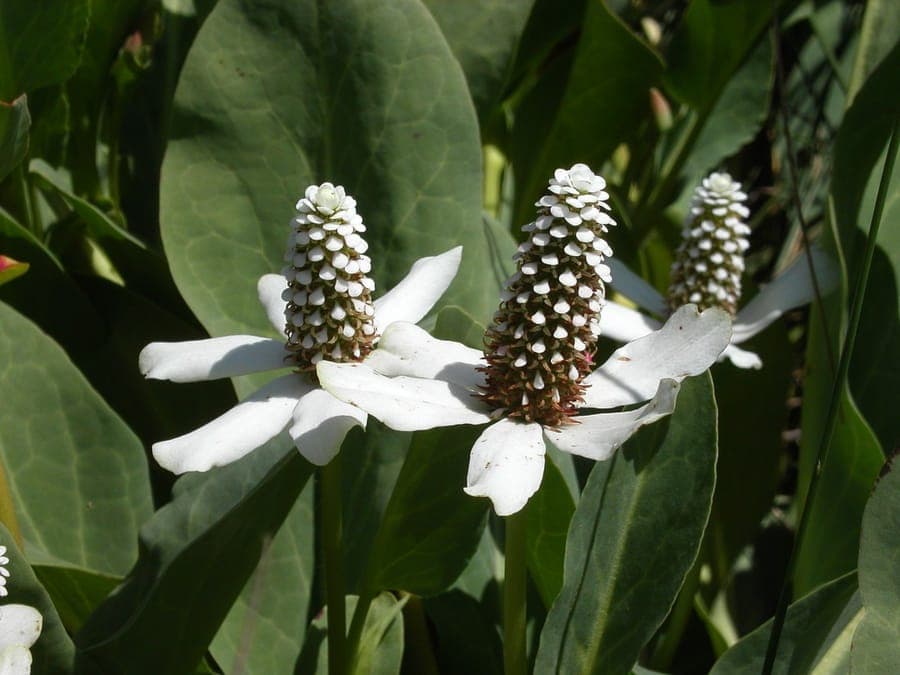
Yerba mansa is a rhizomatous herbaceous perennial, growing 20 to 50 cm tall in flower. The basal leaves are large, oval to oblong, measuring 10 to 20 cm long, with a smooth, blue-grey surface and a waxy sheen. When bruised, they release a distinctive peppery, medicinal scent that has made this plant valued in traditional healing for centuries.
Flowering runs from May through August. Stout, upright stems rise above the foliage, each topped by a cone-shaped flower spike surrounded by six to nine large, pure white bracts that resemble petals. The true flowers are tiny and cream-coloured, densely packed along the cone. The overall effect is striking - bold white 'blooms' held above a carpet of grey-green leaves.
After flowering, brown seed capsules develop on the cone. Plants also spread steadily via surface-running rhizomes, forming a dense, interlocking mat over time. This mat is excellent at excluding weeds while stabilising moist, soft bank soil.
Ideal location
Yerba mansa thrives at pond edges, in bog gardens, alongside streams, and in any garden area that holds moisture for extended periods. Full sun produces the best flowering; partial shade is tolerated but reduces bloom density.
Suitable settings include:
- Pond margins where roots can reach the water
- Rain gardens designed to collect and hold runoff
- Low areas of the lawn or border that stay damp after rain
- Bog planters - containers without drainage holes, kept filled with water
- Under moisture-loving trees such as willows and alders
Dry, sandy ground is unsuitable. Even brief periods of drought cause wilting and leaf scorch. If you want to trial the plant in a normal border, be prepared to water daily throughout warm periods.
Soil
In its native range, yerba mansa grows in heavy, clay-rich, often silty soils along floodplain margins. It tolerates a pH of 6.5 to 9.0 - a wide range that includes neutral to distinctly alkaline conditions. This makes it one of the few ornamental wetland plants that will thrive in limestone-influenced garden soils.
Sandy, fast-draining soils are the wrong choice for this species. If your garden soil drains too freely, consider:
- Lining the planting area with pond liner to slow drainage
- Working in generous amounts of clay or bentonite
- Adding a 10 cm layer of peat moss to the upper soil
For pond-edge plantings, supplemental feeding is rarely needed as marginal soils are typically nutrient-rich. In ordinary garden soils, apply a layer of garden compost in March each year.
Free design
Want to see Yerba mansa: complete guide in your garden? Make a free design now.
Watering
Yerba mansa is a moisture-demanding plant that performs best with consistently wet roots. In temperate climates, this means:
- At a pond margin: no supplemental watering needed
- In ordinary garden soil: daily watering during dry spells
- In containers: keep the saucer permanently filled with water or stand the pot in a shallow tray of water
Unlike most garden plants, it is virtually impossible to overwater yerba mansa when grown in the ground during the active season. Waterlogging is only a concern during cold winter months when root rot can set in if combined with frost.
During establishment - the first growing season after planting - keep the soil exceptionally moist. Once the rhizomes have spread and the mat has formed, the plant is somewhat more resilient, though it still needs reliable moisture throughout summer.
Pruning
Yerba mansa requires minimal pruning. The main tasks are:
- In autumn, after the first frost has blackened the foliage, cut all stems down to just above ground level. This keeps the planting tidy and reduces disease risk over winter.
- During the growing season, trim back spreading rhizomes if the plant is extending beyond its intended area. Use a sharp spade to cut through the surface runners.
- Remove yellowed or damaged leaves as they appear to keep the clump looking fresh.
Deadheading spent flower spikes may encourage a second flush of bloom, though this is not guaranteed. The plant is not aggressively invasive, but does expand steadily - something to factor into your planting scheme.
Maintenance calendar
- March: Clear away any remaining dead stems. Apply a compost mulch around the base.
- April: Resume watering if the soil is drying. Watch for new rhizome growth at the margins.
- May: First flower spikes emerge. Ensure soil stays permanently moist.
- June to August: Peak flowering. Water daily in dry weather. Remove spent stems if desired.
- September: Flowering declines. Begin reducing any unwanted spread.
- October: Foliage starts to yellow after the first night frosts.
- November: Cut back all above-ground growth after hard frost.
- December to February: Plant is dormant. Prevent the root zone from drying out completely.
Winter hardiness
Anemopsis californica is rated for USDA zones 7 to 10. In most of northern Europe - which falls in zone 7 to 8 - it survives most winters without problem when the root zone is lightly protected.
In colder winters, with sustained temperatures below -10 degrees Celsius:
- Mulch the root zone with 10 to 15 cm of straw or autumn leaves
- Avoid standing water around the roots during frost; this combination can cause root rot
- Container-grown plants should be moved to an unheated shed or garage
After a cold winter, the plant regrows reliably from its rhizomes. The above-ground parts die back completely, but healthy rhizomes survive and produce new growth from late March onwards. In mild winters, some foliage may remain green well into December.
Companion plants
Yerba mansa works well alongside other lovers of wet ground. Recommended combinations include:
- Iris pseudacorus (yellow flag iris): Bright yellow flowers in May and June complement the white flower spikes of yerba mansa perfectly
- Carex species: Various sedges provide fine-textured foliage that contrasts with yerba mansa's bold leaves
- Lythrum salicaria (purple loosestrife): Tall pink-purple spikes are striking alongside the white flower cones
- Mentha aquatica (water mint): Aromatic and equally moisture-loving, good for filling gaps in the mat
- Pontederia cordata (pickerelweed): Blue flowers at a similar height for an attractive multi-colour display
At gardenworld.app, you can explore complete planting schemes that incorporate wetland plants to make the most of damp garden areas.
Closing
Yerba mansa is one of those plants that rewards you handsomely if you give it what it needs: wet feet, good light, and patience to let the rhizomes spread. In the right spot - a pond margin, bog bed, or rain garden - it covers the ground beautifully, produces arresting white flower spikes from May to August, and asks for almost nothing in return.
Look for yerba mansa at specialist aquatic and native plant nurseries. It is not yet widely stocked at general garden centres, but specialist growers across Europe increasingly offer it. Given the growing interest in rain garden and bog planting design, yerba mansa deserves far wider recognition.
Want to see Yerba mansa: complete guide in your garden? Make a free design now.
Upload a photo, pick a style, and get a photorealistic design with plant list in under a minute.
10,000+ gardens designed already
No credit card required


Similar plants
Acer pycnanthum: complete guide
Acer pycnanthum
Acer pycnanthum, the Japanese swamp maple, is a fast-growing tree with early red flowers and brilliant autumn color, ideal for damp garden settings.
Freeman maple: complete guide
Acer × freemanii
Everything about the Freeman maple (Acer x freemanii): a fast-growing shade tree with spectacular autumn colour for large gardens.
Silver vine: complete guide
Actinidia polygama
Discover silver vine (Actinidia polygama): a hardy climbing plant with silvery foliage, loved by gardeners and cats alike.