
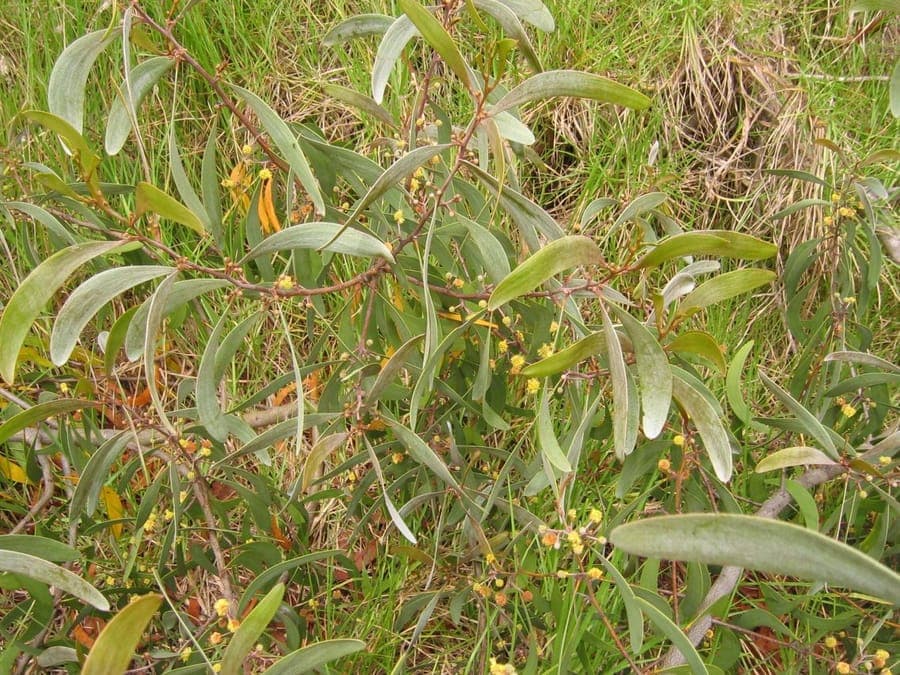
The original uploader was KarlM at English Wikipedia. / CC BY-SA 2.5, via Wikimedia Commons
Koaia: complete guide
Acacia koaia
Want to see Koaia: complete guide in your garden?
1 minute, no credit card
Overview
Koaia (Acacia koaia), also known as koai'e or koaoha, is a rare and ecologically important tree species endemic to the Hawaiian Islands. It is closely related to the better-known koa (Acacia koa) and shares the same family, but occupies distinctly drier habitats at lower to mid-elevations on the main islands. The species was formally described in 1888 by the German-Hawaiian botanist William Hillebrand in his landmark work on Hawaiian flora. For Native Hawaiians, koaia held great cultural significance: its exceptionally dense and hard wood was prized for making weapons such as spears and war clubs, as well as canoe paddles and tool handles - purposes for which the softer-grained koa was less suitable. Today koaia is considered a rare and conservation-dependent species due to historical habitat loss, browsing by introduced cattle and deer, and competition from invasive plants. On gardenworld.app you can explore how unusual trees from distant parts of the world find a home in contemporary garden design.
Appearance and bloom cycle
Koaia is a medium to large tree reaching 5 to 15 metres in height in favourable conditions, though cultivated specimens outside Hawaii typically remain considerably smaller. Like the related koa, koaia does not produce true leaves after the juvenile seedling stage. Instead, the petioles (leaf stalks) expand into flattened, blade-like structures called phyllodes that perform photosynthesis in place of true leaves. The phyllodes of koaia are distinctly narrower, stiffer and more erect than those of koa - a reliable characteristic for distinguishing the two species in the field. They are pale to mid-green or slightly grey-green and give the tree a fine-textured, graceful appearance. The flowers are small, round, lemon-yellow pompoms typical of the Acacia genus, appearing in clusters from January to April in the Hawaiian climate. After flowering, flat, papery seed pods develop containing dark brown to black seeds. The bark is rougher and darker than that of koa.
Ideal location
Koaia is adapted to warm, sunny and relatively dry environments. In its natural Hawaiian habitat it occurs at annual rainfall levels of 300 to 800 mm - far lower than most tropical trees can tolerate. Full sun is essential; shade significantly suppresses growth and vigour. The species tolerates short drought periods well thanks to a deep root system that seeks out soil moisture at depth. In temperate garden cultivation, koaia can be grown outdoors year-round only in frost-free climates (USDA zones 10-12). In cooler regions it is best kept as a container plant that moves outdoors during summer and overwinters in a frost-free greenhouse or conservatory with temperatures above 8 degrees Celsius.
Soil
Koaia thrives in free-draining, light to moderately heavy soils. In its native Hawaiian range it commonly grows on nutrient-poor basaltic lava soils that drain rapidly and efficiently. It tolerates a wide soil pH range from 4.0 to 7.4, with a preference for mildly acid to neutral conditions. Like all Fabaceae, koaia fixes atmospheric nitrogen through root nodule bacteria, which means it can grow on impoverished soils without supplementary fertilisation. Heavy clay soils that retain moisture are unsuitable and will cause root rot. For container cultivation, use a well-draining, low-nutrient substrate mix such as a 2:1 blend of potting compost and perlite.
Free design
Want to see Koaia: complete guide in your garden? Make a free design now.
Watering
As a dryland tree, koaia is adapted to limited water supply. When grown outdoors in a suitable climate, rainfall alone usually suffices, supplemented only during extended dry spells. In container cultivation in temperate regions, water deeply once per week during summer, allowing the substrate to drain thoroughly and dry out moderately before the next watering. Overwatering is the most common mistake when cultivating Acacia species in pots: wet roots quickly lead to rot and plant decline. In winter when the plant is kept indoors, drastically reduce watering to once every two to three weeks, depending on the temperature and humidity of the indoor environment. On gardenworld.app you can find advice on growing tender exotic trees as container specimens.
Pruning
Koaia requires minimal pruning. When young, competing double leaders can be removed to establish a single strong trunk and balanced crown. Dead or damaged branches are best removed in early spring before the new flush of growth begins. Container-grown specimens can be kept compact by lightly shortening the most vigorous new shoots in spring. Avoid heavy pruning because koaia, like many Acacia species, recovers slowly from large wounds. Seal cuts larger than 2 cm diameter with wound sealant to prevent moisture loss and reduce the risk of fungal entry. Avoid pruning during the flowering period to preserve the seed pod set.
Maintenance calendar
January-March: flowering period in Hawaiian climate; for container specimens, keep indoors and apply a slow-release fertiliser lightly. April-May: move containers outdoors after frost risk passes; place in the warmest, sunniest spot available. June-August: active growing season; water weekly during dry spells; inspect for scale insects or mealybugs. September-October: temperatures drop; reduce watering gradually; bring container plants indoors overnight from mid-September. November-December: winter rest; minimal watering; maintain in a light, frost-free location at 8-15 degrees Celsius.
Winter hardiness
Koaia is a tropical to subtropical tree with no frost hardiness whatsoever. Even a brief light frost will cause serious damage or kill the plant outright. Outdoors year-round cultivation is only possible in USDA zones 10-12. In cooler climates, including most of northern Europe, the species must be grown as a container plant and overwintered in a frost-free environment. A cool greenhouse, heated conservatory or a light indoor room that stays above 8 degrees Celsius during winter is suitable. In its native Hawaiian habitat, koaia is classified as a rare species of conservation concern due to habitat loss and browsing by introduced ungulates such as goats, deer and cattle.
Companion plants
In its natural dry-forest habitat on Hawaii, koaia grows alongside other endemic Hawaiian species such as wiliwili (Erythrina sandwicensis), various Dodonaea species and native dryland sedges and grasses. In a botanical garden or specialist collection it pairs well with other drought-tolerant Fabaceae from similar climate zones, including Prosopis and Leucaena species. For container cultivation in a temperate climate, good companions are other drought-tolerant Mediterranean or subtropical plants with similar care needs, such as oleander, olive or dwarf citrus. Avoid pairing koaia with plants that require frequent watering, as the different drainage regimes are difficult to reconcile in a shared container arrangement.
Closing
Koaia is a fascinating tree of great cultural significance to the Native Hawaiian people and a unique ecological role in the dryland ecosystems of the Hawaiian Islands. For the dedicated plant collector or botanical enthusiast, growing koaia as a container specimen is a rewarding challenge that invites admiration and conversation. Young plants and seeds can be found through specialist tropical nurseries and occasional conservation-focused plant sales. Visit gardenworld.app for more inspiration on incorporating rare and remarkable trees into contemporary garden design.
Want to see Koaia: complete guide in your garden? Make a free design now.
Upload a photo, pick a style, and get a photorealistic design with plant list in under a minute.
10,000+ gardens designed already
No credit card required

