
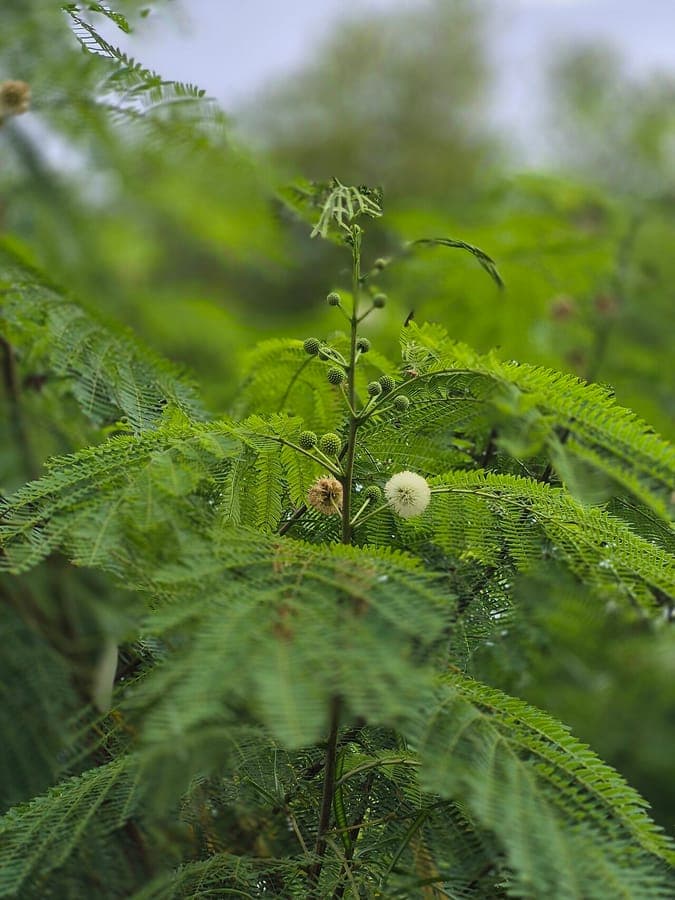
O Tupinólogo / CC BY 4.0, via Wikimedia Commons
White leadtree (Leucaena): complete guide
Leucaena leucocephala
Want to see White leadtree (Leucaena): complete guide in your garden?
Full design in HD: €7.99
Overview
White leadtree (Leucaena leucocephala), also known as ipil-ipil or sneakytree, is a fast-growing legume tree from the Fabaceae family, native to Central America. This tree reaches 3-8 meters at maturity and is renowned for its nitrogen-fixing ability, fine, fern-like foliage, and showy white flower clusters.
Thriving in tropical and subtropical climates, white leadtree excels at rapid shade production, soil enrichment, and erosion control. Caution: can be invasive in some regions; check local regulations.
Appearance & Bloom
White leadtree forms an elegant tree with feathery, fern-like green leaves (bipinnate). The trunk is gray, smooth. From May to July, spectacular ball-shaped flower clusters of pure white appear, highly fragrant, attracting honeybees and butterflies.
After blooming, flat, yellow, pod-shaped fruits of 12-20 cm form with seeds inside. These fruits ripen in September-October.
Ideal Location
White leadtree thrives in full sun to light shade. Suitable for south-facing, open gardens.
- Light requirement: Full sun to light shade (minimum 6 hours sunlight)
- Drainage: Very well-draining
- Temperature: USDA zone 9b-11 (-5 to +10°C winter minimum)
- Height: 3-8 m
Soil Requirements
White leadtree grows on nearly all soils, including very poor ground. It fixes atmospheric nitrogen, so external fertilization is usually unnecessary. Suited to acidic and basic soils.
- pH: 4.5-7.5 (highly tolerant)
- Moisture: Dry to moderately moist; fairly drought-tolerant after establishment
- Nutrition: No external fertilization needed
Free preview
Want to see White leadtree (Leucaena): complete guide in your garden? Make a free preview of your design.
Watering
Regular watering during first 2 years of growth; thereafter very drought-tolerant. During extreme drought (>60 days), spray weekly.
- Year 1: Weekly
- Year 2: Bi-weekly
- After: Only during extreme drought
Pruning & Maintenance
Pruning optional. Remove dead branches annually. For more shape control, prune after bloom. Warning: explosive self-seeding possible; remove dispersed seeds.
Maintenance Calendar
- March-April: Plant from seed or cuttings
- May-July: Blooming
- August-October: Seed ripening
- November-February: Dormant/rest period
Winter Hardiness
Usually for USDA zone 9b-11 (-5 to +10°C winters). In zone 9a-9b possible winter dieback; cut back to buds.
Companion Planting
Combine beneath white leadtree with shade-lovers:
- Aucuba (Aucuba japonica)
- Hydrangea (Hydrangea spp.)
- Fern plantings (Dryopteris erythrosora)
Final Thoughts
White leadtree is an excellent choice for tropical garden designs with sustainable soil enrichment. At gardenworld.app, discover more on fast-growing trees and nitrogen-fixer systems. Note: can be invasive; check local regulations!
Want more ideas for fast, sustainable shade trees? Visit gardenworld.app and download our tropical garden planning guide.

See it in your garden
See White leadtree in your garden
One photo of your garden and a few questions. You see the result in about a minute.
Try it with a photoIdentify this plant in your own garden. Identify a plant
Similar plants
Tall Silky Lupine: complete guide
Lupinus elatus
Tall silky lupine is a fast-growing Californian perennial with silvery foliage and blue-purple flower spikes, ideal for a prairie-style garden.
Garfield Lupine: complete guide
Lupinus garfieldensis
The Garfield lupine is a rare, fast-growing American perennial for alkaline, dry grassland gardens, with striking blue flower spikes.
Lupinus elegans: complete guide
Lupinus elegans
Lupinus elegans, the elegant lupine, is a spectacular blooming plant from Mexico with blue flower spikes. Care, cultivation and garden use.
