
Tall Silky Lupine: complete guide
Lupinus elatus
Want to see Tall Silky Lupine: complete guide in your garden?
1 minute, no credit card
Overview
Tall silky lupine (Lupinus elatus) is a perennial in the pea family, Fabaceae, native to southwestern California. The species grows naturally in mountain meadows, chaparral margins, and open clearings in coniferous woodland at mid to high elevations. The species epithet "elatus" means "tall" or "elevated," a reference to the strikingly upright flower spikes of this species.
The plant is closely related to other well-known Californian lupines such as Lupinus albicaulis and Lupinus formosus, with which it was historically even combined as a variety. In the garden, tall silky lupine stands out for its attractive, silky-haired leaves and impressive, upright flower spikes that appear in early summer.
For gardeners seeking a low-maintenance, fast-growing perennial for a sunny, dry border or a prairie-style planting, tall silky lupine is an appealing choice. As a member of the pea family, the plant is also able to fix nitrogen through root nodules, which benefits soil fertility.
This particular species remains relatively unknown in European gardens, while better-known relatives such as the garden lupine (Lupinus polyphyllus) have long been a staple of borders and cottage gardens. Tall silky lupine, however, offers a refreshing alternative with a wilder, more naturalistic character and a striking silvery foliage that gives the plant ornamental value even outside the flowering season.
Appearance and bloom
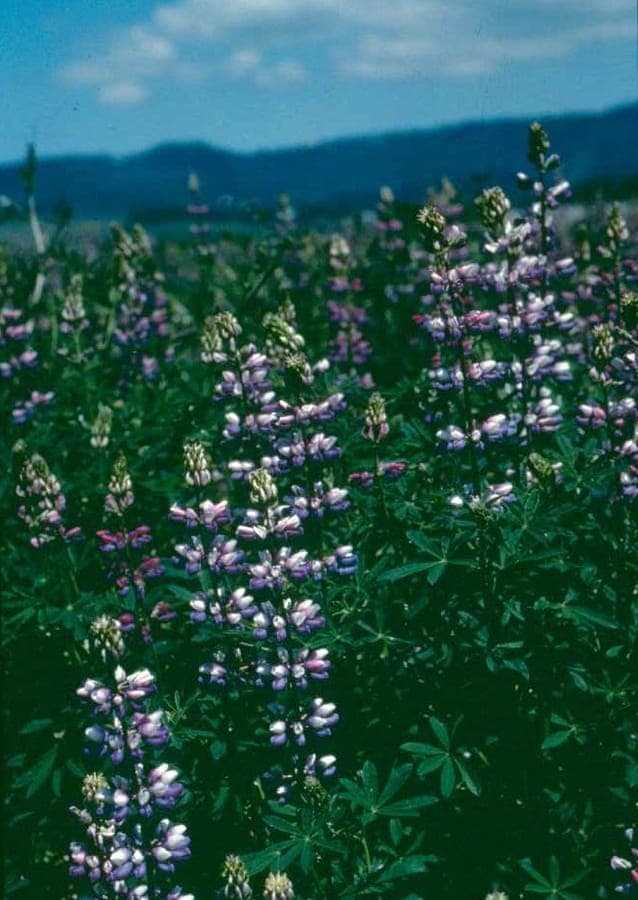
Tall silky lupine grows quickly into a sturdy perennial averaging 60 to 120 centimetres in height, with a single, robust stem per crown. The palmately compound leaves consist of several narrow leaflets covered in dense hairs, giving the plant a distinctive silvery sheen, especially when dew or rain settles on the fine hairs.
In late spring to early summer, long, upright flower spikes appear, bearing dozens of small, pea-shaped flowers in shades of blue to blue-purple. The flowers are followed by elongated, hairy pods that remain visibly present and add to the plant's ornamental value well into late summer, when the pods split open and disperse the seed.
The flower spikes rise like candles above the silvery foliage, creating a strong vertical accent in the border. This makes the plant especially valuable alongside lower-growing, rounder perennials that highlight its vertical form. Bees and bumblebees visit the flowers intensively throughout the bloom period, making the plant a valuable addition to a pollinator-friendly garden.
Ideal location
This lupine thrives best in full sun, with at least six hours of direct light per day. In its natural habitat, the plant grows in open, sunny mountain meadows and along the edges of coniferous woodland where sufficient light reaches the ground. A sheltered but sunny spot in the garden closely mimics these conditions.
The plant tolerates drought well once established, making it suitable for gravel gardens, prairie-style borders, and other drought-resistant planting schemes. Avoid damp, shady spots, as the plant becomes more susceptible to fungal disease there and develops a less compact growth form.
Free design
Want to see Tall Silky Lupine: complete guide in your garden? Make a free design now.
Soil
The ideal soil for tall silky lupine is free-draining, light in texture, and not overly rich. The plant grows naturally at a pH between 6.0 and 7.0, from slightly acidic to neutral, and tolerates both sandy and loamy soils as long as drainage is adequate.
Because the plant can fix nitrogen via root nodules, additional fertilising with nitrogen-rich feeds is actually undesirable, since it comes at the expense of flowering and leads to weak, excessive leaf growth. Lean to moderately fertile soil gives the best results. Heavy, wet clay is unsuitable and leads to root rot.
When planting in heavier garden soil, it helps to mix in coarse sand or grit to improve permeability. A thin layer of gravel mulch around the plant also helps keep its base dry during wet spells, further preventing root rot.
Watering
Young plants need regular watering during their first season after planting to develop a deep root system. Water once the top layer of soil feels dry, but avoid consistently wet ground.
Once established, tall silky lupine is fairly drought-tolerant, and in most European climates natural rainfall is sufficient. Extra water during prolonged summer dry spells encourages a longer bloom period, but overwatering should be avoided to prevent root rot.
Pruning
After flowering, spent flower spikes can be cut back to just above the foliage to encourage a second, lighter flush of bloom. Leave some pods in place if you want the plant to spread through self-seeding.
In late autumn or early winter, above-ground growth can be cut back close to the ground, particularly in gardens where the plant serves as a permanent border feature. Otherwise, simply remove dead or damaged leaves during the growing season.
Maintenance calendar
March-April: new shoots emerge; additional fertilising is rarely necessary.
May-June: main bloom period with blue-purple flower spikes; plenty of bee and bumblebee activity.
July-August: pods develop and split open; seed drops or can be collected.
September-October: spent stems can be cut back.
November-February: winter dormancy; above-ground parts largely die back.
Winter hardiness
Tall silky lupine is hardy to USDA zone 7, corresponding to hardiness zones common across much of the Netherlands, Belgium, France, and the milder regions of Germany. In colder inland areas, a winter mulch layer around the root zone can offer extra protection.
The plant often dies back above ground in colder climates but reliably resprouts from the rootstock in spring, provided winter drainage is adequate to prevent root rot.
Companion plants
Tall silky lupine pairs beautifully with other sun-loving prairie plants such as Achillea, Echinacea, and ornamental grasses like Stipa tenuissima, which tolerate the same dry, sunny conditions. The blue-purple flower display creates a lovely contrast against yellow tones from Rudbeckia or Coreopsis.
For a naturalistic, California-inspired planting scheme, the plant combines well with other drought-tolerant species such as Salvia and Penstemon. As a nitrogen-fixing plant, tall silky lupine also improves soil quality for surrounding planting, making it a valuable companion in mixed borders where lean, dry soil can otherwise limit growth of other species. Plant in loose groups of three to five for the most naturalistic, full effect, spacing individual plants roughly 40 to 50 centimetres apart.
Closing
Tall silky lupine is an attractive, fast-growing perennial that, with its silvery foliage and blue-purple flower spikes, offers valuable interest to any sunny, drought-tolerant garden. Visit GardenWorld to see how this plant fits into a complete garden design, and check the GardenWorld plant database for further growing details.
Want to see Tall Silky Lupine: complete guide in your garden? Make a free design now.
Upload a photo, pick a style, and get a photorealistic design with plant list in under a minute.
No credit card required


Similar plants
Foothill Lupine: complete guide
Lupinus albifrons
Discover Lupinus albifrons, a compact lupine from California with delicate flowers. Ideal for dry, sunny gardens and wildflower plantings.
Pine Lupine: complete guide
Lupinus albicaulis
Pine lupine offers magnificent blue-violet flowers perfect for dry, sunny locations. A hardy North American native.
Lupinus formosus: complete guide
Lupinus formosus
Discover the summer lupine with gorgeous colorful flower spikes. A frost-hardy, sustainable perennial with nitrogen-fixing roots.