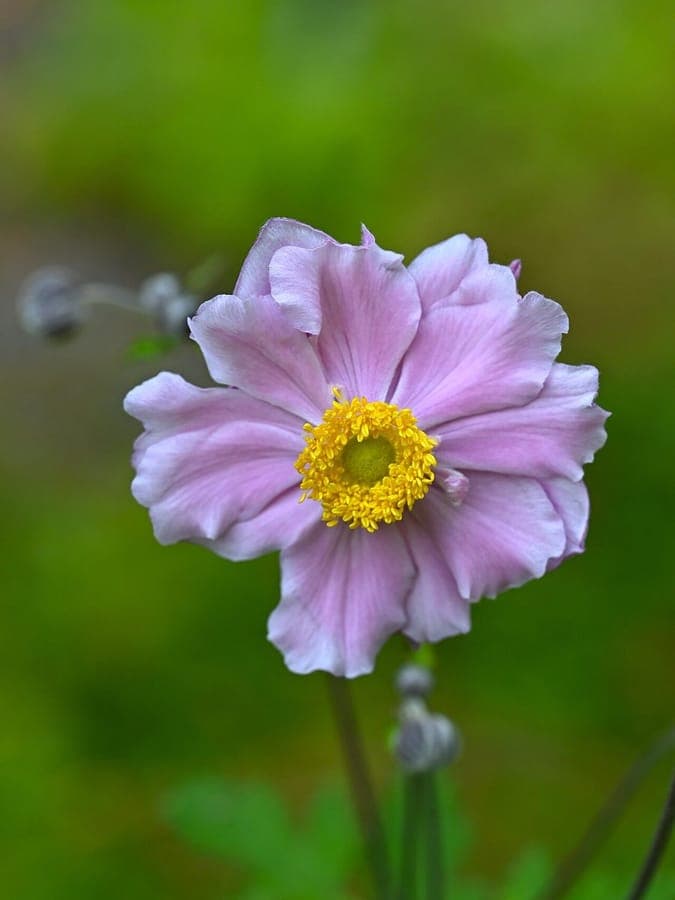
Krzysztof Ziarnek, Kenraiz / CC BY 4.0, via Wikimedia Commons
Japanese Anemone: complete guide
Anemone × hybrida
Want to see Japanese Anemone: complete guide in your garden?
Full design in HD: €7.99
Look after your Japanese Anemone with the GardenWorld app
Identify plants with your camera and get a care calendar with reminders for this plant.


Overview
The Japanese anemone (Anemone × hybrida) is one of the great classics of the late-summer border. Just as most perennials are past their best, its white or pink saucer-shaped flowers float above the foliage on long, slender stems, from mid-August well into October. It brings light and movement to a border that might otherwise start to look tired, and it does so year after year with very little fuss.
Despite its common name, this plant is a garden hybrid. It arose in England in the 1840s from a cross between Anemone hupehensis var. japonica and Anemone vitifolia. Recent research has moved the group into the genus Eriocapitella, but in gardening circles Anemone × hybrida remains the usual name. A mature clump reaches 80 to 150 cm in flower, depending on the cultivar, with a leafy base about 50 cm wide.
Well-known cultivars include 'Honorine Jobert' (pure white, single, grown since 1858), 'Königin Charlotte', often sold as 'Queen Charlotte' (soft pink, semi-double), 'Whirlwind' (white, semi-double) and 'Andrea Atkinson' (white, sturdy). If you would like to know where Japanese anemones would look best in your plot, you can have a garden design made on gardenworld.app that takes light, soil and your existing plants into account.
Appearance and bloom cycle
The foliage forms a dense, low mound of dark green leaves divided into three coarsely toothed leaflets, slightly hairy underneath. Even in spring and early summer it makes an attractive, fresh ground cover. From July the flower stems rise out of it, branching freely and often reaching above eye level.
First come round, silvery buds that look like little pearls. These open into flowers 5 to 8 cm across with anything from five to more than twenty petal-like tepals, depending on whether the cultivar is single or semi-double. At the centre sits a green boss ringed by golden-yellow stamens, which makes the flowers glow. Bees, bumblebees and hoverflies visit them eagerly at a time when there is little else on offer. After flowering, woolly seed heads form and gradually fall apart over winter.
Ideal location
Japanese anemones are remarkably adaptable. They grow in full sun but also in partial shade, beneath tall trees or on the east side of a house. In full sun the soil must stay reasonably moist, otherwise the leaves brown at the edges in summer. The ideal spot has morning sun and light shade in the afternoon.
Choose a sheltered position for tall cultivars, as strong winds can flatten the long stems. Plant three to five together, 50 to 60 cm apart, for a generous group. Bear in mind that after a few years the plant spreads by underground rhizomes. In a mixed border with less vigorous neighbours, give it a space of its own or slice off the spreading edges with a spade every so often.
Soil requirements
Japanese anemones want humus-rich soil that holds moisture yet drains well. Ordinary garden soil enriched with compost suits them, and they are not fussy about pH: slightly acid and chalky soils are both fine. What they dislike are the extremes. In wet clay the roots rot in winter, while on poor, dry sand the leaves wilt in summer.
When planting, work a few spadefuls of compost into the top 20 cm of soil. Spring planting, in April or May, is best because the roots then have a whole season to establish. Plants put in during autumn take longer to settle. An annual spring mulch of compost is all the feeding they need.
Watering
Newly planted Japanese anemones need regular watering during their first year, particularly in a dry spring, so give them a thorough soak once a week. Once established they look after themselves in most summers, but during longer dry spells in July and August it helps to water once or twice a week. Drought just before flowering results in shorter stems and fewer blooms.
A mulch of leaf mould around the clumps keeps the soil cool and moist and suppresses weeds. In winter no extra water is ever needed; too much moisture is more of a risk than too little.
Free preview
Want to see Japanese Anemone: complete guide in your garden? Make a free preview of your design.
Pruning
Japanese anemones do not need pruning in the strict sense, and after flowering you have a choice. If you like a tidy border, cut the stems down to just above ground level in November. If you would rather leave winter structure for birds and frosty mornings, keep them until February or March: the fluffy seed heads and brown stems add character, and the old growth helps protect the crown from frost.
Remove the old stems in spring before the new shoots appear. Tall cultivars in an open spot can be given discreet support in May with a ring stake or a few twiggy sticks. Deadheading during flowering is unnecessary, as new buds keep coming.
Wear gloves when handling the plant. Like many members of the buttercup family (Ranunculaceae), Japanese anemones contain protoanemonin. The sap can irritate skin, and if eaten the plant causes stomach upsets and irritation of the mouth and throat in people, dogs and cats. Fortunately it tastes so bitter that animals rarely eat much of it.
Maintenance calendar
February-March: Cut down old stems if you left them over winter. Spread a layer of compost.
April-May: Best planting time. Protect young shoots from slugs. Support tall cultivars in windy spots.
June-July: Foliage fills out and flower stems appear. Water during prolonged drought.
August-October: Flowering season. Enjoy the display and keep the soil moist in dry weeks.
November: Cut back the stems or leave them for winter interest. Mulch young plants with leaves or straw.
December-January: Dormant season. To propagate, take root cuttings about 5 cm long and lay them in a tray of gritty compost in a cold frame.
Winter hardiness
Anemone × hybrida is fully hardy and tolerates temperatures down to about -25 °C. An established clump survives any normal winter in Britain and north-west Europe without protection. Young plants are a little more vulnerable in their first winter, so a layer of dead leaves or straw over the crown in November gives extra security.
Wet feet are more dangerous than cold. On poorly drained soil the rhizomes can rot during a wet winter, so pay attention to soil structure when planting. Avoid moving established plants if you can: a Japanese anemone often needs a year to recover after being lifted. Any piece of root left behind will also sprout again, so be thorough if you want to remove a clump.
In the garden the plant can spread enthusiastically, but it hardly sets seed and is not known as an invasive species in the wild in Europe.
Companion plants
Japanese anemones shine alongside other late bloomers. Asters such as the New England aster (Symphyotrichum novae-angliae) add purple and blue to the pink and white of the anemone. Ice plant (Sedum spectabile) provides sturdy pink heads at the front of the border. Ornamental grasses like Calamagrostis × acutiflora add vertical lines and stand through winter, just like the anemone's seed heads.
In partial shade, pair them with black cohosh (Actaea racemosa), which flowers at the same time with tall white spires, and with the scented cranesbill Geranium macrorrhizum as ground cover beneath. Japanese forest grass and ferns also suit them well. The plant calendar on gardenworld.app shows when each of these partners flowers, so your border stays colourful well into autumn.
Final thoughts
The Japanese anemone is a plant for anyone who wants to enjoy their border for as long as possible. Its elegant flowers on tall stems extend the season into October, it feeds pollinators when food is scarce, and it needs very little care. The only things to remember: plant in spring, water in the first year and then leave it alone.
Give Anemone × hybrida humus-rich soil, some afternoon shade and room to spread, and you will have a perennial that lasts for decades and surprises you again every late summer.
Frequently asked questions about Japanese Anemone
Is Japanese Anemone winter hardy?
Anemone × hybrida is fully hardy and tolerates temperatures down to about -25 °C. An established clump survives any normal winter in Britain and north-west Europe without protection.
When and how do you prune Japanese Anemone?
Japanese anemones do not need pruning in the strict sense, and after flowering you have a choice. If you like a tidy border, cut the stems down to just above ground level in November.
How much water does Japanese Anemone need?
Newly planted Japanese anemones need regular watering during their first year, particularly in a dry spring, so give them a thorough soak once a week. Once established they look after themselves in most summers, but during longer dry spells in July and August it helps to water once or twice a week.
Where does Japanese Anemone grow best?
Japanese anemones are remarkably adaptable. They grow in full sun but also in partial shade, beneath tall trees or on the east side of a house.
What soil does Japanese Anemone need?
Japanese anemones want humus-rich soil that holds moisture yet drains well. Ordinary garden soil enriched with compost suits them, and they are not fussy about pH: slightly acid and chalky soils are both fine.

See it in your garden
See Japanese Anemone in your garden
One photo of your garden and a few questions. You see the result in about a minute.
Try it with a photoIdentify this plant in your own garden. Identify a plant
Similar plants
New England aster: complete guide
Symphyotrichum novae-angliae
Learn all about New England aster (Symphyotrichum novae-angliae), a stunning fall-blooming perennial.
Stonecrop: complete guide
Sedum spectabile
Everything about Showy Stonecrop (Sedum spectabile): planting, care, cultivars and combinations. Practical tips for this drought-tolerant butterfly magnet.
Feather reed grass: complete guide
Calamagrostis × acutiflora
Feather reed grass (Calamagrostis × acutiflora 'Karl Foerster'): a bolt-upright, sterile ornamental grass. Position, planting, cutting back in late February and partners.
