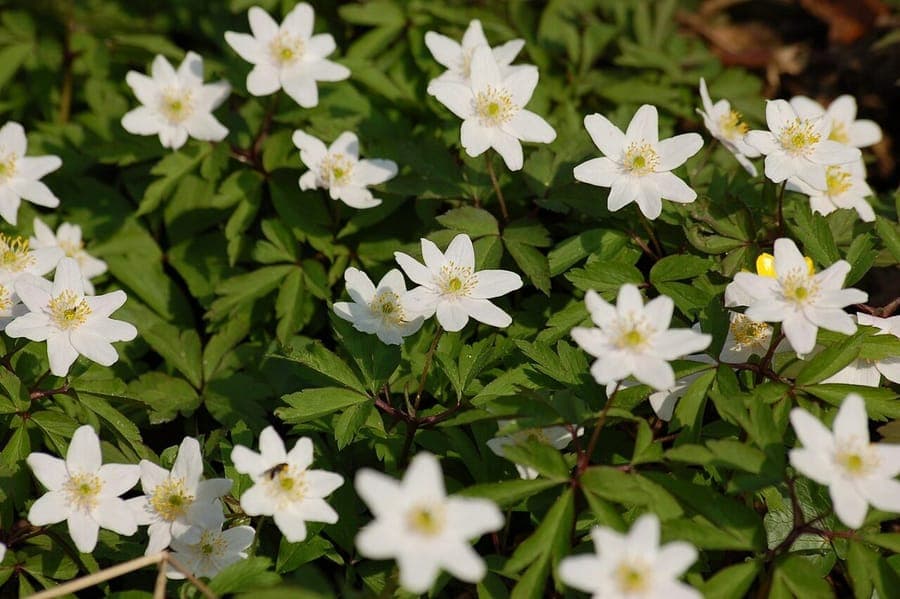
Lilly M / CC BY-SA 3.0, via Wikimedia Commons
Wood anemone: complete guide
Anemone nemorosa
Want to see Wood anemone: complete guide in your garden?
Full design in HD: €7.99
Look after your Wood anemone with the GardenWorld app
Identify plants with your camera and get a care calendar with reminders for this plant.


Overview
The wood anemone (Anemone nemorosa) is one of the first signs of spring in deciduous woodland and shady gardens. While the trees are still bare and light reaches the woodland floor, thousands of white star-shaped flowers open and spread across the ground like a carpet. This little plant belongs to the buttercup family (Ranunculaceae) and is native to almost the whole of Europe, including Britain and Ireland. Botanists now often place it in the genus Anemonoides, but in the trade it is still sold as Anemone nemorosa.
In the wild, the wood anemone is a classic indicator of ancient woodland. It spreads extremely slowly, often only a few centimetres a year, so large carpets may be centuries old. That is why one rule is non-negotiable: never dig up wood anemones from the wild. In the UK it is illegal to uproot wild plants without the landowner's permission, it damages fragile populations, and lifted rhizomes rarely establish well in a garden anyway. Always use nursery-grown stock, ideally pot-grown plants or fresh rhizomes from a specialist bulb or perennial grower.
A drift of wood anemones under a shrub or tree brings a touch of woodland to your garden in March and April. On gardenworld.app you can have a garden design made in which wood anemones, snowdrops, lungwort and ferns form a natural shade border together.
Appearance and bloom cycle
Anemone nemorosa grows only 10 to 25 cm tall. In early spring, a stem rises from a thin brown rhizome that creeps just below the surface, bearing a whorl of three deeply lobed, hand-shaped leaves. Above them sits a single flower, 2 to 4 cm across. Each flower has six to eight white tepals, sometimes flushed pink or purple on the outside, around a boss of yellow stamens. On dull days and at night the flowers close and nod slightly.
Flowering usually runs from mid-March to late April, depending on the weather and the site. Early solitary bees, queen bumblebees and hoverflies collect pollen at a time when little else is in bloom. After flowering, small seeds form, and by June the foliage has died back completely. The plant then retreats underground until the following spring.
Besides the wild white form there are lovely garden selections: 'Robinsoniana' with soft lavender-blue flowers, 'Allenii' in a deeper blue, the double white 'Vestal' and 'Bracteata', which has a ruff of green bracts beneath each bloom.
Ideal location
The wood anemone follows the rhythm of the deciduous wood. It wants light in spring and shade in summer. A spot beneath deciduous trees and shrubs is therefore ideal: in March and April plenty of sun reaches the ground, and by the time the canopy closes, the plant is almost dormant. Think of the base of a hazel, a group of birches, an old fruit tree or the north side of a hedge.
Full sun all year round does not suit it, nor does a position under dense evergreen conifers, where it stays too dark and dry in spring. Choose a spot where the soil is not regularly dug over. Wood anemones need years to form a carpet, and every round of digging undoes that work. A quiet corner of the garden with a layer of fallen leaves is perfect.
Plant in groups of ten or more, 10 to 15 cm apart. After a few years they will knit together into a continuous mat.
Soil requirements
Anemone nemorosa likes a loose, humus-rich woodland soil that stays moist in spring. A soil topped with decayed leaves, leaf mould or fine wood chips comes closest to its natural home. Both slightly acid and chalky soils are suitable, as long as the structure is open and there is plenty of organic matter.
On heavy clay, work a generous amount of leaf mould into the top 10 to 15 cm before planting. On poor sandy soil, add compost too, so the ground does not dry out too fast in spring. Chemical fertiliser is unnecessary. Leave fallen leaves where they land in autumn: they form the humus-rich layer in which wood anemones thrive.
Free preview
Want to see Wood anemone: complete guide in your garden? Make a free preview of your design.
Watering
Because the plant grows in early spring, it usually receives enough rain in our climate. Extra water is only needed in an exceptionally dry spring, or during the first months after planting. Keep the soil lightly moist until the leaves fade.
In summer the wood anemone is dormant and copes well with drought. Watering is then unnecessary and may even do harm if the soil stays wet for long. One crucial point when planting dry rhizomes: soak them overnight in lukewarm water first. Dried-out rhizomes otherwise sprout poorly or not at all, and that is the most common reason a planting fails.
Pruning
Wood anemones need no pruning. Let the foliage die back naturally after flowering so the plant can store reserves in its rhizomes. Never mow or cut the leaves early. If you have wood anemones in grass under trees, hold off mowing that area until mid-June.
To increase your stock, lift a small piece of an existing clump in your own garden straight after flowering or in early autumn, and replant it elsewhere. Do this gently and with a good rootball, as the rhizomes are brittle. Wear gloves: like many members of the buttercup family, Anemone nemorosa contains compounds that can irritate the skin and are poisonous if eaten, both for people and for pets such as dogs, cats and rabbits.
Maintenance calendar
February: The first leaf tips appear. Clear away branches and thick debris that could smother the shoots.
March-April: Full bloom. Enjoy the flowers and water only during an exceptional dry spell. A good time to plant nursery-grown pot plants in growth.
May: The leaves are still green. Leave them and avoid trampling the clump.
June-July: The plant goes dormant. Mark the spot with a stick so you do not dig into it by accident later.
August-October: Planting season for fresh rhizomes from the nursery. Soak them overnight and plant them horizontally, 3 to 5 cm deep. The plant calendar on gardenworld.app shows month by month which spring flowers go into the ground now.
November-January: Rest. Leave fallen leaves in place as a natural mulch.
Winter hardiness
The wood anemone is a native plant and fully hardy throughout Britain and the Low Countries. Its rhizomes withstand severe frost down to about -30 °C. Even late frosts after the shoots have emerged hardly bother it: the flowers close in the cold and open again as soon as the sun comes out.
No protection is needed. The biggest winter risk is not frost but newly planted rhizomes drying out in a dry autumn, or rotting in soil that sits waterlogged for months. A layer of leaves over the ground helps in both cases.
Companion plants
Wood anemones fit perfectly into a layered shade border with other spring flowers. Combine them with snowdrops (Galanthus nivalis), which flower just before them, and with English bluebells (Hyacinthoides non-scripta), which take over in April and May. Make sure you choose the native Hyacinthoides non-scripta and not the Spanish bluebell, which hybridises with the wild species.
Lungwort (Pulmonaria officinalis), dog's-tooth violet (Erythronium dens-canis), primrose (Primula vulgaris) and Lenten rose (Helleborus orientalis) are also good neighbours. Ferns and hostas fill the space in summer that the anemones leave behind, so the border stays furnished all year. Under a hazel or a group of birches, this creates a small woodland full of life.
Final thoughts
The wood anemone (Anemone nemorosa) is a modest plant with a big impact. It asks for a quiet spot under trees, a humus-rich soil and, above all, patience. After a few years it rewards you every spring with a white carpet that seems to bring the whole wood into your garden.
Always work with nursery-grown material and leave wild populations in woods and hedgerows untouched. Start with a small group under a shrub, leave the leaves where they fall and watch the carpet grow a little larger each year.
Frequently asked questions about Wood anemone
Is Wood anemone winter hardy?
The wood anemone is a native plant and fully hardy throughout Britain and the Low Countries. Its rhizomes withstand severe frost down to about -30 °C.
When and how do you prune Wood anemone?
Wood anemones need no pruning. Let the foliage die back naturally after flowering so the plant can store reserves in its rhizomes.
How much water does Wood anemone need?
Because the plant grows in early spring, it usually receives enough rain in our climate. Extra water is only needed in an exceptionally dry spring, or during the first months after planting.
Where does Wood anemone grow best?
The wood anemone follows the rhythm of the deciduous wood. It wants light in spring and shade in summer.
What soil does Wood anemone need?
Anemone nemorosa likes a loose, humus-rich woodland soil that stays moist in spring. A soil topped with decayed leaves, leaf mould or fine wood chips comes closest to its natural home.

See it in your garden
See Wood anemone in your garden
One photo of your garden and a few questions. You see the result in about a minute.
Try it with a photoIdentify this plant in your own garden. Identify a plant
Similar plants
Common snowdrop: complete guide
Galanthus nivalis
Common snowdrop growing guide. The world's most familiar snowdrop with delicate white pendant flowers.
English bluebell: complete guide
Hyacinthoides non-scripta
Discover the English bluebell (Hyacinthoides non-scripta): planting tips, blooming time, care requirements, soil needs and winter hardiness for stunning spring displays.
Jerusalem cowslip: complete guide
Pulmonaria officinalis
Pulmonaria officinalis, or Jerusalem cowslip, is a charming spring-blooming perennial for shady gardens. Learn how to grow, where to plant, and what companions work best.
