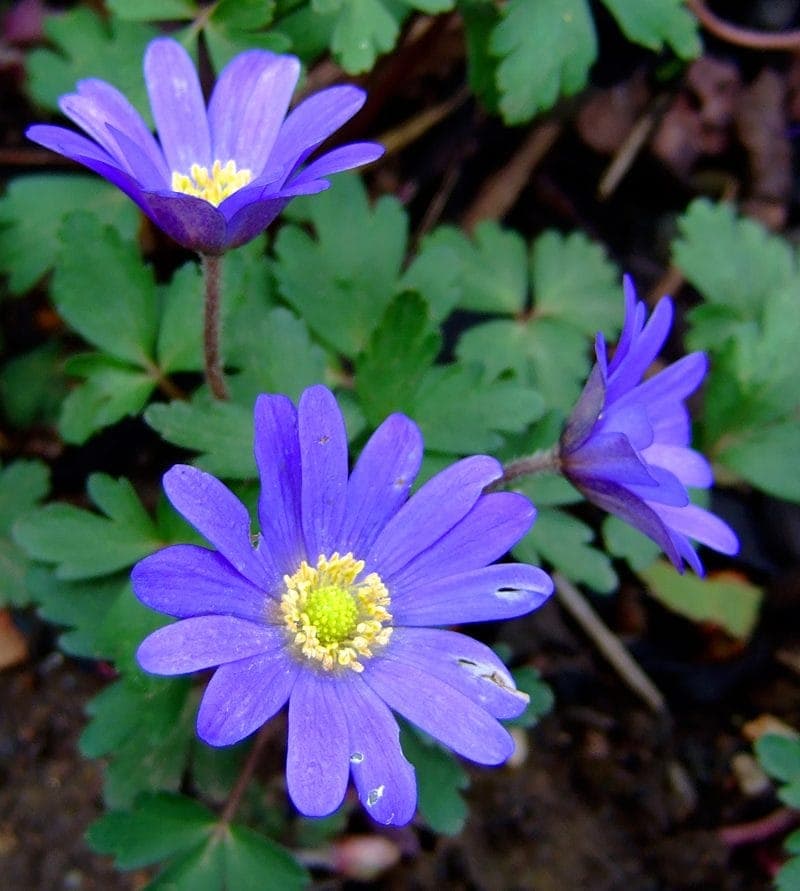
GrooverFW / CC BY 2.0, via Wikimedia Commons
Grecian windflower: complete guide
Anemone blanda
Want to see Grecian windflower: complete guide in your garden?
Full design in HD: €7.99
Look after your Grecian windflower with the GardenWorld app
Identify plants with your camera and get a care calendar with reminders for this plant.


Overview
Grecian windflower (Anemone blanda) is a small tuberous plant that brings carpets of blue, white or pink to the garden in early spring. It only reaches 10 to 15 cm in height, but what it lacks in stature it makes up for in numbers: a handful of tubers can spread within a few years into a dense mat covered with starry flowers. It is happiest beneath deciduous shrubs and trees, where there is still plenty of light in March.
The species is native to Greece, the Balkans, Turkey, Cyprus and the Caucasus. There it grows in open woodland and on stony slopes, flowering during the moist spring and resting underground through the dry summer. Botanists now place it in the genus Anemonoides, but in the trade and on labels it is nearly always still sold as Anemone blanda.
It is one of the cheapest spring flowers you can plant and also one of the most rewarding. On gardenworld.app you can create a garden design in which windflowers, crocuses and snowdrops form the lowest layer of a border or shrub bed. The best-known cultivars are 'Blue Shades' (a mix of blue tones), 'White Splendour' (large, pure white), 'Pink Star' (pink) and 'Radar' (magenta with a white centre). Mixed packs create a cheerful patchwork.
Appearance and bloom cycle
The flowers are 3 to 5 cm across, with ten to twenty narrow, glossy petals around a yellow boss of stamens. They look rather like daisies, but in a clear blue-violet. The leaves are deeply divided into three, somewhat ferny, dark green and sometimes slightly hairy. Each flower sits on its own slender stem just above the foliage.
In a mild winter flowering can begin in late February and continues until mid-April. A striking feature is that the flowers only open fully in sunshine. In cold, overcast weather they stay half closed, and in the evening they shut completely. On a sunny March day a carpet of blue stars can appear almost out of nowhere.
After flowering, small seed heads form. In May and June the foliage yellows, and from then on the tuber rests until the following spring. In a good spot the plant also self-seeds, so the group grows a little larger every year.
Ideal location
Anemone blanda flowers best in full sun or light shade. Because it blooms so early, a spot under deciduous trees or shrubs is ideal: there is still enough light in March and April, and in summer the canopy shields the resting tubers from drying out. It also does well in a rock garden, at the front of a border or in a lawn that is not cut until late spring.
Deep shade under evergreen shrubs or conifers is less suitable, as it stays too dark and dry there. You can also plant windflowers in pots and containers, for example beneath tulips or daffodils. Stand them in a sunny place in spring so the flowers open.
Soil requirements
Grecian windflower wants a well-drained, humus-rich soil. It is happy with lime and grows on both light and heavier soils, provided water does not lie around in winter. On wet clay the tubers rot. On heavy ground, work some compost and grit into the top layer.
The tubers look like small, hard, brown lumps. Before planting, soak them in lukewarm water for 12 to 24 hours. They swell up and sprout faster and more reliably. Plant them in September or October, 5 cm deep and 8 to 10 cm apart. It is often hard to tell top from bottom. Look for tiny buds or old root scars: the smoother side usually goes downwards. If in doubt, lay them on their side and the plant will sort itself out.
Plant in groups of at least twenty or thirty. A single flower barely registers in March, but a drift certainly does.
Free preview
Want to see Grecian windflower: complete guide in your garden? Make a free preview of your design.
Watering
Water once after planting. After that, autumn and winter rain usually provide enough moisture. In a dry spring, while the plants are flowering and in leaf, water occasionally so the tubers can build up their reserves.
From June, once the foliage has died down, the tuber needs a dry rest. Under trees and shrubs this happens naturally. Move pots to a sheltered spot after flowering and give them almost no water through the summer.
Pruning
No pruning is needed. Let the foliage die back completely after flowering, as this is how the tuber builds its reserves for next year. Mow a lawn with windflowers only once the leaves have yellowed, usually from mid-June. You can leave spent flowers if you want the plant to self-seed.
Take care when handling the plant. Like many members of the buttercup family, Grecian windflower contains protoanemonin, which can irritate sensitive skin and causes stomach upsets if eaten. The plant is also toxic to dogs, cats, rabbits and horses. Wear gloves when planting and do not let pets chew the tubers.
Maintenance calendar
September–October: Soak the tubers for 12 to 24 hours and plant them 5 cm deep, in groups of at least twenty.
November–January: A quiet period. Scatter a thin layer of leaf mould over the planting if you like.
February–April: Flowering. Water during a dry spring. Protect young shoots from slugs if they are a problem in your garden.
May–June: The foliage yellows. Leave it until it has died back fully, and only mow after that.
July–August: Dormant. If you want to move a group, lift the tubers in late summer and replant them straight away.
Winter hardiness
Anemone blanda is reliably hardy and survives temperatures down to about -20 °C without difficulty. In the ground it needs no extra protection anywhere in Britain or the Low Countries. Hard frost during flowering can damage the blooms, but new buds usually follow quickly.
As with many bulbs, wet soil in winter is a bigger risk than cold. Tubers in pots are more vulnerable: in a cold winter, move the pot against a wall or wrap it in hessian or bubble wrap.
Companion plants
Grecian windflower is a plant for the ground layer above all. It pairs beautifully with other early bulbs. Crocus tommasinianus and Siberian squill (Scilla siberica) flower in the same weeks and, together with the windflower, make a blue and violet carpet. Yellow winter aconite (Eranthis hyemalis) blooms slightly earlier and gives a lovely bridge from February into March.
For a little more height, combine it with dwarf daffodils such as 'Tête-à-tête' and other forms of Narcissus cyclamineus. The yellow and blue set each other off well. Under shrubs, Lenten rose (Helleborus orientalis) is another excellent partner, its large flowers and leathery leaves contrasting nicely with the fine carpet of windflowers.
Later in the season, ferns, hostas or hardy geraniums can fill the gap the windflower leaves behind in summer.
Final thoughts
Grecian windflower is a small marvel for very little money. Soak the tubers, plant them shallowly in a well-drained spot and let the foliage die back quietly after flowering. That is all it asks. Year after year the group spreads, until there is a blue carpet beneath your shrubs announcing spring every March.
Do bear in mind its toxicity to pets, and wear gloves when planting. The plant calendar on gardenworld.app shows month by month when to plant tubers, when they flower and when it is safe to mow. Plant a few handfuls of windflower tubers this autumn and enjoy the first blue stars in your garden next spring.
Frequently asked questions about Grecian windflower
Is Grecian windflower winter hardy?
Anemone blanda is reliably hardy and survives temperatures down to about -20 °C without difficulty. In the ground it needs no extra protection anywhere in Britain or the Low Countries.
When and how do you prune Grecian windflower?
No pruning is needed. Let the foliage die back completely after flowering, as this is how the tuber builds its reserves for next year.
How much water does Grecian windflower need?
Water once after planting. After that, autumn and winter rain usually provide enough moisture.
Where does Grecian windflower grow best?
Anemone blanda flowers best in full sun or light shade. Because it blooms so early, a spot under deciduous trees or shrubs is ideal: there is still enough light in March and April, and in summer the canopy shields the resting tubers from drying out.
What soil does Grecian windflower need?
Grecian windflower wants a well-drained, humus-rich soil. It is happy with lime and grows on both light and heavier soils, provided water does not lie around in winter.

See it in your garden
See Grecian windflower in your garden
One photo of your garden and a few questions. You see the result in about a minute.
Try it with a photoIdentify this plant in your own garden. Identify a plant
Similar plants
Early crocus: complete guide
Crocus tommasinianus
Crocus tommasinianus blooms early in spring and naturalizes easily. Learn how to plant, care for and combine this hardy, low-maintenance bulb.
Scilla siberica: complete guide
Scilla siberica
Discover Scilla siberica, the Siberian squill - the most reliable and prolific early spring bulb. With vivid blue flowers that multiply readily, it creates stunning naturalized drifts and restores joy to winter-weary gardens.
Lenten-rose: complete guide
Helleborus orientalis
Learn how to grow and care for Helleborus orientalis. This early-blooming perennial thrives in shady spots and flowers from February to April, adding colour when little else is blooming.
