
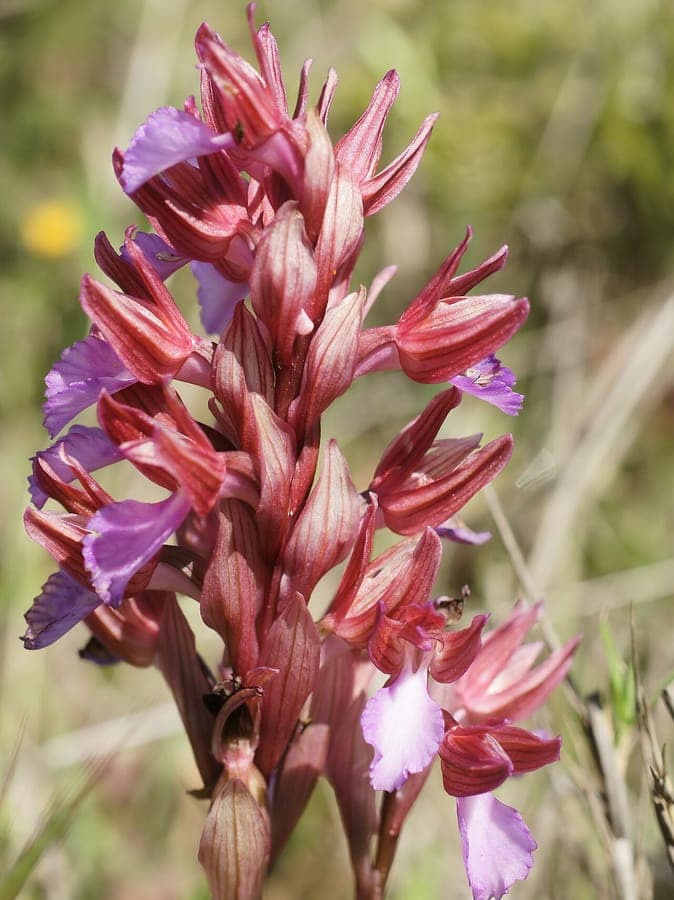
Hans Hillewaert / CC BY-SA 3.0, via Wikimedia Commons
Butterfly orchid: complete guide
Anacamptis papilionacea
Want to see Butterfly orchid: complete guide in your garden?
1 minute, no credit card
Overview
Butterfly orchids (Anacamptis papilionacea), also known as pink butterfly-orchid and butterfly-flowered knabenkraut, are stunning Mediterranean orchids naturally occurring across a vast region from North Africa to the Caucasus.
This species is highly interesting for gardeners in temperate climates because it can be grown relatively easily outdoors, unlike most tropical orchids. The plant is known for its elegant, butterfly-shaped flowers in shades of purple to pink.
Appearance and Bloom
Butterfly orchids are tuberous plants that emerge in spring with narrow, lance-shaped leaves. The leaves form a neat rosette near the ground.
From April to June, slender, upright flower spikes 20 to 40 cm tall emerge. These flowers are highly characteristic: they resemble butterflies with large, widely spreading petals and a distinctive lip that extends strongly forward. Color ranges from purple to deep pink, sometimes with white spots.
Each plant can produce 10 to 25 flowers in a neat, compact inflorescence. After blooming, the above-ground parts retreat and enter dormancy.
Ideal Location
Butterfly orchids grow best in fully sunny locations with good air circulation. At least 6 hours of direct sunlight daily is ideal. Semi-shade also works but reduces flower production.
The plant appreciates protection from wet winters and very heavy rainfall.
Soil
Butterfly orchids require very well-draining soil. They grow best in soil with good pH between 7 and 8 (neutral to slightly alkaline). Add extra sand, gravel, or perlite to improve drainage.
The plant cannot tolerate nutrient-rich soil; poor, mineral-rich soil is strongly preferred.
Watering
Watering must be careful. During the growing season (October to May), water regularly but never to waterlogging. Once above-ground parts retreat (May/June), allow to dry until September.
Water from below preferably: place pots in water baths until soil becomes moist.
Free design
Want to see Butterfly orchid: complete guide in your garden? Make a free design now.
Pruning and Maintenance
Butterfly orchids require minimal maintenance beyond watering management. Spent flowers can remain; they look pleasant as they fade.
After bloom, as foliage yellows, gradually reduce watering. Once fully yellow and withered, plants can be moved to a cool, dry location.
Maintenance Calendar
August to September: Wake tubers from dormancy. Start careful watering. October to December: Leaf and root growth. Regular watering. Cool nights help trigger bloom. January to March: Continued growth. Bloom begins. Ample watering. April to May: Full bloom. Continue watering. June to July: Foliage retreat. Reduce watering. Tubers enter dormancy. August: Complete rest. No water.
Winter Hardiness
Butterfly orchids are frost-hardy to approximately USDA Zone 6, meaning they can tolerate down to -20 degrees. In the Netherlands and Belgium, they can be planted in mixed borders, but many gardeners prefer container cultivation.
Pots can be stored in winter in a cool, dry place (unheated greenhouse, cellar).
Suitable Combinations
In borders, butterfly orchids combine beautifully with early spring bloomers like anemone, Adonis, and dwarf crocuses. Later in the season, this plant fits perfectly among Mediterranean herbs like lavender and sage.
In pots on patios or terraces, you create an exotic Mediterranean atmosphere.
In Conclusion
Butterfly orchids are a fascinating introduction to wild orchid cultivation for gardeners in temperate climates. Though they require careful watering management, the reward of their exotic beautiful flowers is more than worthwhile.
Tubers are available online or from specialized nurseries, typically 3-8 euros per tuber. Beware: many commercial tubers are wild-collected, so buy from propagating nurseries.
Visit gardenworld.app for more garden integration tips.
Want to see Butterfly orchid: complete guide in your garden? Make a free design now.
Upload a photo, pick a style, and get a photorealistic design with plant list in under a minute.
10,000+ gardens designed already
No credit card required


Similar plants
Ram's-head lady's slipper: complete guide
Cypripedium arietinum
Everything you need to know about growing Cypripedium arietinum, a rare woodland orchid for cool, moist garden settings. Soil, care and planting tips.
Sparrow's-egg lady's slipper: complete guide
Cypripedium passerinum
Everything about growing Cypripedium passerinum, a cold-hardy subarctic orchid suited to cool, moist, shaded garden spots. Soil, care and companion plants.
Algerian Butterfly-orchid: complete guide
Platanthera algeriensis
Everything about Platanthera algeriensis, the rare Mediterranean orchid with greenish flowers native to Algeria, Morocco, Corsica and Spain.