
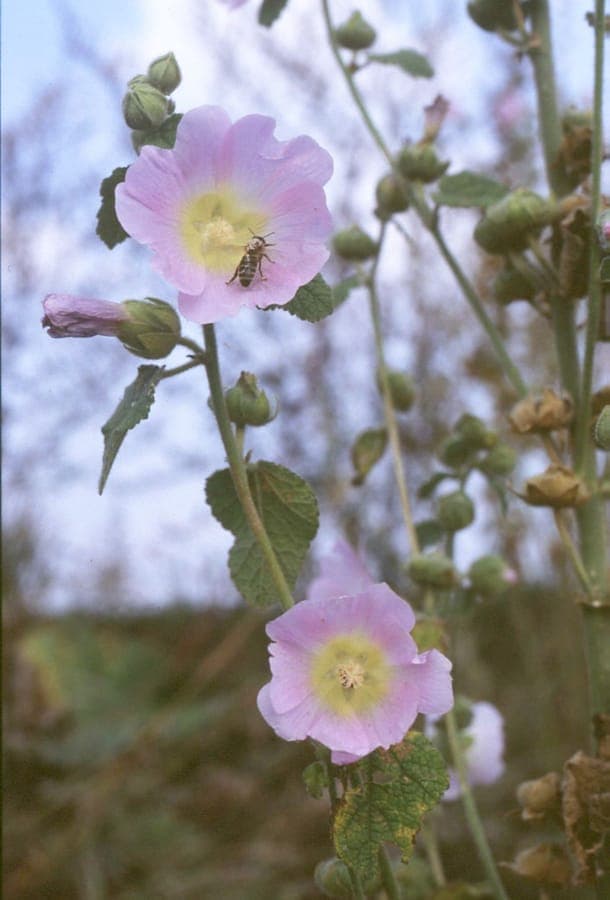
Franz Xaver / CC BY-SA 3.0, via Wikimedia Commons
Biennial Hollyhock: complete guide
Alcea biennis
Want to see Biennial Hollyhock: complete guide in your garden?
1 minute, no credit card
Overview
Alcea biennis, commonly known as the pale hollyhock or biennial hollyhock, is a striking garden plant belonging to the mallow family (Malvaceae). The species was described in 1781 by the Hungarian botanist Jozef Jakab Winterl and is native to south-eastern and central Europe - from Austria and Hungary through the Balkans to Turkey, Ukraine, and the Crimea. It has also been introduced to Italy and Pakistan outside its original range.
The species epithet 'biennis' means 'biennial': the plant requires two growing seasons to complete its life cycle. In the first year it forms a leafy rosette; only in the second year do the tall flowering stems appear. After flowering and setting seed the plant dies, but it self-seeds freely enough to maintain a persistent presence in a garden where it feels at home.
Compared to the widely grown common hollyhock (Alcea rosea), A. biennis has softer, more restrained flowers in gentle purple shades, making it particularly suited to romantic cottage gardens, farmhouse borders, and naturalistic planting schemes. Several synonyms exist in botanical literature - Althaea biennis and Alcea pallida among them - which can cause some confusion when purchasing plants. If you enjoy planning flower-rich borders with tall seasonal plants, gardenworld.app offers personalised design tools to help you visualise and plan your ideal garden.
Appearance and bloom cycle
Alcea biennis reaches an impressive height of 100 to 200 cm in its second year, depending on soil quality and site conditions. The stems are sturdy, upright, and lightly hairy. The leaves are large, palmately lobed, and have a rough texture typical of the mallow family.
The flowers are the true highlight: purple in colour with subtle veining and a soft, satiny sheen. The flower cup has the classic saucer shape of hollyhocks, with five broad petals. Flowering begins in June and continues through August - a generous period of two to three months. Flowers open progressively from the base of the stem upwards, so there are always fresh blooms while the lower ones already form fruit.
The calyx and stems are covered with a dense, felty hair that gives the plant a slightly grey-green appearance, creating a pleasing contrast with the purple flowers. After blooming, disc-shaped seed pods form and add modest winter interest.
The overall silhouette is tall and narrow - ideal as a vertical accent at the back of a border or against a wall or fence.
Ideal location
Alcea biennis needs a sunny position: the plant thrives best in full sunlight (light rating of 7 on a scale of 10), so choose a spot that receives sun for most of the day. In shade the plant becomes leggy and flowers much less freely.
The species originates from a climate with relatively warm, dry summers, but tolerates the wetter conditions of north-western Europe provided the soil drains well. Shelter from strong wind is helpful: the tall stems can be blown over in severe gusts unless they are supported.
Long garden walls, boundary fences, and hedges make ideal backdrops for this tall plant. In a cottage garden, a farmhouse border, or a naturalistic planting scheme, the pale hollyhock fits perfectly. It combines well with other tall summer-flowering plants and allows space for lower-growing species in front.
For design inspiration when planning a border with tall summer-blooming plants, gardenworld.app generates expert garden layouts based on your own garden photos and preferences.
Soil
The pale hollyhock has moderate soil requirements. The ideal pH falls between 6.5 and 7 - slightly acid to neutral. A nutrient-rich soil (nutrient rating 7 out of 10) supports vigorous growth and generous flowering. In very poor soil the plant stays smaller and blooms less freely.
Good drainage is essential: Alcea biennis does not tolerate prolonged wet conditions around the root crown, especially in winter. On heavy clay soil it is advisable to work organic matter and coarse sand into the top layer to improve structure.
A light soil with adequate humus - a good garden loam or lightly sandy soil enriched with compost - is ideal. Work compost into the planting holes to give young plants a good start. The plant is less suitable for containers because of the deep taproot it develops.
Because the species has low salt tolerance, it is less suited to gardens directly on the coast or on heavily saline soils.
Free design
Want to see Biennial Hollyhock: complete guide in your garden? Make a free design now.
Watering
Alcea biennis has moderate water needs and does best in environments with average atmospheric humidity. In its native south-eastern European range it gets along well with average rainfall without supplementary water.
In Dutch, Belgian, or British gardens, watering is not normally required in average summers. During prolonged heat and drought, a weekly watering can extend the flowering period and keep plants vigorous. Water at the base and avoid wetting the leaves and stems, as damp foliage encourages rust fungus (Puccinia malvacearum), a common hollyhock problem.
Young first-year plants need more moisture than mature flowering specimens. During the establishment phase, water regularly to encourage strong root formation.
In autumn and winter, supplementary water is rarely needed. Never allow standing water around the roots, as this is the most common cause of crown rot and plant failure in hollyhocks.
Pruning
As a biennial, Alcea biennis has a different pruning regime from perennials. After flowering in the second year, the spent stem can be removed or left in place until the seed is fully ripe. To encourage natural self-seeding, leave the stem standing until the seed pods are completely dry and the seeds release easily.
If you want to control self-seeding, cut the stems before the seed is fully ripe and collect it yourself for deliberate resowing in the desired location. Store seed dry and cool until sowing in spring or early summer.
In the first year, the rosette can be lightly tidied if leaves are diseased or damaged, but drastic cutting is neither necessary nor desirable.
After winter, as the plant puts on new growth in its second year, any brown or damaged leaves at the base can be removed to give the plant a fresh start.
Maintenance calendar
February - March: check that first-year rosettes are healthy. Gently remove damaged or diseased leaves.
April - May: in the second year the flowering stem begins to develop. Plant any young seedlings in their final position if not already done.
June - August: full bloom. Watch for rust (Puccinia malvacearum), a common fungal issue in hollyhocks.
September: seed ripens. Decide whether to collect seed or leave it for self-seeding.
October - November: remove spent stems or leave as winter decoration.
December - January: no active maintenance; check that young rosettes are not sinking into waterlogged ground.
Winter hardiness
Alcea biennis is reliably hardy to USDA zone 6, corresponding to minimum temperatures of approximately -23 degrees Celsius. In UK and Irish gardens (USDA zone 8-9), the plant overwinters as a rosette without difficulty, provided drainage is good.
First-year rosettes survive normal European winters well. In prolonged hard winters with persistently wet weather the risk of failure increases. A light covering of straw or coarsely shredded material can help protect rosettes during the coldest periods.
As with most hollyhocks, good drainage is the best winter protection. Wet, poorly draining soil combined with frost is more dangerous than frost alone.
In hot, dry summers, flowering may end somewhat earlier than usual. In such cases, early sowing in spring can shift the life cycle slightly and prolong the ornamental season.
Companion plants
The pale hollyhock is an ideal background plant that combines beautifully with lower-growing summer flowers:
- Echinacea purpurea (purple coneflower): same flowering period, complementary purple tones
- Salvia nemorosa (woodland sage): blue-purple, shorter, plant in front of the hollyhock
- Verbascum thapsus (great mullein): similar vertical silhouette, yellow flowering
- Rosa (climbing or shrub rose): classic combination for cottage garden atmosphere
- Achillea millefolium (common yarrow): white or yellow, lower, strong contrast
The pale hollyhock combines especially well with other biennials such as Digitalis purpurea (foxglove) and Verbascum for a fully self-renewing planting scheme that creates a different picture each year without much effort on the part of the gardener.
Look for it at specialist cottage garden nurseries or in the biennial section at well-stocked garden centres. It is sometimes only available as seed, which is easily sown and an attractive alternative to buying plants.
Closing
Alcea biennis is an elegant, understated hollyhock that deserves far greater recognition. With its soft purple flowers, impressive height, and ability to sustain itself through self-seeding, it is a valuable addition to any garden with a naturalistic or cottage-garden character. Whether you place it against a wall, at the back of a border, or as part of a mixed biennial planting, the pale hollyhock will reward you with months of flower and a generous supply of seed for future generations. Sunny, well-drained conditions are the key to success.
Want to see Biennial Hollyhock: complete guide in your garden? Make a free design now.
Upload a photo, pick a style, and get a photorealistic design with plant list in under a minute.
10,000+ gardens designed already
No credit card required


Similar plants
Crimean linden: complete guide
Tilia × euchlora
Crimean linden is an elegant, fast-growing shade tree ideal for large gardens. Discover cultivars, spacing, maintenance tips and winter hardiness.
California flannelbush: complete guide
Fremontodendron californicum
Everything about California flannelbush (Fremontodendron californicum): sunny placement, drainage, pruning and care for this spectacular yellow-flowering shrub.
Hairy rose mallow: complete guide
Hibiscus moscheutos subsp. lasiocarpos
Full growing guide for hairy rose mallow (Hibiscus moscheutos subsp. lasiocarpos): location, soil, watering, winter hardiness and garden design tips.