
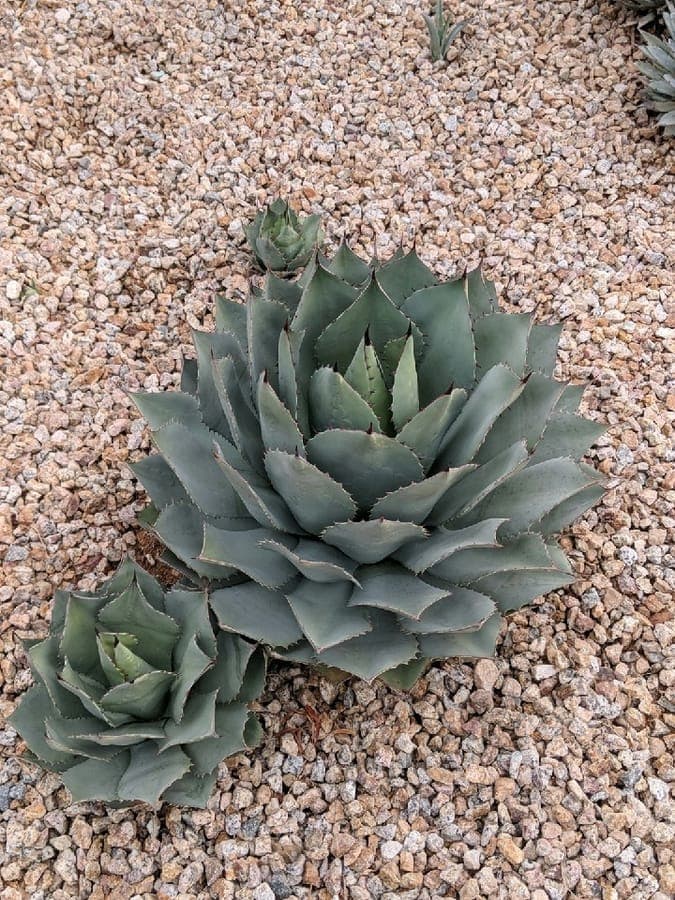
Froody / CC BY-SA 4.0, via Wikimedia Commons
Agave potatorum: complete guide
Agave potatorum
Want to see Agave potatorum: complete guide in your garden?
1 minute, no credit card
Overview
Agave potatorum, commonly called Tobala or Mezcal Agave, is an impressive succulent native to the arid highlands of south-central Mexico. This remarkable plant is prized for its compact rosette form, distinctive silvery-blue foliage, and exceptional drought tolerance. It represents an excellent choice for xeriscaping, contemporary gardens, and collectors of architectural succulents. The plant develops slowly but creates visual impact through its bold geometric form.
Appearance and Bloom
Agave potatorum forms a compact rosette measuring 60-90 centimeters in diameter. Leaves are green to grey-green with an characteristic silvery bloom. Leaf margins range from nearly smooth to slightly toothed with dark reddish-brown terminal spines. After many years, the plant produces an impressive flowering spike reaching 3 meters with yellow tubular flowers. Following bloom, the mother rosette dies, though numerous offsets ensure continuation.
Ideal Location
Position Agave potatorum in full sun, receiving at least six hours of direct sunlight daily. Intense afternoon sun intensifies the silver-grey coloration. The plant tolerates partial shade but grows more slowly. A warm, sheltered location protected from excessive moisture is optimal. South-facing walls that radiate heat are particularly suitable.
Soil
Agave potatorum requires exceptionally well-draining soil. Mix standard potting soil with coarse sand or perlite in a 1:1 ratio. Specialized cactus or succulent soil also works excellently. pH should be neutral to slightly acidic. Drainage is non-negotiable - this plant cannot tolerate waterlogging.
Watering
Once established, Agave potatorum exhibits remarkable drought tolerance. During the growing season, water sparingly and only when soil is completely dry. In autumn and winter, minimize or cease watering altogether - the plant enters dormancy. Excessive moisture causes root rot and decline. Underwatering is far preferable to overwatering for long-term plant health.
Free design
Want to see Agave potatorum: complete guide in your garden? Make a free design now.
Pruning
Pruning is generally unnecessary. Remove only dead leaves from the rosette base. Damaged foliage may be carefully removed. The natural geometric form requires no intervention and is inherently beautiful. Avoid the temptation to manipulate the plant's shape.
Maintenance Calendar
Spring (March-April): Plant new specimens and resume minimal fertilization. Summer (June-August): Water sparingly, apply no fertilizer. Autumn (September-October): Gradually reduce watering frequency. Winter (November-February): Cease watering; plant is fully dormant.
Winter Hardiness
Agave potatorum tolerates temperatures down to approximately -8 degrees Celsius, making it marginally hardy in milder climates. In regions with harsh winters, protect with a dry mulch or relocate to a greenhouse. Young plants are less resilient and benefit from frost protection.
Companion Plants
Agave potatorum pairs beautifully with other succulents and drought-tolerant species. Sedums, echeveria, and fellow agaves create stunning combinations. Mediterranean herbs like rosemary and lavender complement it effectively. Avoid moisture-demanding plants that create conflicting care requirements.
Closing
Agave potatorum serves as a dramatic focal point in contemporary and Mediterranean gardens. Its striking form, silvery-blue coloration, and minimal maintenance requirements deliver years of visual interest with negligible horticultural effort. Once established, this plant demands virtually no care and shrugs off extreme drought. Specialist garden centers frequently stock young specimens during spring sales, making this exceptional plant accessible to adventurous gardeners.
Want to see Agave potatorum: complete guide in your garden? Make a free design now.
Upload a photo, pick a style, and get a photorealistic design with plant list in under a minute.
No credit card required


Similar plants
Narrow-leaved dracaena: complete guide
Dracaena angustifolia
Everything about Dracaena angustifolia - the narrow-leaved dracaena: location, care, overwintering and use as a houseplant or patio plant.
Chaparral yucca: complete guide to Hesperoyucca whipplei
Hesperoyucca whipplei
Hesperoyucca whipplei (Our Lord's candle) is a dramatic rosette-forming plant from California that produces a towering flower spike, ideal for dry and gravel gardens.
False lily-of-the-valley: complete guide
Maianthemum dilatatum
Everything about Maianthemum dilatatum, the false lily-of-the-valley. Care, shade location, propagation and garden combinations for this popular shade ground cover.