
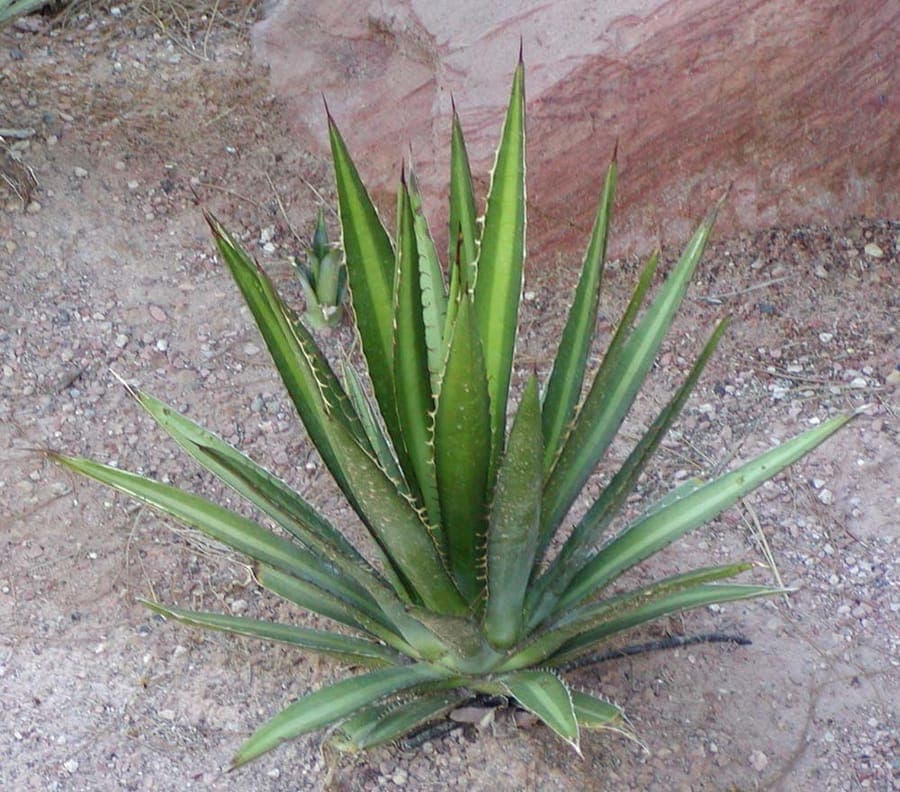
Stan Shebs (talk · contribs) / CC BY-SA 3.0, via Wikimedia Commons
Agave lechuguilla: complete guide
Agave lechuguilla
Want to see Agave lechuguilla: complete guide in your garden?
1 minute, no credit card
Overview
The Agave lechuguilla, commonly called 'Tampico fiber', is a fascinating succulent naturally occurring in the arid regions of northern Mexico, New Mexico, and Texas. This robust plant is renowned for its exceptional drought tolerance and striking architectural presence. It's ideal for xeriscaping projects and low-maintenance garden designs.
Appearance and bloom
Agave lechuguilla forms dense rosettes with stiff leaves displaying gray-green to blue-green coloring. The leaves feature characteristic white or yellow stripes along the edges and can reach 30-50 cm in length. The plant achieves a mature height of 1-1.5 meters. During flowering season (early summer), the plant produces spectacular yellow flower spikes on tall, unbranched stalks.
Ideal location
As a true desert lover, Agave lechuguilla demands full sun for optimal growth. Position it where it receives 6-8 hours of direct sunlight daily. The plant handles heat stress exceptionally well and flourishes in very hot locations. In wet climates, afternoon shade provides welcome relief.
Soil
This agave thrives in extremely well-draining soil. Use cactus or succulent potting mix, optionally amended with sand, gravel, or perlite to enhance drainage further. pH can be neutral to slightly alkaline. In heavy clay soils, ensure excellent drainage to prevent root rot.
Free design
Want to see Agave lechuguilla: complete guide in your garden? Make a free design now.
Watering
Agave lechuguilla exhibits outstanding drought tolerance and requires minimal water. During the growing season (spring/summer), water once every two to three weeks. In winter, water sparingly or not at all. Allow soil to dry completely between waterings. This plant tolerates prolonged dry periods far better than wet feet.
Pruning
Pruning is rarely necessary. You may carefully remove dead or damaged leaves at the base. After flowering, cut away the entire flower spike. Work carefully during pruning, as leaves are sharp and can inflict painful cuts.
Maintenance calendar
Spring: Begin watering gradually as growth resumes. Check for frost damage from winter. Summer: Occasional watering only. Do not fertilize. Autumn: Gradually reduce watering. Winter: Minimal watering; only light misting during very dry spells.
Winter hardiness
Agave lechuguilla shows moderate cold hardiness down to approximately -10 degrees Celsius. In colder climates, provide extra protection such as a mulch layer around the base. In very wet winters, rot may develop, so ensure optimal drainage. Container plants can be moved to a dry shelter.
Companion plants
This agave pairs excellently with other xeriscape species such as Sedum, Sempervivum, and drought-tolerant succulents. Its architectural silhouette complements gray-foliaged plants and stonecrops beautifully. For garden design ideas, visit gardenworld.app/en for personalized designs with xeriscape features. Discover more about drought-tolerant plant combinations at gardenworld.app/en.
Want to see Agave lechuguilla: complete guide in your garden? Make a free design now.
Upload a photo, pick a style, and get a photorealistic design with plant list in under a minute.
No credit card required


Similar plants
Narrow-leaved dracaena: complete guide
Dracaena angustifolia
Everything about Dracaena angustifolia - the narrow-leaved dracaena: location, care, overwintering and use as a houseplant or patio plant.
Chaparral yucca: complete guide to Hesperoyucca whipplei
Hesperoyucca whipplei
Hesperoyucca whipplei (Our Lord's candle) is a dramatic rosette-forming plant from California that produces a towering flower spike, ideal for dry and gravel gardens.
False lily-of-the-valley: complete guide
Maianthemum dilatatum
Everything about Maianthemum dilatatum, the false lily-of-the-valley. Care, shade location, propagation and garden combinations for this popular shade ground cover.