Daderot / CC0, via Wikimedia Commons
Himalayan maidenhair fern (Adiantum venustum): complete guide
Adiantum venustum
Want to see Himalayan maidenhair fern (Adiantum venustum): complete guide in your garden?
Full design in HD: €7.99
Look after your Himalayan maidenhair fern with the GardenWorld app
Identify plants with your camera and get a care calendar with reminders for this plant.


Overview
Maidenhair ferns have a reputation for being delicate. The familiar indoor species Adiantum raddianum shrivels at the slightest neglect. The Himalayan maidenhair fern, botanically Adiantum venustum, proves it does not have to be that way. It has the same graceful, finely divided foliage on thin black stalks, yet it lives outdoors in the garden and survives hard winters without protection.
Adiantum venustum belongs to the Pteridaceae family and grows wild in the mountains of Central Asia and the western Himalaya, from Afghanistan and Pakistan to Nepal and western China. There it grows in shady, moist spots in mountain forests, often among rocks and on slopes. The species name venustum means graceful or charming, which is exactly what this fern brings to a garden.
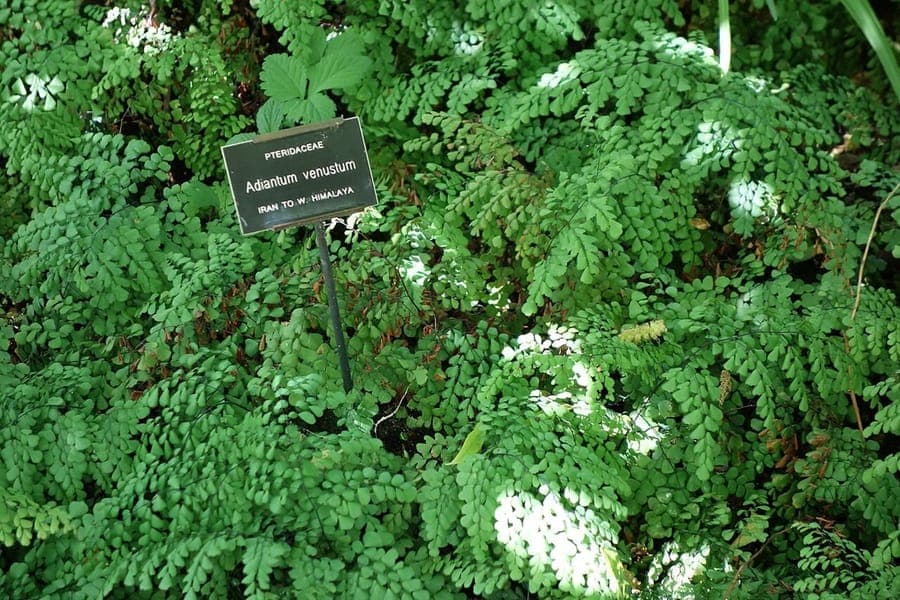
The Himalayan maidenhair is a creeping fern that slowly forms a dense, low carpet. That makes it excellent ground cover for shade: under shrubs and trees, along a north-facing wall or between the stones of a shaded rock garden. It holds the Royal Horticultural Society's Award of Garden Merit, a sign of reliable performance. If you would like to see how such a green carpet would suit your shady corner, you can have a garden design made on gardenworld.app that takes account of the light and soil in your garden.
Appearance and growth
Being a fern, Adiantum venustum does not flower. It reproduces by spores, which ripen in summer beneath the rolled-under edges of the leaflets, and above all by its creeping rhizome. Its ornamental value lies entirely in the foliage, and that foliage is special.
The leaves, known as fronds, are triangular and two or three times divided. They grow 15 to 30 cm tall. Each leaflet is small, fan-shaped and finely toothed along its upper edge. The colour is fresh to bluish green. The stalks are thin, wiry and glossy dark purple to almost black, contrasting beautifully with the pale foliage.
New fronds appear in spring, usually in April. At first they are a striking pink to bronze, then gradually turn green. This spring display is one of the highlights of the fern. In mild winters the foliage stays green; in hard frost it turns brown and remains as a protective layer. The plant eventually reaches about 20 to 30 cm tall and slowly spreads into a mat of 60 cm or more.
Ideal location
Himalayan maidenhair wants shade to partial shade. A spot under deciduous trees, on the north or east side of the house or in the shadow of a wall is ideal. It copes well with morning sun, but strong midday sun scorches the fine leaves.
Shelter from wind is welcome, as cold, dry winds can damage the fronds in winter. Because it stays so low, it is perfect as underplanting beneath shrubs such as hydrangeas and rhododendrons, or between larger shade plants. Plant 30 to 40 cm apart for a closed carpet after a few years. It also looks lovely in a wide, shallow bowl or pot on a shady patio.
Soil requirements
Adiantum venustum likes a humus-rich soil that holds moisture yet drains well. Leaf mould, garden compost and some fine grit make an ideal mix. On heavy clay, work plenty of compost and grit into the top layer so that water does not sit around the rhizome in winter. On dry, sandy soil, add generous amounts of leaf mould or compost to improve water retention.
Unlike many ferns, this species also tolerates neutral to slightly chalky soil, which makes it suitable for a wide range of gardens. A 3 to 5 cm mulch of leaf mould or fine composted bark keeps the rhizome cool and the soil moist. Feeding is hardly necessary; a thin layer of compost in spring is enough. Too much fertiliser makes the fronds floppy.
Free preview
Want to see Himalayan maidenhair fern (Adiantum venustum): complete guide in your garden? Make a free preview of your design.
Watering
In the first year after planting, water weekly in dry weather so the rhizome establishes well. After that the plant usually looks after itself in a shady, humus-rich spot. During prolonged summer drought, give it a thorough soak every few days, especially if it grows under trees that take up a lot of water themselves.
Curled, brown frond tips are a sign that the soil is too dry. Fortunately, an established plant recovers quickly once it gets water again. Plants in containers dry out faster and need checking more often in summer. Water at the base of the plant.
Pruning
Pruning comes down to one session a year. In February or early March, cut all the old fronds back to just above the ground before the new pink fronds appear. That way you see the fresh growth at its best in spring and avoid accidentally damaging the young croziers. If you leave it too late, cut very carefully around the new shoots.
To propagate, divide a piece from the edge of the mat in spring with a sharp spade. Each piece should have a section of rhizome with several growing points. Replant straight away and keep it well watered during its first season.
Maintenance calendar
February–March: Cut old fronds back to just above the ground. Spread a thin layer of compost and renew the mulch.
April–May: New pink to bronze fronds unfurl. Divide or move plants if needed. Watch out for slugs.
June–August: Water during dry spells, particularly under trees and in containers.
September–October: A good time to plant, so new plants can root before winter.
November–January: Leave the foliage as protection. Fallen tree leaves can stay between the fronds, where they break down into leaf mould.
Winter hardiness
Himalayan maidenhair is very hardy. It tolerates frost down to about -20 °C, and according to some nurseries a little colder still. In the UK and the Low Countries it therefore needs no winter protection. In mild winters the foliage stays green; in harsh winters it turns brown, but the rhizome survives safely underground.
In containers the risk is greater because the roots are less sheltered. Move pots against a wall in winter or wrap them in hessian.
Maidenhair ferns are not known to be toxic to people or pets. Even so, it is always sensible not to let animals graze on garden plants.
Companion plants
The fine, airy foliage of Himalayan maidenhair looks best next to plants with large, solid leaves. Hostas are a classic partner, their broad leaves standing out against the delicate fern. The spring pink of the young fronds goes beautifully with the Lenten rose (Helleborus orientalis), which is often still in flower at that time.
For low, mixed ground cover, combine it with barrenwort (Epimedium grandiflorum) or European wild ginger (Asarum europaeum). Ivy-leaved cyclamen (Cyclamen hederifolium) adds pink flowers among the green in September and October. Spring bulbs such as snowdrops also show up well against the green carpet.
Final thoughts
Adiantum venustum is the maidenhair fern for anyone who thought these plants only belonged indoors. It combines the refined looks of its fragile relatives with real hardiness and a modest, creeping habit. Give it shade, humus-rich soil that does not dry out and a yearly trim at the end of winter, and it will form a graceful green carpet for many years.
To know when to cut back the old foliage or plant new specimens, use the plant calendar on gardenworld.app. That way you can look after your Himalayan maidenhair at just the right moment.
Frequently asked questions about Himalayan maidenhair fern
Is Himalayan maidenhair fern winter hardy?
Himalayan maidenhair is very hardy. It tolerates frost down to about -20 °C, and according to some nurseries a little colder still.
When and how do you prune Himalayan maidenhair fern?
Pruning comes down to one session a year. In February or early March, cut all the old fronds back to just above the ground before the new pink fronds appear.
How much water does Himalayan maidenhair fern need?
In the first year after planting, water weekly in dry weather so the rhizome establishes well. After that the plant usually looks after itself in a shady, humus-rich spot.
Where does Himalayan maidenhair fern grow best?
Himalayan maidenhair wants shade to partial shade. A spot under deciduous trees, on the north or east side of the house or in the shadow of a wall is ideal.
What soil does Himalayan maidenhair fern need?
Adiantum venustum likes a humus-rich soil that holds moisture yet drains well. Leaf mould, garden compost and some fine grit make an ideal mix.

See it in your garden
See Himalayan maidenhair fern in your garden
One photo of your garden and a few questions. You see the result in about a minute.
Try it with a photoIdentify this plant in your own garden. Identify a plant
Similar plants
Hosta: complete guide
Hosta
Everything about hostas (plantain lilies): varieties, planting, care and slug control. Expert tips for stunning foliage in shade gardens.
Lenten-rose: complete guide
Helleborus orientalis
Learn how to grow and care for Helleborus orientalis. This early-blooming perennial thrives in shady spots and flowers from February to April, adding colour when little else is blooming.
Barrenwort: complete guide for shade plants
Epimedium grandiflorum C.Morren
Discover Barrenwort, a fascinating shade plant with elegant foliage and beautiful flowers. Perfect groundcover for moist shade.
