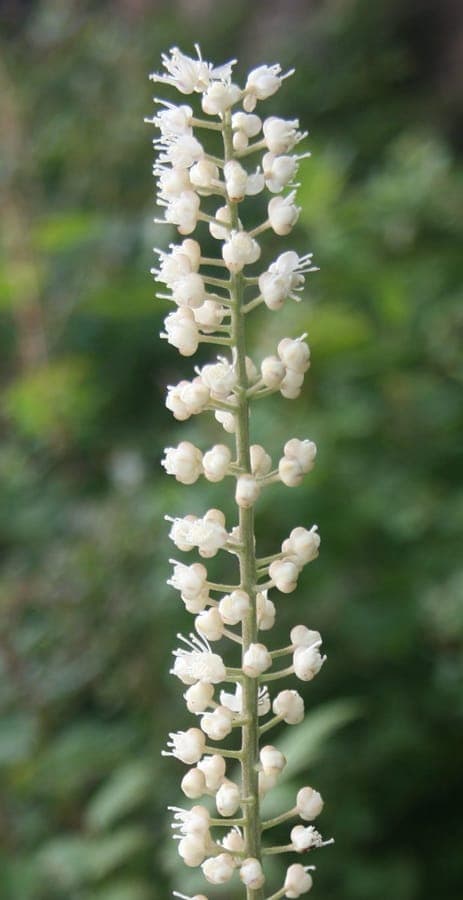
Alpsdake / CC BY-SA 3.0, via Wikimedia Commons
Bugbane (Actaea simplex): complete guide
Actaea simplex
Want to see Bugbane (Actaea simplex): complete guide in your garden?
Full design in HD: €7.99
Look after your Bugbane with the GardenWorld app
Identify plants with your camera and get a care calendar with reminders for this plant.


Overview
Actaea simplex, widely known as bugbane or Japanese bugbane, is one of the last great performers of the gardening year. When most perennials have finished in September and October, this elegant plant sends tall, white flower spires high above its foliage, often with a sweet scent you can catch from several metres away on a still autumn day. It grows wild in Japan, Korea, China and the Russian Far East, in open woodland, along forest edges and in moist mountain meadows.
For a long time the plant was known as Cimicifuga simplex, and that name still appears in many nurseries and older gardening books. Following DNA research, the genus Cimicifuga was merged into Actaea, so the correct name is now Actaea simplex. It belongs to the buttercup family, Ranunculaceae.
In flower the species reaches 1 to 1.5 metres, some cultivars a little more, with a spread of about 60 cm. The dark-leaved selections of the Atropurpurea Group are especially popular, among them 'Brunette', 'James Compton' and 'Pink Spike', which add striking foliage colour all season as well as elegant flowers. 'White Pearl' has green leaves and gracefully arching, pure white spikes. If you would like to see where bugbane will look its best among your other shade plants, on gardenworld.app you can create a garden design that takes the light and soil in your garden into account.
Appearance and bloom cycle
The leaves are large and compound, divided two or three times into threes, with toothed, slightly glossy leaflets. In the green-leaved forms they are a fresh mid-green; in the Atropurpurea Group they range from bronze-brown to almost black-purple, darkest in a bright but not dry position. The foliage builds an elegant, bushy clump around 60 to 90 cm tall.
From late August or September, dark, slender stems rise above it carrying long, bottlebrush-like racemes 20 to 40 cm in length. In bud they are round and creamy white, sometimes flushed pink. As the flowers open the petals drop quickly, leaving mainly a fluffy ring of stamens, which gives the typical bottlebrush effect. Flowering continues into October, and into early November in a mild autumn.
The fragrance is sweet and honeyed, intense in some cultivars. Late butterflies such as the red admiral, along with bees and bumblebees, still find food here in autumn. After flowering the seed heads remain, and they look lovely rimed with frost in winter.
Ideal location
Bugbane is happiest in light to partial shade, in a spot sheltered from fierce midday sun. Think of the edge of a woodland area, the east side of a house or a border beneath high-canopied trees. It tolerates full sun only where the soil stays constantly moist; otherwise the leaves scorch and the plant stays small. It will grow in deep shade, but flowers less freely and the stems lean towards the light.
The dark-leaved cultivars colour best with a little morning sun. Plant bugbane where you can see and smell the late flowers, near a bench or beside the patio, and give it a dark backdrop of shrubs or a hedge so the white spires really stand out. A sheltered position stops the tall stems from being blown over.
Soil requirements
Actaea simplex wants humus-rich, cool and evenly moist soil. Woodland soil, rich loam and well-improved clay are ideal. Sandy soil is suitable only if you work in plenty of compost, leaf mould or well-rotted manure. Slightly acidic to neutral ground suits it.
Plant in spring or early autumn with the crown just at soil level, and add a few spadefuls of compost to the planting hole. A mulch of leaf mould or compost every spring keeps the roots cool and moist. The plant establishes slowly in its first years and dislikes being moved, so choose its permanent home from the start. After three or four years you will have a mature, free-flowering clump.
Free preview
Want to see Bugbane (Actaea simplex): complete guide in your garden? Make a free preview of your design.
Watering
Drought is bugbane's worst enemy. Water regularly in the first year, and afterwards during dry summer spells, especially on lighter soils. A useful rule of thumb: the soil should never dry out completely at a depth of 5 cm. A thorough soak once or twice a week is better than a daily splash.
Brown, crisp leaf edges and missing flower buds in August are signs that the plant has been too dry. On the other hand, it dislikes sitting in wet soil over winter, so good drainage remains important.
Pruning
Pruning amounts to a single annual tidy-up. Leave the faded stems standing in autumn; the seed heads are decorative and give insects somewhere to shelter. Cut everything back to just above ground level in February or March, before the new shoots appear.
Division is rarely needed and the plant does not appreciate it. If you do want more plants, carefully split a mature clump with a sharp spade in early spring, making sure each piece keeps enough roots and buds. In a windy garden you can support the flower stems in summer with a few discreet canes.
Maintenance calendar
- February - March: cut back old stems, spread compost or leaf mould around the plant.
- April: new foliage emerges; a good time to plant.
- May - July: water during dry spells and watch for slugs on young shoots.
- August: flower stems lengthen; support them if necessary.
- September - October: peak flowering and scent.
- November - January: leave the seed heads standing while the plant rests.
Use the planting calendar on gardenworld.app to see month by month which jobs are waiting in your garden, so bugbane never gets forgotten.
Winter hardiness
Bugbane is very hardy and withstands frosts well below -20 °C without protection. Because it dies back completely in autumn, its buds overwinter safely underground. In Britain, Ireland and the Low Countries winter protection is unnecessary, although a layer of leaf mould or mulch helps keep the soil evenly moist.
A late frost in April can occasionally damage the young, dark leaves, but the plant simply grows on afterwards. More important is soil that does not become compacted or waterlogged in winter.
Be aware that, like many members of the buttercup family, Actaea simplex is poisonous. All parts, particularly the roots and seeds, can cause stomach and intestinal upset in people and pets if eaten. Wear gloves if you have sensitive skin and avoid planting it where young children or pets are likely to chew it. The species is not invasive in Europe.
Companion plants
In a shade border, bugbane works beautifully with hostas such as Hosta sieboldiana, whose large blue-green leaves contrast superbly with the fine, dark foliage of 'Brunette'. Ferns such as the male fern (Dryopteris filix-mas) create a fresh, natural mood and enjoy the same cool, humus-rich soil.
For earlier colour, combine it with astilbe (Astilbe japonica), so the border has something to offer from June to October. At the back, panicle hydrangea (Hydrangea paniculata) does well, its white flower heads ageing at about the same time. If you want a related species that flowers in July, add the North American Actaea racemosa, known as black cohosh, to spread the white spires over a longer season.
Final thoughts
Actaea simplex is a gem for the partly shaded garden. It gives autumn a second high point with fragrant white spires, offers colour all season in its dark-leaved forms, and asks for little more than cool, moist, humus-rich soil. Give it time to settle, leave it undisturbed in a permanent spot and enjoy its late, scented display every year, keeping your garden lively well into October.
Frequently asked questions about Bugbane
Is Bugbane winter hardy?
Bugbane is very hardy and withstands frosts well below -20 °C without protection. Because it dies back completely in autumn, its buds overwinter safely underground.
When and how do you prune Bugbane?
Pruning amounts to a single annual tidy-up. Leave the faded stems standing in autumn; the seed heads are decorative and give insects somewhere to shelter.
How much water does Bugbane need?
Drought is bugbane's worst enemy. Water regularly in the first year, and afterwards during dry summer spells, especially on lighter soils.
Where does Bugbane grow best?
Bugbane is happiest in light to partial shade, in a spot sheltered from fierce midday sun. Think of the edge of a woodland area, the east side of a house or a border beneath high-canopied trees.
What soil does Bugbane need?
Actaea simplex wants humus-rich, cool and evenly moist soil. Woodland soil, rich loam and well-improved clay are ideal.

See it in your garden
See Bugbane in your garden
One photo of your garden and a few questions. You see the result in about a minute.
Try it with a photoIdentify this plant in your own garden. Identify a plant
Similar plants
Hosta sieboldiana: complete guide
Hosta sieboldiana
Hosta sieboldiana growing guide: large blue-green shade plant from Japan. Complete care tips, placement and maintenance for shady gardens and woodland areas.
Male fern: complete guide
Dryopteris filix-mas
Learn how to grow Male fern (Dryopteris filix-mas) successfully: care, soil, watering, and ideal companion plants for lush green woodland gardens.
Japanese astilbe: complete guide
Astilbe japonica
Japanese astilbe brings elegant feathery flowers and fine foliage to shaded gardens. Perfect border perennial for moist soils and cool settings.
