
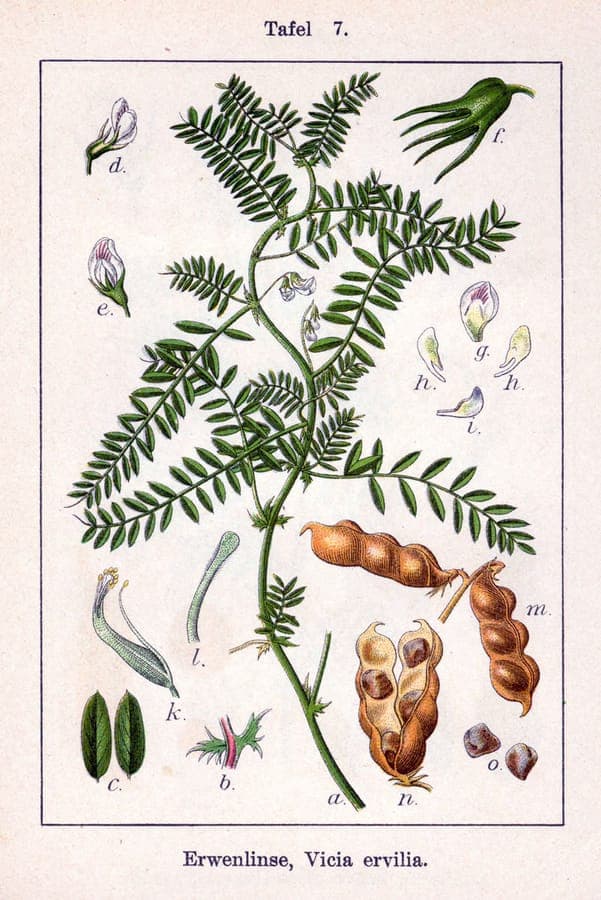
Johann Georg Sturm (Painter: Jacob Sturm) / Public domain, via Wikimedia Commons
Bitter vetch: complete guide
Vicia ervilia
¿Quieres ver Bitter vetch: complete guide en tu jardín?
1 minuto, sin tarjeta de crédito
Overview
Bitter vetch (Vicia ervilia), also called ervil or French pea, is a delicate, low-climbing plant in the pea family native to the Mediterranean and Central Asian regions. This traditional crop has been cultivated for millennia for its nutritious seeds and as a nitrogen-fixing green manure. With white flowers and fine tendrils, bitter vetch fits well into modern organic and regenerative gardens, bridging culinary heritage with ecological farming.
Appearance and Bloom
Bitter vetch develops slender, finely-branched stems with very small, pinnate leaves and delicate tendrils. The plant grows low to moderate height (40-80 cm) depending on support and soil nutrition. White to very pale pink-tinged flowers appear from May through August in loose clusters. Following bloom, small, hairy seed pods develop containing small, round seeds colored brown to yellow.
Ideal Location
Position bitter vetch in full sun on warm, open locations. The plant thrives with 8+ hours direct daily sunlight. In colder climates, warmer positions (south-facing walls, south slopes) enhance productivity. The plant is wind-tolerant and grows well in open gardens. Avoid dense shade and dark corners.
Soil
Bitter vetch prefers lightly alkaline to neutral soils (pH 7-7.5). The plant is adaptable and grows in poor, dry soils due to nitrogen-fixation capability. Good drainage is essential; avoid waterlogged conditions. Heavy clay can be improved with sand or grit. Rich soils are unnecessary. The plant thrives in marginal land.
Watering
Modest to moderate watering regimen is appropriate. Once established, bitter vetch exhibits good drought tolerance. Water regularly at planting and during dry spells. Excess water promotes fungal diseases. In Mediterranean regions, rainwater or minimal supplemental irrigation works well. Summer drought is usually well-tolerated.
Diseño gratis
¿Quieres ver Bitter vetch: complete guide en tu jardín? Crea un diseño gratis ahora.
Pruning
Pruning bitter vetch is rarely necessary. Remove spent flowers or damaged stems. After flowering, fading flower clusters can be removed. Avoid heavy pruning. When used as green manure, the plant is typically turned under in autumn or winter.
Maintenance Calendar
Spring: Plant seeds or seedlings. Water regularly during growth. Summer: Enjoy white blooms. Water cautiously during heat stress. Deadhead spent flowers. Autumn: Reduce watering. Harvest seeds or incorporate as green manure. Winter: In frost zones, plant dies; in warm climates, regrowth may occur from seed.
Winter Hardiness
Vicia ervilia is not cold-hardy and dies back at temperatures below -5 to -10 degrees Celsius. This is an annual plant in harsh climates. In Mediterranean regions, overwintering and regrowth from seed can occur. Severe frost zones should treat as a single-season spring-to-autumn crop.
Companion Plants
Create ecological cropping systems by pairing bitter vetch with:
- Other legumes like peas and beans
- Grains like oats and barley
- Herbs like coriander and dill
- Vegetables like spinach and cucumbers
- Flowering species for insects
- Trailing groundcovers
- Native wildflowers
Closing
Bitter vetch deserves recognition in modern organic and regenerative gardens as a useful green manure and seed crop. White flowers attract pollinators; seeds provide nutritional benefits. In warm regions, seed can be saved for next season. Design complete ecological growing systems with gardenworld.app including green manure planning. Discover more on gardenworld.app for organic gardening strategies.
¿Quieres ver Bitter vetch: complete guide en tu jardín? Crea un diseño gratis ahora.
Sube una foto, elige un estilo y obtén un diseño fotorrealista con lista de plantas en menos de un minuto.
Más de 10.000 jardines diseñados
Sin tarjeta de crédito


Plantas similares
Bithynian vetch: complete guide
Vicia bithynica
Bithynian vetch is an elegant wildflower with delicate blue blooms for meadows. Learn cultivation, care, and companion planting for naturalistic gardens.
Cow vetch: complete guide
Vicia cracca
Cow vetch is a vigorous climbing herb with stunning purple flower clusters. Ideal for wildlife gardens. Learn cultivation and important ecological benefits.
Great wood-vetch: complete guide
Vicia dumetorum
Great wood-vetch is an elegant shade-loving climber with delicate white flowers. Perfect for woodland gardens and semi-shaded borders. Complete growing guide.